
GFCI vs AFCI: What Each Protects and Where the NEC Requires It
- 03 Aug, 2026
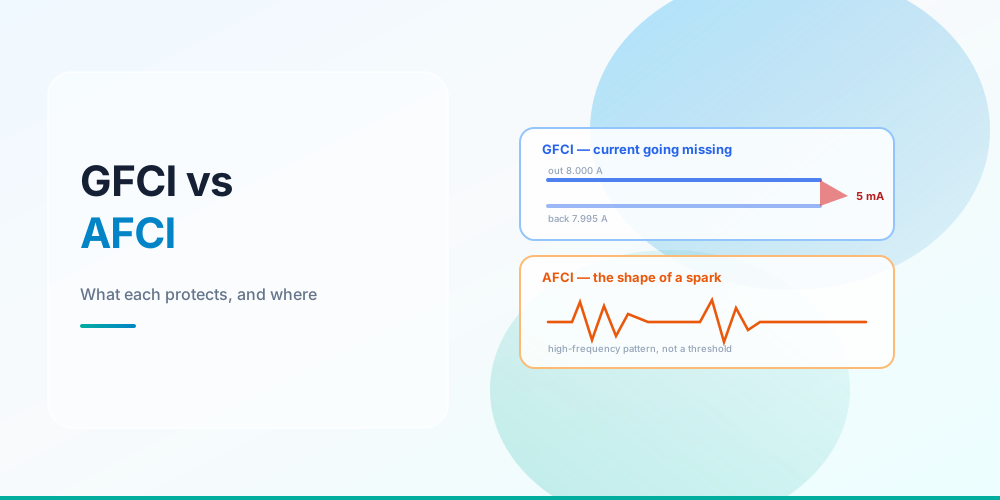
These two devices look similar, cost about the same, and fit the same slot in a panel - which is why they get treated as interchangeable. They aren’t. They watch for completely different faults, and installing one where the code calls for the other leaves a real hazard uncovered.
The one-line version: GFCI protects people from shock. AFCI protects buildings from fire.
Different faults, different jobs
How a GFCI Works
A GFCI compares the current leaving on the hot conductor with the current returning on the neutral. In a healthy circuit those match exactly. If they don’t, current is getting back by some other route - through a person, through wet ground, through a metal enclosure.
A Class A GFCI (the standard for personnel protection under UL 943) trips when that imbalance reaches 4–6 mA, in a fraction of a cycle. That threshold isn’t arbitrary: it’s below the level at which current across the chest interferes with the heart, and well below the level at which a person loses the ability to let go.
Note that GFCIs don’t need a ground to work. They measure hot against neutral, so a GFCI is a legitimate way to protect an ungrounded two-wire circuit - that’s what 406.4(D)(2) permits, with the receptacle marked “GFCI Protected” and “No Equipment Ground.”
Don’t confuse a GFCI with GFPE (ground-fault protection of equipment), which trips around 30 mA. That’s a device-protection threshold, far above what a person can tolerate, and it satisfies different requirements entirely.
How an AFCI Works
An AFCI looks for the electrical signature of arcing. An arc doesn’t draw enough current to trip a breaker - a loose terminal can spark away at a couple of amps indefinitely, quietly charring the surrounding material - but it produces a distinctive high-frequency, erratic current pattern. The AFCI recognises that pattern and opens the circuit.
The faults it’s aimed at are the ones that start fires: a cord crushed under furniture, a cable nicked by a staple during rough-in, a terminal screw that was never quite tight, a rodent-damaged conductor in a wall.
Because it’s pattern recognition rather than a threshold, AFCIs are more prone to reacting to loads that look like arcing - which is where most of their reputation for nuisance tripping comes from.
Where Each Is Required
Which protection goes where
GFCI - 210.8. Broadly, anywhere water and electricity might meet: bathrooms, kitchens, laundry areas, garages and accessory buildings, outdoors, crawl spaces, unfinished basements, and within 6 feet of a sink, bathtub or shower. Note that recent code cycles raised the scope from 125 V to 125–250 V, which brought 240-volt receptacles into the requirement.
AFCI - 210.12. Broadly, the living areas: kitchens, family rooms, dining rooms, living rooms, parlors, libraries, dens, bedrooms, sunrooms, recreation rooms, closets, hallways and laundry areas, on 120-volt 15- and 20-amp branch circuits. 210.12(D) also pulls in circuit extensions and modifications, so adding a receptacle to an existing bedroom circuit can trigger an AFCI requirement.
Where both apply - kitchen countertop receptacles and laundry areas being the obvious cases - a dual-function AFCI/GFCI device satisfies both, and is usually the simplest answer.
One important caveat on scope
Recent editions of the NEC have expanded GFCI requirements to cover specific appliances under 210.8(D) - dishwashers were added first, and NEC 2023 broadened the list further to include certain cooking equipment and other appliances. This expansion has been genuinely contentious, partly because some appliances trip GFCIs for reasons unrelated to any hazard, and several jurisdictions have amended it out or delayed it.
So treat the lists above as the general pattern rather than a definitive answer for your job. Which code cycle your state has adopted, and what it amended, decides it. Ask the AHJ - this is one of the areas where the model code and local practice diverge most.
Diagnosing Nuisance Trips
Same complaint, different diagnosis
A GFCI that keeps tripping usually means moisture - an outdoor box with a failed gasket or a cover left open is the classic. Long circuits can also accumulate enough capacitive leakage to approach the 5 mA threshold on their own, and motor loads with ageing insulation (well pumps, sump pumps, old freezers) leak progressively more as they degrade.
An AFCI that keeps tripping most often means a loose terminal screw, which is worth checking before anything else because it’s both the most common cause and a genuine hazard. Beyond that: damaged cords, staple damage from rough-in, and some motor and electronic loads whose switching noise resembles an arc.
A shared neutral trips both, and it’s the single most common wiring error behind these complaints. If two circuits share a neutral somewhere - usually a junction box where someone tied neutrals together across circuits - both devices see current that doesn’t add up. Separating the neutrals fixes it.
What you should never do is replace the device with a standard breaker to stop the tripping. Both of these devices are reporting a condition. A GFCI trip means current is finding a path it shouldn’t; an AFCI trip means something may be arcing inside a wall. What Size Breaker Do I Need makes the same point about ordinary overcurrent trips - the device is the messenger.
Breaker or Receptacle?
Both device types come as breakers and as receptacles, and the choice matters practically:
GFCI receptacle - protects that outlet and everything downstream on the load terminals. Cheaper, and the test/reset button is where you can reach it. The usual choice for a bathroom or kitchen.
GFCI breaker - protects the whole circuit from the panel, including the cable run itself. Better where the first outlet is inaccessible, or where you want the entire circuit covered.
AFCI is normally a breaker, because it needs to see the whole branch circuit to do its job - the cable in the wall is exactly what it’s protecting. Outlet-branch-circuit AFCI receptacles exist for specific retrofit situations, but the breaker is the default.
Testing
Both types have a test button, and both should be tested monthly - pressing test should trip the device, and reset should restore it. If test does nothing, the device has failed and needs replacing.
GFCIs manufactured since the 2015 revision of UL 943 include self-test functionality and will indicate failure themselves, typically by refusing to reset or showing an indicator. That doesn’t remove the value of pressing the button.
A plug-in tester with a GFCI trip button is useful but not authoritative - it works by creating a small hot-to-ground leak, so it won’t trip a GFCI on an ungrounded circuit even when that GFCI is working perfectly.
Common Mistakes
- Treating them as interchangeable. Different faults; installing one doesn’t satisfy the other’s requirement.
- Replacing a tripping device with a standard breaker. That removes the protection and leaves the fault.
- Assuming a GFCI needs a ground. It doesn’t - which is why it’s the permitted fix for ungrounded circuits.
- Confusing 30 mA GFPE with a Class A GFCI. Six times the threshold, and not personnel protection.
- Sharing neutrals between circuits. Trips both device types and is the most common wiring cause.
- Assuming the model code applies as written. The 2023 appliance GFCI expansion is amended in several states.
- Skipping the monthly test. These are electromechanical devices and they do fail.
Get the Circuit Right First
Breaker Size Calculator - establishes the rating and conductor before you choose the device type.
Protection type is a separate decision from sizing, and sizing comes first. The Breaker Size Calculator settles the rating and minimum conductor - the method is in What Size Breaker Do I Need. For the circuits these devices most often protect, see How Many Outlets on a 20 Amp Circuit and 15 Amp vs 20 Amp Circuit; for the grounding side, Ground Wire Size Chart.
Sources & standards: NEC (NFPA 70) 2023 - 210.8, 210.8(A), 210.8(D), 210.12, 210.12(A), 210.12(D), 406.4(D)(2), 240.4. UL 943 for Class A ground-fault circuit interrupters (4–6 mA) and self-test requirements. Recent GFCI expansions to specific appliances are amended or delayed in several jurisdictions - local amendments override the model code, and the AHJ has final say.
FAQ
What is the difference between GFCI and AFCI?
A GFCI compares current on the hot and neutral and trips at a 4–6 mA imbalance, protecting people from shock. An AFCI recognises the high-frequency current pattern of arcing and trips on that, protecting the building from fire. They detect different faults and are not substitutes for one another.
Do I need both GFCI and AFCI?
In some places, yes. Kitchen countertop receptacles and laundry areas typically need both, which is what dual-function AFCI/GFCI devices are for. Bathrooms, garages and outdoors generally need GFCI only; bedrooms and living areas generally need AFCI only.
Can an AFCI replace a GFCI?
No. An AFCI doesn’t measure the hot-to-neutral imbalance that indicates current leaking through a person, so it provides no shock protection and won’t satisfy a 210.8 GFCI requirement. Where both are required, use a dual-function device.
Why does my AFCI breaker keep tripping?
Check for a loose terminal screw first - it’s both the most common cause and a real hazard. After that, look for damaged cords, cable nicked by a staple during rough-in, and shared neutrals between circuits. Some motor and electronic loads produce switching noise that resembles an arc signature. Never swap it for a standard breaker to stop the trips.
Does a GFCI need a ground wire to work?
No. A GFCI measures the difference between hot and neutral current, so it functions correctly with no equipment grounding conductor. That’s why 406.4(D)(2) permits a GFCI as the remedy for a non-grounding-type receptacle, provided it’s marked “GFCI Protected” and “No Equipment Ground.”
Are GFCIs now required for kitchen appliances?
Recent code cycles expanded GFCI requirements to specific appliances under 210.8(D), starting with dishwashers and broadening in NEC 2023. That expansion has been contentious and several jurisdictions have amended or delayed it, so whether it applies depends on which cycle your state adopted and what it changed. Confirm with your AHJ rather than assuming the model code text.