
Ground Wire Size Chart: EGC vs GEC (250.122 and 250.66)
- 03 Aug, 2026
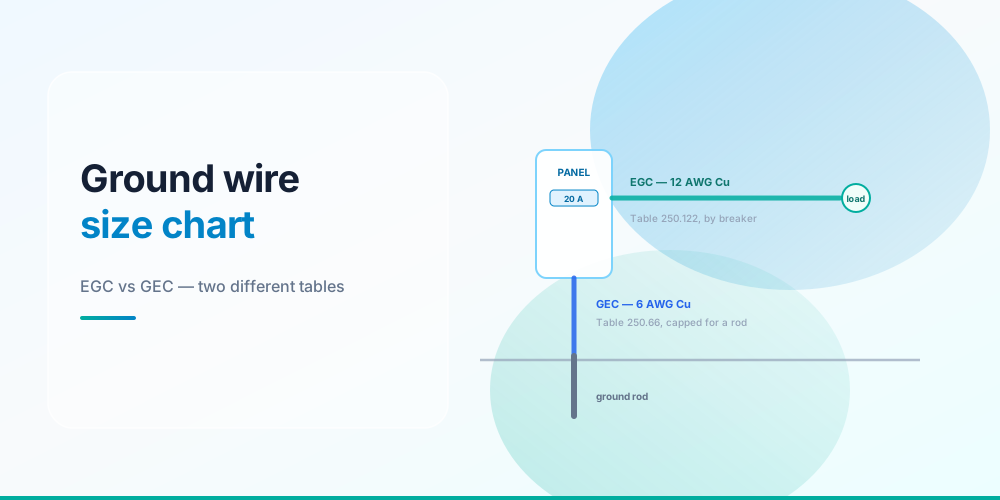
“What size ground wire do I need?” has two answers, because two entirely different conductors get called the ground wire. They come from different tables, they’re keyed to different things, and one of them doesn’t exist on a branch circuit at all.
Sort out which one you’re sizing and the rest is a table lookup.
EGC and GEC are not the same conductor
- The equipment grounding conductor (EGC) runs with every circuit and feeder in the building. Its job is to carry fault current back to the source fast enough to trip the breaker. It comes from Table 250.122, keyed to the overcurrent device rating.
- The grounding electrode conductor (GEC) connects the service to earth - a driven rod, a concrete-encased electrode, a metal water pipe. There’s one per service, not one per circuit. It comes from Table 250.66, keyed to the size of the largest ungrounded service-entrance conductor.
If you’re wiring a receptacle circuit, you want the EGC. If you’re landing a conductor on a ground rod, you want the GEC.
The EGC Chart - Table 250.122
Equipment grounding conductor by breaker
| OCPD up to | Copper | Aluminum |
|---|---|---|
| 15 A | 14 AWG | 12 AWG |
| 20 A | 12 AWG | 10 AWG |
| 60 A | 10 AWG | 8 AWG |
| 100 A | 8 AWG | 6 AWG |
| 200 A | 6 AWG | 4 AWG |
| 300 A | 4 AWG | 2 AWG |
| 400 A | 3 AWG | 1 AWG |
| 500 A | 2 AWG | 1/0 AWG |
| 600 A | 1 AWG | 2/0 AWG |
| 800 A | 1/0 AWG | 3/0 AWG |
| 1000 A | 2/0 AWG | 4/0 AWG |
There is no 30-amp row. A 30-amp circuit falls under the 60-amp row, so it takes 10 AWG copper - the same as a 60-amp circuit. Same for 25, 35, 40, 45 and 50 amps. This surprises people who expect a row per breaker size.
Three rules travel with that table:
250.122(A) - the EGC never has to be larger than the circuit conductors. If you’re running 12 AWG on a 20-amp circuit, the EGC is 12 AWG and that’s that.
250.122(B) - upsize the phase conductors, upsize the EGC proportionally. This is the one that gets missed. If you went up a size for voltage drop, the EGC has to grow in proportion to the increase in circular mils. Bump a 100-amp feeder from 3 AWG to 2 AWG for a long run and the 8 AWG EGC has to grow too. The Ground Wire Size Calculator handles the proportional maths, and Voltage Drop covers when you’d be upsizing in the first place.
250.122(C) - one EGC shared by several circuits is sized to the largest OCPD among them. Four circuits in a raceway protected at 20, 20, 30 and 50 amps share a single 10 AWG EGC, sized off the 50.
The GEC Chart - Table 250.66
Grounding electrode conductor, then the caps
| Copper service conductor | Aluminum service conductor | Copper GEC | Aluminum GEC |
|---|---|---|---|
| 2 AWG or smaller | 1/0 or smaller | 8 AWG | 6 AWG |
| 1 or 1/0 | 2/0 or 3/0 | 6 AWG | 4 AWG |
| 2/0 or 3/0 | 4/0 or 250 kcmil | 4 AWG | 2 AWG |
| over 3/0 – 350 kcmil | over 250 – 500 kcmil | 2 AWG | 1/0 AWG |
| over 350 – 600 kcmil | over 500 – 900 kcmil | 1/0 AWG | 3/0 AWG |
| over 600 – 1100 kcmil | over 900 – 1750 kcmil | 2/0 AWG | 4/0 AWG |
Then - and this is the part that saves copper - the electrode caps it:
- Rod, pipe or plate electrode - need not exceed 6 AWG copper (250.66(A))
- Concrete-encased electrode (Ufer) - capped at 4 AWG copper (250.66(B))
- Ground ring - never larger than the ring conductor itself (250.66(C))
- Metal water pipe - no cap, so the full table size applies
That’s why a typical 200-amp service with driven rods only needs 6 AWG copper to the rods, even though the table says 4 AWG for 2/0 copper service conductors. Running 4 AWG there is legal and a waste.
Where a service has both rods and a Ufer, size each GEC for the electrode it actually serves - the rod run gets 6 AWG, the Ufer run gets 4 AWG.
Worked example
A 200-amp dwelling service in 4/0 aluminum, grounded to two driven rods and a water pipe:
- Table 250.66 row for 4/0 aluminum service conductors → 4 AWG copper
- The run to the rods is capped by 250.66(A) at 6 AWG copper
- The run to the water pipe has no cap → 4 AWG copper
- The EGC for the 200-amp feeder, from Table 250.122, is 6 AWG copper - a different conductor answering a different question
Grounded ≠ Grounding
Worth being precise, because the vocabulary trips people constantly:
- Grounded conductor = the neutral. It’s a normal current-carrying conductor.
- Grounding conductor = the EGC or GEC. Carries no current except during a fault.
The neutral is bonded to the grounding system at exactly one place - the service disconnect. Bond them anywhere downstream and normal return current starts flowing on the grounding conductors and any metal they touch. That’s why a subpanel’s neutral and ground bars stay separate, covered in What Size Wire for a 100 Amp Sub Panel.
Common Mistakes
- Sizing the EGC off the conductor instead of the breaker. Table 250.122 is keyed to the OCPD.
- Looking for a 30-amp row. There isn’t one; 30 A uses the 60 A row.
- Forgetting 250.122(B). Upsizing for voltage drop means upsizing the ground too.
- Using the full Table 250.66 size to a ground rod. 250.66(A) caps it at 6 AWG copper.
- Confusing the two tables. A 200 A service’s GEC and its feeder EGC are different conductors - 6 AWG copper each here by coincidence, not by rule.
- Bonding neutral to ground downstream of the service. Once, at the service disconnect, and nowhere else.
- Assuming a ground rod replaces the EGC. Earth is not a fault-current path. A detached building needs both its own electrode and an EGC run with the feeder.
Size the Ground
Ground Wire Size Calculator - switches between EGC and GEC, applies the 250.66 electrode caps, and does the 250.122(B) proportional upsizing.
The Ground Wire Size Calculator reads from both tables and asks which conductor you’re sizing first, which is the distinction this whole article is about. Pair it with the Breaker Size Calculator to establish the OCPD the EGC keys off, and the Service & Feeder Wire Size Calculator for the service conductors the GEC keys off - see 200 Amp Service Wire Size.
Sources & standards: NEC (NFPA 70) 2023 - Table 250.122, 250.122(A), 250.122(B), 250.122(C), Table 250.66, 250.66(A), 250.66(B), 250.66(C), 250.24(A)(5), 250.32, 250.50. Local amendments override the model code, and the AHJ has final say.
FAQ
What size ground wire do I need for a 200 amp service?
Two answers, because two conductors are involved. The grounding electrode conductor to driven rods is 6 AWG copper - Table 250.66 says 4 AWG for 2/0 copper service conductors, but 250.66(A) caps a rod run at 6 AWG. The equipment grounding conductor for a 200-amp feeder is 6 AWG copper from Table 250.122.
What size ground wire for a 100 amp subpanel?
8 AWG copper or 6 AWG aluminum, from Table 250.122 based on the 100-amp breaker protecting the feeder. If you upsized the feeder conductors for voltage drop, 250.122(B) requires the ground to be upsized in proportion.
What’s the difference between an EGC and a GEC?
The equipment grounding conductor runs with every circuit and carries fault current back to trip the breaker; it’s sized from Table 250.122 by the overcurrent device rating. The grounding electrode conductor connects the service to earth and there’s one per service; it’s sized from Table 250.66 by the largest service-entrance conductor, then capped by which electrode it serves.
What size ground wire for a 30 amp circuit?
10 AWG copper. Table 250.122 has no 30-amp row - 30 amps falls under the 60-amp row, which specifies 10 AWG copper or 8 AWG aluminum. The same row covers 25, 35, 40, 45 and 50 amps.
Do I need to upsize the ground wire if I upsize the conductors?
Yes, if the upsizing was to compensate for voltage drop or another reason that increases conductor size beyond the ampacity requirement. 250.122(B) requires the equipment grounding conductor to be increased proportionally to the increase in the ungrounded conductors’ circular-mil area.
Can I use aluminum for a grounding electrode conductor?
Sometimes, with restrictions. Aluminum grounding electrode conductors can’t be in contact with earth or masonry, and where used outdoors they must terminate at least 18 inches above earth. Because of those limits and the corrosion risk at terminations, copper is the normal choice for a GEC.