
What Size Breaker Do I Need? Sizing OCPD by Load
- 03 Aug, 2026
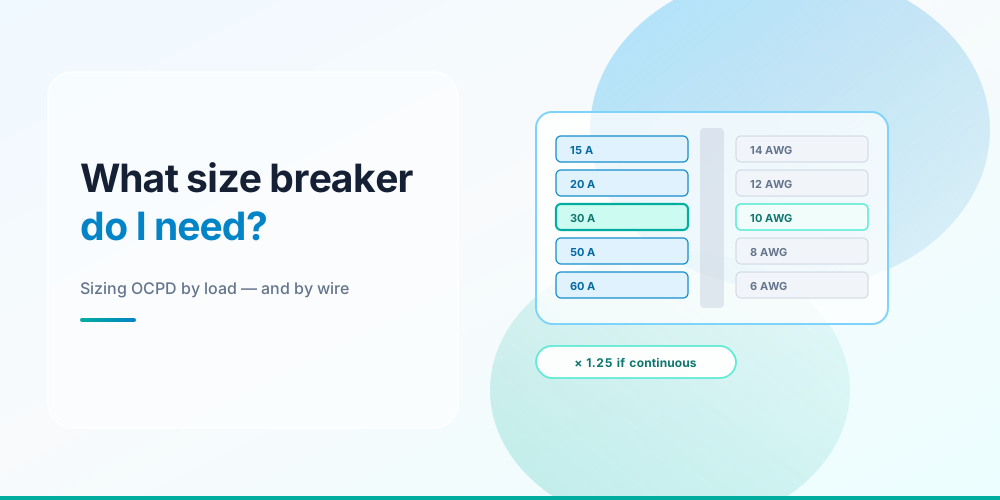
The most important thing to understand about breaker sizing is what the breaker is actually for. It is not there to protect your appliance - the appliance has its own protection. It’s there to protect the wire in the wall from carrying more current than it can dissipate as heat.
That reframes the whole question. The load tells you the minimum breaker you need. The conductor tells you the maximum you’re allowed. Your answer is a standard rating that satisfies both.
What the device does once it reaches that number - a bimetal strip for sustained overload, a solenoid for a short circuit, and a second rating nobody reads - is in How a Circuit Breaker Works.
The order the checks run in
Step 1: Find the Actual Load
Not the breaker that’s there now, and not a guess. Either read the nameplate - appliances list amps, or watts you can divide by voltage - or run a calculation for a circuit serving several things.
Step 2: Add 25% If the Load Is Continuous
210.20(A) requires the overcurrent device to be rated at least 125% of the continuous load plus 100% of the non-continuous load. A continuous load is one expected to operate for three hours or more.
This is the same arithmetic behind the “80% rule” you’ll hear on job sites - a 20-amp breaker being good for 16 amps of continuous load is just 20 ÷ 1.25 stated backwards. Breakers aren’t derated to 80% for ordinary intermittent loads; the 125% adder applies to the continuous portion only.
What’s continuous in practice:
- Continuous - EV charging (625.41 requires it be treated as continuous), commercial and shop lighting, electric signs, pool pumps on long cycles, server and network gear
- Not continuous - ranges, ovens, dryers, dishwashers, disposals, most residential receptacle circuits, well pumps
Step 3: Round Up to a Standard Rating
Breakers only come in the ratings 240.6(A) lists. A calculation landing on 33 amps doesn’t get a 33-amp breaker; it gets 35.
Standard ampere ratings
Step 4: Confirm the Conductor Can Take It
Per 240.4, conductors have to be protected at their ampacity. So once you have a candidate breaker, check the wire.
Breaker to minimum conductor
There’s a useful allowance here. 240.4(B) lets you go up to the next higher standard rating when the conductor’s ampacity doesn’t land exactly on a standard size - provided the rating is 800 A or less and the circuit doesn’t supply receptacles for cord-and-plug-connected loads.
Example: 2 AWG copper is 115 A at 75 °C. There’s no 115-amp breaker. Rather than dropping to 110, 240.4(B) permits 125 A on that conductor. Above 800 A the allowance disappears - 240.4(C) requires the device not to exceed the conductor ampacity at all.
Step 5: Apply the Small-Conductor Cap
240.4(D) overrides everything above for the three smallest common sizes:
| Conductor | Max breaker |
|---|---|
| 14 AWG copper | 15 A |
| 12 AWG copper | 20 A |
| 10 AWG copper | 30 A |
| 12 AWG aluminum | 15 A |
| 10 AWG aluminum | 25 A |
12 AWG copper reads 25 A in the ampacity table and still never exceeds a 20-amp breaker on a general circuit. That gap is the most-argued detail in the whole code - 12 Gauge Wire Amps works through it.
Worked Examples
A 48-amp EV charger
EVSE is continuous by rule (625.41), so: 48 × 1.25 = 60 A. That’s a standard rating, so the breaker is 60 A. The conductor needs ampacity of at least 60 A, which is 6 AWG copper (65 A at 75 °C). This is exactly why the standard hardwired 48-amp charger install is a 60-amp breaker on 6 AWG.
An electric dryer
A 30-amp dryer is non-continuous, so no adder: 30 A breaker, 10 AWG copper. 10 AWG is capped at 30 A by 240.4(D), which happens to match perfectly.
A feeder on 2 AWG copper
Load calculation says 118 A. Next standard rating is 125 A, and 2 AWG copper is 115 A - so on the face of it the breaker exceeds the wire. But 115 A isn’t a standard rating, the feeder is under 800 A, and it doesn’t supply cord-and-plug receptacles, so 240.4(B) permits the 125 A breaker on 2 AWG.
A 5 HP motor - where the rules invert
Motor circuits work differently, and the numbers look alarming until you see why.
A 5 HP, 230 V single-phase motor has a table full-load current of 28 A (Table 430.248 - and note 430.6(A) says you use the table value, not the nameplate, for conductor and OCPD sizing). Conductors get 125% of that per 430.22: 35 A minimum ampacity. But Table 430.52 permits an inverse-time breaker at up to 250% of FLC - that’s 70 A.
A 70-amp breaker on a conductor rated 35 A. That’s legal and correct, because the breaker is only doing short-circuit and ground-fault protection; overload protection comes from a separate device sized to the motor (typically 115–125% of FLC). Without that separate overload relay, the arrangement would be dangerous. 240.4(G) is what routes motor circuits to Article 430 and out of the normal rules.
Air conditioning equipment works the same way through Article 440: size from the nameplate MCA and protect at the nameplate MOCP, which routinely exceeds conductor ampacity.
Size, Then Type
Sizing gets you the amperage. You still have to choose the right device:
- Standard thermal-magnetic - general circuits with no special requirement
- AFCI - required by 210.12 for most dwelling living-area circuits
- GFCI - required by 210.8 in bathrooms, kitchens, garages, outdoors, basements, laundry areas and more; can be a breaker or a receptacle
- Dual-function (AFCI + GFCI) - increasingly the simplest way to satisfy both
- Tandem / twin - two circuits in one slot, only where the panel is listed for them and only up to the panel’s circuit limit
The breaker also has to be listed for the panel it goes in, and its interrupting rating (AIC) has to equal or exceed the available fault current at that point.
Never Upsize a Breaker to Stop It Tripping
This deserves saying plainly, because it’s the most dangerous mistake on this topic. A breaker that trips repeatedly is reporting a real condition: too much load, a fault, or a failing device. Fitting a bigger breaker doesn’t fix any of those - it removes the protection from a conductor that is already being overloaded, and the wire in the wall becomes the fuse.
The correct fixes are to move load to another circuit, add a circuit, or find the fault. The only time a larger breaker is right is when you’re also upsizing the conductor to match.
Common Mistakes
- Upsizing to stop nuisance tripping. The conductor is the thing at risk.
- Sizing off the old breaker. It may have been wrong for decades.
- Forgetting the 125% continuous adder. An EV charger without it is undersized from day one.
- Reading the ampacity table past the 240.4(D) cap. 12 AWG is a 20-amp conductor.
- Using nameplate FLA for motor sizing. 430.6(A) sends you to Table 430.248/430.250 instead.
- Ignoring voltage drop. Ampacity and OCPD say nothing about distance - see Voltage Drop.
- Assuming any breaker fits any panel. It must be listed for that panelboard, with an adequate AIC rating.
Size the Breaker
Breaker Size Calculator - enter the load, mark it continuous or not, and get the standard OCPD rating with the minimum conductor beside it.
The Breaker Size Calculator applies the 125% adder, rounds to the next 240.6(A) rating, and checks the conductor - including the 240.4(D) cap. Working from the other direction, the Wire Size Calculator sizes the conductor from the load and run length, and the Ampacity Calculator gives you the maximum breaker for a conductor in specific conditions. Full method in What Size Wire Do I Need and the tables in the Wire Size Chart.
Sources & standards: NEC (NFPA 70) 2023 - 240.4, 240.4(B), 240.4(C), 240.4(D), 240.4(G), 240.6(A), 210.8, 210.12, 210.20(A), Table 310.16, 430.6(A), 430.22, Table 430.52, Table 430.248, 440.22, 625.41. Local amendments override the model code, and the AHJ has final say.
FAQ
What size breaker do I need for a 20 amp load?
If the 20 amps is non-continuous, a 20-amp breaker on 12 AWG copper. If it’s continuous - three hours or more - 210.20(A) requires 125% of it, so 20 × 1.25 = 25 A, meaning a 25-amp breaker on 10 AWG copper.
How do I know what size breaker my circuit needs?
Take the actual load in amps, multiply the continuous portion by 1.25, round up to the next standard rating in 240.6(A), then confirm the conductor’s ampacity covers that rating and respect the 240.4(D) cap on 14, 12 and 10 AWG. Special equipment - motors, A/C - follows Article 430 or 440 instead.
Can I put a bigger breaker on an existing circuit?
Only if the conductor supports it. A larger breaker on the same wire removes the protection that wire depends on, and an overloaded conductor then heats up with nothing to stop it. If a breaker keeps tripping, the answer is to reduce the load, add a circuit, or find the fault - not to fit a bigger device.
What is the 80% rule for breakers?
It’s the 125% continuous-load rule stated backwards: a breaker should carry no more than 80% of its rating as continuous load, so 16 amps on a 20-amp breaker. It applies to loads running three hours or more. For ordinary intermittent residential loads there’s no 80% derating.
Why is my motor breaker bigger than the wire can carry?
Because motor circuits split the two protection jobs. Table 430.52 lets an inverse-time breaker reach 250% of full-load current so it can survive inrush during starting, while a separate overload device sized near 115–125% of FLC protects the conductor. 240.4(G) is the section that routes motor circuits out of the normal conductor-protection rules.
What size breaker for a 50 amp circuit?
A 50-amp breaker, on 8 AWG copper or 6 AWG aluminum - 8 AWG copper is exactly 50 A at 75 °C. If the load is continuous you’d need 50 × 1.25 = 62.5 A, rounding to a 70-amp breaker and 4 AWG copper.