
Conduit Fill Chart: How Many Wires Fit in EMT, PVC, and RMC
- 03 Aug, 2026
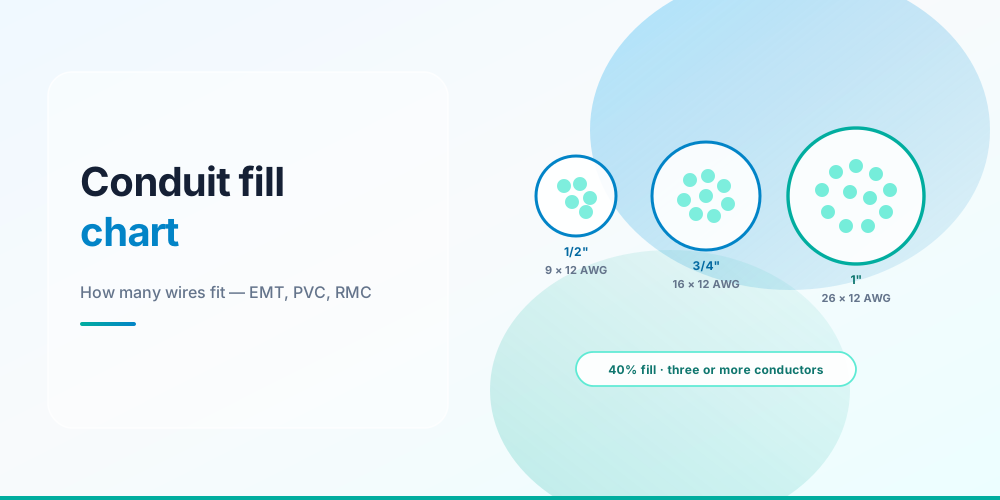
Here are the charts. Then the part most fill charts leave out: the number of conductors you can legally pull is usually smaller than the number that physically fits, because bundling derating limits you before the fill percentage does.
THHN in EMT
Maximum THHN conductors in EMT
| AWG | 1/2” | 3/4” | 1” | 1-1/4” | 1-1/2” | 2” |
|---|---|---|---|---|---|---|
| 14 | 12 | 22 | 35 | 61 | 84 | 138 |
| 12 | 9 | 16 | 26 | 45 | 61 | 101 |
| 10 | 5 | 10 | 16 | 28 | 38 | 63 |
| 8 | 3 | 6 | 9 | 16 | 22 | 36 |
| 6 | 1 | 4 | 7 | 12 | 16 | 26 |
| 4 | 1 | 2 | 4 | 7 | 10 | 16 |
THHN in PVC Schedule 40
| AWG | 1/2” | 3/4” | 1” | 1-1/4” | 1-1/2” | 2” |
|---|---|---|---|---|---|---|
| 14 | 11 | 21 | 34 | 60 | 82 | 135 |
| 12 | 8 | 15 | 25 | 43 | 59 | 99 |
| 10 | 5 | 9 | 15 | 27 | 37 | 62 |
| 8 | 3 | 5 | 9 | 16 | 21 | 36 |
| 6 | 1 | 4 | 6 | 11 | 15 | 26 |
| 4 | 1 | 1 | 4 | 7 | 9 | 16 |
THHN in RMC
| AWG | 1/2” | 3/4” | 1” | 1-1/4” | 1-1/2” | 2” |
|---|---|---|---|---|---|---|
| 14 | 13 | 22 | 36 | 63 | 85 | 140 |
| 12 | 9 | 16 | 26 | 46 | 62 | 102 |
| 10 | 6 | 10 | 17 | 29 | 39 | 64 |
| 8 | 3 | 6 | 9 | 16 | 22 | 37 |
| 6 | 1 | 4 | 7 | 12 | 16 | 27 |
| 4 | 1 | 2 | 4 | 7 | 10 | 16 |
RMC has slightly more internal area than EMT at most trade sizes, and PVC Schedule 40 slightly less - PVC Schedule 80 has considerably less again because of its thicker wall, so never assume a PVC count from an EMT chart.
Where the Percentages Come From
Chapter 9 Table 1 fill limits
Table 1 sets the allowable fill by conductor count:
- 1 conductor - 53%
- 2 conductors - 31%
- 3 or more - 40%
The two-conductor tier being tighter than the three-conductor tier looks wrong and isn’t. It comes from the geometry of how few round objects pack inside a circle, and it has a practical consequence: you can’t find the maximum count with a single division, because the percentage you’re dividing by changes with the answer. Two conductors can fail at 31% where three would pass at 40%.
Note 4 adds a useful exception. Where the raceway is a nipple no longer than 24 inches, fill goes up to 60% - and the 310.15(C)(1) bundling adjustment factors don’t apply to it. Both allowances at once, which is why short nipples between adjacent enclosures are so useful.
The Limit That Actually Binds
This is the part worth internalising. Fill and ampacity derating are two separate limits, and on small conductors derating almost always binds first.
Fill says 16. Derating says 9.
Take 3/4” EMT. The chart says 16 twelve-gauge conductors fit. Now apply 310.15(C)(1), which reduces ampacity once you have more than three current-carrying conductors in the raceway. 12 AWG THHN starts from its 90 °C base of 30 A:
| Current-carrying conductors | Factor | Derated ampacity | 20 A circuit? |
|---|---|---|---|
| 1–3 | 1.00 | 30.0 A | Yes |
| 4–6 | 0.80 | 24.0 A | Yes |
| 7–9 | 0.70 | 21.0 A | Yes |
| 10–20 | 0.50 | 15.0 A | No |
At ten conductors the derated ampacity drops to 15 A, which won’t carry a 20-amp circuit. So the practical maximum is nine current-carrying conductors - and since neutrals count while equipment grounding conductors don’t, that’s four 20-amp circuits with individual neutrals, not sixteen.
Pull 16 twelves into that raceway and you’ve satisfied the fill chart and violated ampacity. This is the most common real conduit mistake, and no fill chart on its own will catch it. The Ampacity Calculator applies the bundling factors, and 12 Gauge Wire Amps works through why starting from the 90 °C column matters here.
What Counts Toward Fill
Everything in the raceway counts toward fill - including equipment grounding conductors and neutrals. Fill is a physical measure; it doesn’t care what a conductor does.
Derating is different. Only current-carrying conductors count for 310.15(C)(1). Equipment grounding conductors never do. A neutral does if it carries current - in a multiwire branch circuit on a single-phase system the neutral carries only unbalance and may be excluded in some configurations, which is worth checking against 310.15(E) before you rely on it.
So a raceway with 8 hots, 8 neutrals and 1 ground has 17 conductors for fill and 16 for derating.
Practical Notes
- Leave room. Filling to exactly 40% is legal and miserable to pull. Most people target 30–35% on anything long or with bends.
- Bends cost you. 360° of bend between pull points is the maximum (358.26 for EMT), and every bend makes a legal fill harder to pull.
- PVC Schedule 80 is much smaller inside. Don’t read Schedule 40 numbers for it.
- Larger conduit is cheap; a re-pull isn’t. The material cost of going up a trade size is usually trivial next to the labour of discovering you can’t pull it.
- Check the box, too. Fill in the raceway is a separate calculation from fill in the box - see Box Fill Calculation.
Check Your Fill
Conduit Fill Calculator - enter raceway type, trade size, and a mix of conductors; get fill percentage, the limit that applies, and how many more will fit.
The Conduit Fill Calculator handles mixed conductor sizes, which is where charts stop being usable - the method is in How to Calculate Conduit Fill. Pair it with the Ampacity Calculator so the derating limit gets checked at the same time, and the Wire Size Calculator for the conductors themselves.
Sources & standards: NEC (NFPA 70) 2023 - Chapter 9 Table 1 and Notes, Table 4, Table 5, Annex C, 310.15(C)(1), 310.15(E), 358.26. Counts computed by the Chapter 9 area method and cross-checked against Annex C. Local amendments override the model code, and the AHJ has final say.
FAQ
How many wires can I put in a 1/2 inch conduit?
In 1/2” EMT: 12 of 14 AWG THHN, 9 of 12 AWG, 5 of 10 AWG, or 3 of 8 AWG. PVC Schedule 40 is slightly less at 11, 8, 5 and 3. But bundling derating will often limit you further - more than three current-carrying conductors starts reducing ampacity.
How many 12 gauge wires fit in 3/4 EMT?
Sixteen, on fill. In practice nine is the working maximum for 20-amp circuits, because at ten or more current-carrying conductors 310.15(C)(1) derates 12 AWG to 15 A, which no longer covers a 20-amp breaker. Nine conductors is four circuits with individual neutrals.
What is the 40% rule for conduit fill?
Chapter 9 Table 1 permits conductors to occupy 40% of a raceway’s internal cross-sectional area where there are three or more of them. A single conductor may use 53%, two conductors only 31%, and a nipple no longer than 24 inches may go to 60%.
Does the ground wire count in conduit fill?
Yes. Every conductor in the raceway counts toward the fill percentage, including equipment grounding conductors and neutrals. Derating is the opposite: equipment grounding conductors never count as current-carrying for 310.15(C)(1).
Is conduit fill based on inside diameter?
It’s based on internal cross-sectional area, taken from Chapter 9 Table 4 for each raceway type and trade size - not on diameter, and not on the nominal trade size. That’s why 3/4” EMT, PVC and RMC all hold slightly different counts despite sharing a trade size.
Can I fill conduit to exactly 40%?
Legally yes. Practically it’s a hard pull, especially with bends, and 358.26 limits you to 360 degrees of bend between pull points regardless. Most electricians target 30–35% on anything long, and going up a trade size costs far less than a failed pull.