
15 Amp vs 20 Amp Circuit: Wire, Outlets, and When to Use Each
- 03 Aug, 2026
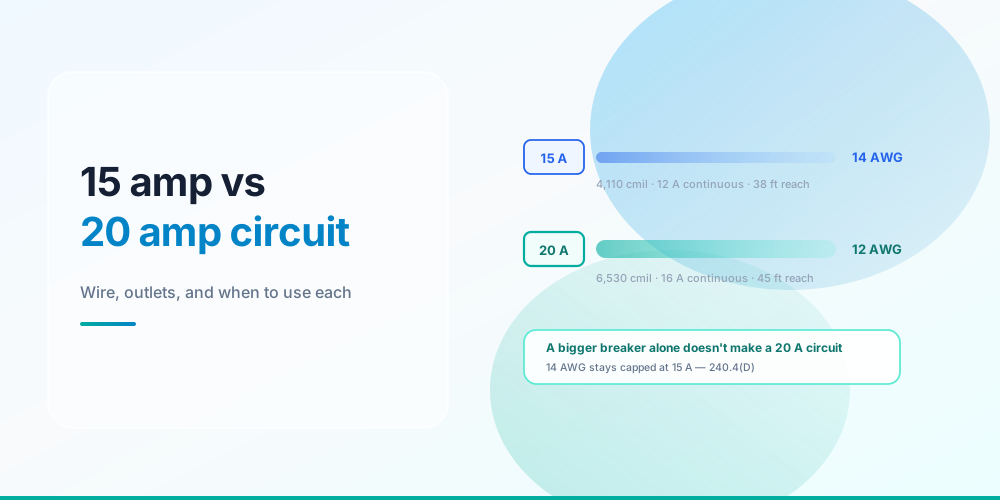
The difference between a 15-amp and a 20-amp circuit is the wire, not the breaker. A 20-amp circuit is one pulled in 12 AWG copper; a 15-amp circuit is one pulled in 14 AWG. The breaker on the end just reflects what the conductor can take.
That sounds like a technicality until you realise what follows from it: you cannot turn a 15-amp circuit into a 20-amp circuit by changing the breaker. The wire is the circuit.
15 A vs 20 A, spec for spec
The Conductor Is the Circuit
240.4(D) caps 14 AWG copper at a 15-amp breaker and 12 AWG copper at 20 amps, regardless of what the ampacity table says either could carry. 14 AWG actually reads 20 A in the 75 °C column - and it still never goes on a 20-amp breaker on a general branch circuit, because the small-conductor rule doesn’t allow it.
So the two circuits are defined by their wire:
| 15 amp | 20 amp | |
|---|---|---|
| Copper conductor | 14 AWG | 12 AWG |
| Conductor area | 4,110 cmil | 6,530 cmil |
| Continuous load ceiling | 12 A | 16 A |
| Reach at full load, 120 V, 3% drop | ~38 ft | ~45 ft |
The continuous figures come from 210.20(A): the breaker must be at least 125% of a continuous load, so the usable continuous load is the rating ÷ 1.25. They happen to match the 210.23(A)(1) cap of 80% of the circuit rating for a single portable appliance - the same two numbers, arrived at from different directions.
Which Receptacles Are Legal
This is where most of the confusion lives, and the answer surprises people.
Receptacle ratings by circuit rating
Table 210.21(B)(3) permits 15-amp receptacles on a 20-amp circuit. Ordinary duplex receptacles - the ones without the sideways T-slot - are 15-amp devices, and they are entirely legal on a 20-amp circuit. Walk into a code-compliant modern kitchen and the countertop receptacles on those two 20-amp small-appliance circuits are, almost certainly, 15-amp duplexes.
The logic is that a duplex spreads its load across two outlets, so no single device is likely to draw the full 20 amps through one set of contacts.
There’s one exception. 210.21(B)(1) requires a single receptacle installed alone on an individual branch circuit to have an ampere rating not less than the circuit. So a lone simplex receptacle on a dedicated 20-amp circuit does need to be a 20-amp device - the T-slot one.
Going the other way is never permitted: a 20-amp receptacle may not go on a 15-amp circuit. That would advertise 20 amps at a point where only 15 is available.
Where the NEC Requires 20 Amps
Where each one belongs
Three places in a dwelling require 20-amp circuits:
- Kitchen and dining small-appliance circuits - at least two 20-amp circuits (210.11(C)(1)), and 210.52(B) limits what else they may serve
- Laundry receptacle circuit - one dedicated 20-amp circuit (210.11(C)(2)), separate from the dryer’s own 30-amp circuit
- Bathroom receptacle circuit - one dedicated 20-amp circuit (210.11(C)(3))
Everywhere else, 15-amp circuits remain fully compliant. Bedrooms, living rooms, hallways, and lighting-only circuits are all perfectly legal on 14 AWG, and a great deal of existing housing stock is wired exactly that way.
Where 20 amps is worth choosing anyway: garages and workshops, where a table saw and a shop vac can easily total 25 amps between them; home offices, where a 12.5-amp space heater is the classic cause of a tripped circuit; and basements and utility spaces where the future use is unknown.
You Cannot Upgrade With a Breaker Swap
Worth stating on its own, because it’s a genuinely dangerous mistake and an easy one to rationalise.
Putting a 20-amp breaker on a circuit wired in 14 AWG does not give you a 20-amp circuit. It gives you a 15-amp conductor with 20-amp protection - a wire that can now be loaded past its rating with nothing to interrupt it. The insulation degrades, the connections heat, and the failure shows up inside a wall.
To go from 15 to 20 amps you replace the conductors with 12 AWG for the entire run, and then change the breaker. There’s no shortcut.
The same trap appears in remodels as a mixed circuit. If any segment of a run is 14 AWG - a spur someone added, a section reused from an older layout - then the whole circuit is limited to 15 amps, no matter that the rest is 12 AWG. The smallest conductor in the circuit governs.
Cost
12 AWG carries about 60% more copper by cross-section than 14 AWG, and the cable price broadly tracks that. It’s also stiffer, harder to fold into a box, and eats more box fill - 314.16 allocates 2.25 in³ per 12 AWG conductor against 2.00 in³ for 14 AWG, which matters in a crowded device box.
On a new circuit the material difference is small enough that many electricians default to 12 AWG throughout for the flexibility it buys later. On a long run you may not have the choice: voltage drop can push you to 12 AWG even on a 15-amp circuit, since 14 AWG only reaches about 38 feet at a full 15-amp load on 120 volts. That calculation is in Voltage Drop.
Common Mistakes
- Swapping in a 20-amp breaker on 14 AWG. The conductor is unprotected from that moment on.
- Mixing 14 and 12 AWG on one circuit. The smallest conductor sets the rating.
- Thinking 15-amp receptacles are illegal on 20-amp circuits. Table 210.21(B)(3) permits them.
- Putting a 20-amp receptacle on a 15-amp circuit. Never permitted.
- Using 15-amp circuits for the kitchen counter, laundry, or bathroom. Those three must be 20 A.
- Assuming 20 amps means 20 usable amps. Continuous load caps out at 16.
- Forgetting box fill. 12 AWG needs more room per conductor than 14 AWG.
Size the Circuit
Breaker Size Calculator - enter the load and get the breaker with the minimum conductor beside it, 240.4(D) cap included.
The Breaker Size Calculator settles which rating a given load needs, and the Wire Size Calculator adds the run-length check that sometimes pushes a 15-amp circuit onto 12 AWG anyway. For how many receptacles either circuit can carry, see How Many Outlets on a 20 Amp Circuit; for the OCPD method in full, What Size Breaker Do I Need; and for the three-way argument about 12 AWG’s rating, 12 Gauge Wire Amps.
Sources & standards: NEC (NFPA 70) 2023 - 210.11(C)(1)–(3), 210.20(A), 210.21(B)(1), Table 210.21(B)(3), 210.23(A)(1), 210.52(B), 240.4(D), Table 310.16, 314.16. Local amendments override the model code, and the AHJ has final say.
FAQ
Can I use 15 amp outlets on a 20 amp circuit?
Yes. Table 210.21(B)(3) permits 15-amp receptacles on a 20-amp branch circuit, and standard duplex receptacles are 15-amp devices. The exception is a single receptacle alone on an individual branch circuit, which 210.21(B)(1) requires to match the circuit rating.
Can I put a 20 amp breaker on 14 gauge wire?
No. 240.4(D) limits 14 AWG copper to a 15-amp overcurrent device on general branch circuits. A 20-amp breaker would allow the conductor to be loaded beyond its rating with no protection - the wire itself becomes the weak point, inside the wall.
Is 12 gauge wire better than 14 gauge?
It carries more current, drops less voltage over the same distance, and gives you room to grow - but it costs more, is harder to work, and takes more box fill. For circuits the code allows on 14 AWG, 14 AWG is a correct choice. Many electricians run 12 AWG throughout anyway for the flexibility.
Do I need 20 amp circuits in a kitchen?
Yes, at least two of them. 210.11(C)(1) requires a minimum of two 20-amp small-appliance branch circuits for the kitchen, pantry, and dining areas, and 210.52(B) restricts what else those circuits may serve. Bathrooms and the laundry each need their own 20-amp circuit as well.
How many outlets can I put on a 15 amp circuit?
In a dwelling the NEC sets no limit - 220.14(J) already counts general-use receptacles within the general lighting load. The working convention is 8 per 15-amp circuit. In commercial work, 220.14(I) assigns 180 VA each, giving 1,800 ÷ 180 = 10 outlets.
What happens if I mix 12 and 14 gauge wire on one circuit?
The whole circuit is limited to 15 amps, because the smallest conductor governs. This shows up often in remodels where a 14 AWG section was reused or spurred off a 12 AWG run - and it means the 20-amp breaker on that panel is protecting a 15-amp conductor somewhere along the way.