
How Many Outlets on a 20 Amp Circuit? The Real NEC Answer
- 03 Aug, 2026
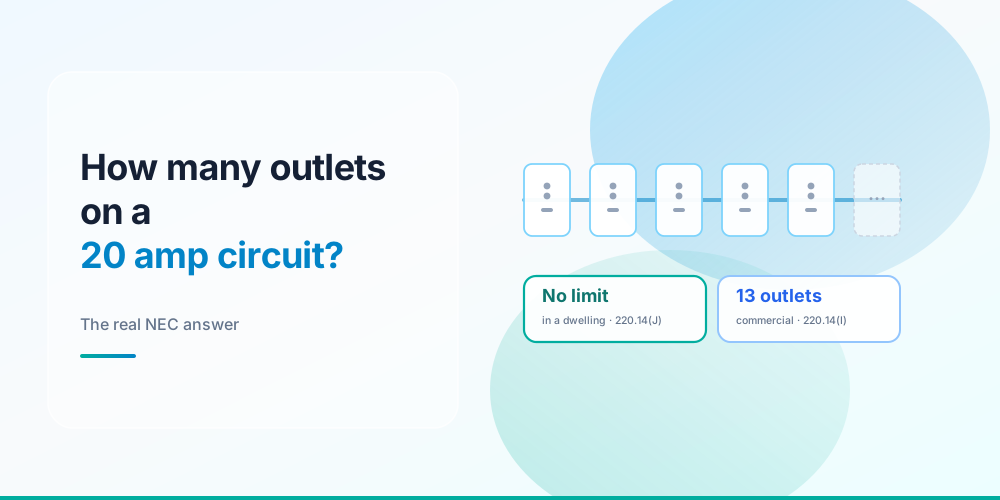
Ask this online and you’ll get “10” from one person, “13” from the next, and “8, because of the 80% rule” from a third. All three are quoting something real, and none of them is quite the answer.
In a dwelling, the NEC places no limit on the number of general-use receptacles on a branch circuit. None. You could legally put twenty on one 20-amp circuit. In a commercial building the answer is a firm 13. Here’s why they differ, and what actually constrains you in practice.
Two different rules, two different answers
In a Dwelling: No Limit
The reason is how dwelling loads are calculated. 220.14(J) says that in dwelling units, the general lighting load computed at 3 VA per square foot under 220.12 is deemed to include all general-use receptacle outlets of 20 amps or less, along with lighting outlets.
In other words, the code already accounted for your receptacles when it charged you 3 VA for every square foot of the house. Assigning each one an individual load would be counting the same thing twice. And with no per-receptacle load, there’s no arithmetic that produces a maximum count.
What the NEC regulates in dwellings is where receptacles go, not how many share a circuit:
- 210.52(A) - the “6-foot rule”: no point along the floor line of any wall space may be more than 6 feet from a receptacle, and every wall space 2 feet or wider needs one
- 210.52(C) - kitchen countertops: no point more than 24 inches from a receptacle
- 210.11(C)(1) - at least two 20-amp small-appliance circuits for the kitchen and dining areas, and 210.52(B) restricts what else they may serve
- 210.11(C)(2) - a dedicated 20-amp laundry circuit
- 210.11(C)(3) - a dedicated 20-amp bathroom circuit
- 210.8 - GFCI protection; 210.12 - AFCI protection
So the code is prescriptive about coverage and about which rooms get dedicated circuits. Quantity per circuit it leaves to you.
In Commercial Work: 13
Non-dwelling occupancies use a different load rule. 220.14(I) assigns 180 VA to each receptacle outlet - specifically, to each single or multiple receptacle on one strap or yoke.
The 180 VA calculation
A 20-amp, 120-volt circuit is 2,400 VA. Divide by 180 and you get 13.33, so 13 outlets. On a 15-amp circuit it’s 1,800 ÷ 180 = 10 outlets.
Where the circuit is treated as a continuous load, apply the 125% rule first - 2,400 × 0.8 = 1,920 VA - and a 20-amp circuit comes down to 10 outlets, a 15-amp circuit to 8.
That “counts once per strap” detail matters. A standard duplex receptacle is one strap, so it’s 180 VA no matter that two things plug into it. A four-plex assembled from two duplexes on two straps is 360 VA.
What Actually Limits You
The number isn’t the constraint. The load is, and there are two real code limits people rarely quote:
The limits that do apply
210.23(A)(1) - a single piece of cord-and-plug equipment not fastened in place may not exceed 80% of the branch-circuit rating. On a 20-amp circuit that’s 16 amps, which is why a 20-amp circuit can’t legally serve a single 18-amp portable appliance.
210.23(A)(2) - equipment fastened in place is limited to 50% of the circuit rating where that circuit also supplies lighting outlets or ordinary receptacles. So 10 amps on a 20-amp circuit for something like a hardwired fan or a small water heater sharing a general circuit.
Beyond those, it’s judgment. Twenty receptacles in bedrooms where nothing draws more than a phone charger is fine. Six in a workshop where a table saw and a shop vac might run together is already optimistic - a 15-amp saw plus a 10-amp vac is 25 amps on a 20-amp circuit, and the breaker will tell you about it.
The 8–10 Convention
Most electricians install 8 to 10 receptacles per 20-amp general-purpose circuit, and 8 on a 15-amp circuit. This isn’t code - it’s a habit built on a rough allowance of 1.5 amps (180 VA) per outlet, which conveniently matches the commercial figure: 16 usable amps ÷ 1.5 ≈ 10.
It’s a sound default. It leaves headroom, it keeps a single tripped breaker from taking out half a floor, and it means the next person to add a circuit isn’t starting from a fully-loaded one. Some jurisdictions have adopted a limit as a local amendment, so it’s worth asking your AHJ rather than assuming the model code’s silence applies where you work.
Room by Room
- Bedrooms and living areas - 20-amp circuit, 8–10 receptacles is comfortable. AFCI required (210.12).
- Kitchen - two 20-amp small-appliance circuits minimum (210.11(C)(1)), serving only the areas 210.52(B) permits. Countertop receptacles are GFCI. Split them so a toaster and a kettle aren’t on the same one.
- Bathroom - dedicated 20-amp circuit (210.11(C)(3)), GFCI. A hair dryer alone can be 12–15 amps.
- Laundry - dedicated 20-amp circuit (210.11(C)(2)) for the receptacle outlets, separate from the dryer’s own 30-amp circuit.
- Garage and workshop - be generous with circuits, not outlets. Power tools stack up fast, and 210.8 requires GFCI.
- Home office - computers and monitors are light, but space heaters are 12.5 amps and are the usual cause of a tripped office circuit.
Common Mistakes
- Believing a hard limit exists in a dwelling. It doesn’t; 220.14(J) is why.
- Applying the commercial 180 VA rule to a house. Correct rule, wrong occupancy.
- Counting receptacles instead of straps. A duplex is one outlet for load purposes.
- Putting the kitchen counter receptacles on a general circuit. They need the dedicated small-appliance circuits.
- Adding outlets to an already-loaded circuit. Legal, and still a nuisance-tripping complaint waiting to happen.
- Assuming the number is the safety question. What’s plugged in is what matters - see 210.23(A).
Check the Circuit
Receptacle & Circuit Calculator - pick the occupancy and it applies the right rule: 180 VA per strap for non-dwellings, or no count limit for a dwelling, with the 210.23(A) load limits alongside.
The Receptacle & Circuit Calculator is built around the distinction this article is about - it will tell you “no limit” for a dwelling rather than inventing a number, and give you the firm count for commercial work. To check the load rather than the count, the Breaker Size Calculator applies the 125% continuous adder; for the whole-house picture, the Load Calculator. Sizing the conductor for a long run is in What Size Wire Do I Need, and the 15-versus-20 decision in 15 Amp vs 20 Amp Circuit.
Sources & standards: NEC (NFPA 70) 2023 - 220.12, 220.14(I), 220.14(J), 210.8, 210.11(C)(1)–(3), 210.12, 210.23(A)(1), 210.23(A)(2), 210.52(A), 210.52(B), 210.52(C). Local amendments override the model code, and the AHJ has final say.
FAQ
How many outlets can I put on a 20 amp circuit?
In a dwelling, the NEC sets no maximum - 220.14(J) already includes general-use receptacles in the 3 VA per square foot general lighting load, so there’s no per-receptacle figure to divide by. In a commercial occupancy, 220.14(I) assigns 180 VA each, giving 13 outlets on a 20-amp 120-volt circuit. Most electricians install 8–10 in either case.
Is there a 10 outlet rule?
Not in the NEC for dwellings. The figure comes from allowing roughly 1.5 amps per outlet against 16 usable amps, and it matches the commercial 180 VA calculation on a 15-amp circuit. It’s a good working default and some jurisdictions adopt it as a local amendment, but the model code doesn’t impose it.
How many outlets on a 15 amp circuit?
Same answer: no NEC limit in a dwelling. Commercially, 1,800 VA ÷ 180 = 10 outlets, dropping to 8 if the circuit is treated as continuous. The usual convention is 8.
Does a duplex receptacle count as one outlet or two?
One. 220.14(I) assigns 180 VA to each single or multiple receptacle on one strap or yoke, and a standard duplex is a single strap. A four-plex built from two duplexes sits on two straps and counts as 360 VA.
Can I mix lights and outlets on the same circuit?
Yes, in a dwelling - general lighting and general-use receptacles may share a branch circuit. The exceptions are the circuits the code requires to be dedicated: the kitchen small-appliance circuits, the laundry circuit, and the bathroom circuit. Note that 210.23(A)(2) then limits fastened-in-place equipment on that circuit to 50% of its rating.
Why does my 20 amp circuit trip if the NEC allows unlimited outlets?
Because the breaker responds to current, not to receptacle count. Unlimited outlets is a statement about load calculation, not about simultaneous use. Two power tools or a space heater plus a vacuum will exceed 20 amps regardless of how many receptacles are on the circuit - the fix is more circuits, not fewer outlets.