
Copper vs Aluminum Wire: Sizing, Cost, and Where Each Belongs
- 04 Aug, 2026
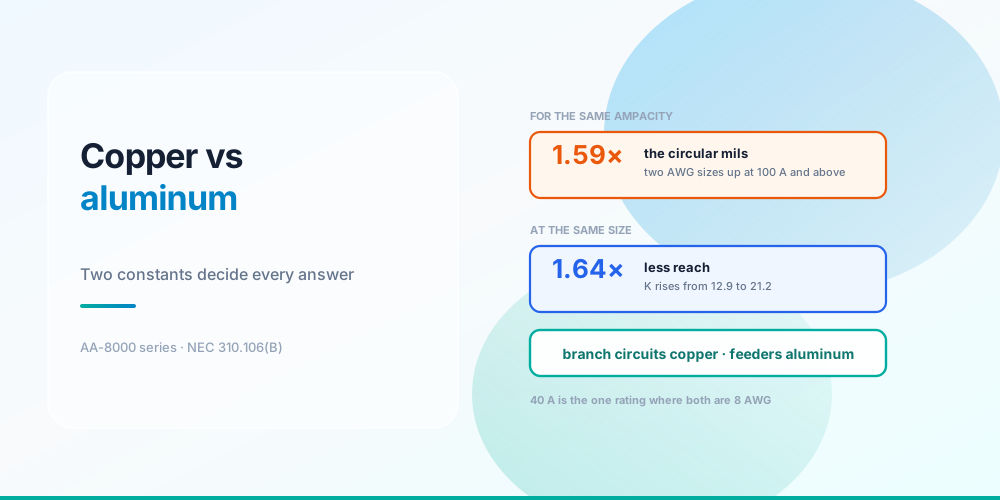
Two numbers settle almost every copper-versus-aluminum argument, and both of them turn out to be constants.
For the same ampacity, aluminum needs 1.59× the circular mils. Work it out at 30 A, at 100 A, at 200 A, or through NEC Table 310.12 - the ratio holds. Usually that’s one AWG size up; from 100 A upward it’s two.
At the same size, aluminum reaches 1.64× less far. That one is exact and it never moves, because it’s just the resistivity constant K rising from 12.9 to 21.2.
Everything else - cost, terminations, where each belongs - follows from those two facts and from one piece of history that gets conflated with modern aluminum and shouldn’t be.
The Size Ladder
Aluminum needs a bigger conductor - but how much bigger changes
| Rating | Copper | Aluminum | Sizes apart | Circular mils |
|---|---|---|---|---|
| 30 A | 10 AWG | 8 AWG | 1 up | 1.59× |
| 40 A | 8 AWG | 8 AWG | same size | 1.00× |
| 50 A | 8 AWG | 6 AWG | 1 up | 1.59× |
| 60 A | 6 AWG | 4 AWG | 1 up | 1.59× |
| 100 A | 3 AWG | 1 AWG | 2 up | 1.59× |
| 150 A | 1/0 AWG | 3/0 AWG | 2 up | 1.59× |
| 200 A | 3/0 AWG | 250 kcmil | 2 up | 1.49× |
40 A is the one rating where the two materials land on the same size, because aluminum 8 AWG is rated exactly 40 A at 75 °C. It’s a coincidence of where the table rounds, but it’s a useful one: a 40 A circuit is the only place aluminum costs you nothing in conductor size.
Notice that the AWG gap widens even though the circular-mil ratio stays put. That’s because the AWG scale isn’t linear - each step is about 1.26× in area, so 1.59× is “one and a bit” steps. Below 100 A it rounds to one size; above, to two.
Services and feeders get their own table
If the conductors are the service for a dwelling, or the single feeder carrying an entire dwelling load, Table 310.12 lets you use 83% of the rating instead:
| Service | Copper | Aluminum |
|---|---|---|
| 100 A | 4 AWG | 2 AWG |
| 125 A | 2 AWG | 1/0 AWG |
| 150 A | 1 AWG | 2/0 AWG |
| 200 A | 2/0 AWG | 4/0 AWG |
| 400 A | 400 kcmil | 600 kcmil |
The 1.59× ratio survives here too - 2/0 copper is 133,100 cmil and 4/0 aluminum is 211,600, which is 1.59×.
4/0 aluminum for a 200 A service is the single most common aluminum specification in residential work, and it’s why aluminum is worth understanding even if you never run it on a branch circuit. Be careful with the scope of that table, though: it applies to a service or a whole-dwelling feeder, not to an ordinary garage or shop subpanel. That trap is worked through in 200 Amp Service Wire Size and What Size Wire for a 100 Amp Sub Panel.
The Reach Penalty Is a Constant
The reach penalty never changes: 1.64× at every size
| Size | Copper reach | Aluminum reach |
|---|---|---|
| 3 AWG | 147 ft | 89 ft |
| 1 AWG | 234 ft | 142 ft |
| 2/0 AWG | 371 ft | 226 ft |
| 4/0 AWG | 591 ft | 359 ft |
Every row is 1.64× apart, because voltage drop by the circular-mils method is directly proportional to K. That invariance is genuinely useful: you never need a second table. Take any copper reach figure and divide by 1.64.
The practical consequence shows up on long feeders. A 100 A feeder run 150 feet at 240 V lands at 3.06% on 3 AWG copper and 5.04% on 3 AWG aluminum - one is at the conventional design target and the other is well past it. Upsizing the aluminum two sizes to 1 AWG brings it to 3.17%, and 1/0 gets it to 2.51%.
Worth restating here, because it gets misquoted constantly: the 3% and 5% figures live in informational notes to 210.19(A) and 215.2(A) and are not enforceable code. Design to 3% because it’s good practice, not because an inspector can cite it. The detail is in Voltage Drop.
Where Each Belongs
The question is scale, not which metal is better
Copper for branch circuits. At 14, 12 and 10 AWG, aluminum isn’t an option worth considering - the material saving on a few hundred feet of 12 AWG is negligible, and it costs you a size, a set of listed terminations and a torque spec. 14 AWG aluminum isn’t even in Table 310.16.
Aluminum for services and feeders. The saving scales with conductor mass, so it becomes real exactly where the conductors get heavy. At 4/0 and above the material cost difference is large enough to matter on a single job, and aluminum is also easier to pull and to support because it’s roughly a third the weight for a given ampacity. Utility service laterals are almost universally aluminum for both reasons.
The middle ground, 50–100 A, is a judgement call. A 60 A feeder in 4 AWG aluminum instead of 6 AWG copper saves a modest amount of money and costs you a conduit size. Often not worth the bother; occasionally clearly worth it on a long run.
Terminating Aluminum Properly
This is where aluminum earns its reputation, and every item on the list is a real requirement rather than folklore.
AA-8000 series alloy is mandatory. NEC 310.106(B) requires that aluminum conductors be of an AA-8000 series alloy. This is the single most important fact in the article, because it is what separates modern aluminum from the material that caused the problems - see below.
Listed terminations only. Lugs and connectors must be marked AL/CU or AL9CU (or simply listed for aluminum). Most modern breakers, panel lugs and mechanical connectors are dual-rated; the exception you will actually meet is small receptacles and switches, where an aluminum-rated device is marked CO/ALR and is genuinely uncommon.
Torque to specification. 110.14(D) requires terminations to be tightened to the manufacturer’s torque value using a calibrated tool. This applies to copper too, and almost nobody does it on copper - but aluminum is the material where under- and over-torquing actually causes failures, because it’s softer and it creeps.
Antioxidant compound where specified. Not universally required by the NEC, but specified by many manufacturers for aluminum terminations and cheap insurance. Aluminum oxidises to a non-conductive film, unlike copper’s conductive oxide.
Never mix copper and aluminum under a single terminal unless the connector is specifically listed for it. Galvanic action plus the different thermal expansion rates makes the joint loosen over time.
The Aluminum Branch Wiring Problem - a Separate Thing Entirely
Between roughly 1965 and 1973, when copper prices spiked, a great deal of US housing was wired with aluminum branch-circuit conductors in 12 and 10 AWG. That material was not AA-8000. It was a harder alloy that crept under thermal cycling, oxidised at terminations, and caused a real and well-documented pattern of overheated connections and fires.
Three things about it are worth being precise about:
It is a termination problem, not a wire problem. The conductor in the wall is fine. The failures happen at receptacles, switches and splices, throughout the house.
The recognised repairs are specific. COPALUM crimp connectors (a proprietary, tooled crimp applied by a certified installer) or listed connectors such as AlumiConn, applied at every device and splice. Pigtailing with ordinary wire nuts is not a recognised repair and is generally considered to make things worse.
A panel upgrade does not fix it. This is a common and expensive mis-sell. Replacing the panel does nothing about a hazard that lives at the terminations of every device in the house. If someone quotes you a panel upgrade as a remedy for aluminum branch wiring, they’ve either misunderstood or they’re hoping you have. See Do I Need a Panel Upgrade for what a panel upgrade does and doesn’t address, and Cost to Rewire a House for the real remediation.
None of that applies to modern AA-8000 feeder and service aluminum. They share a name and nothing else - different alloy, different application, different failure history. Conflating the two is the most common error in this whole topic, and it costs homeowners money in both directions: unnecessary fear of a 4/0 service lateral, and unwarranted comfort about 1968 branch circuits.
What Doesn’t Change with Material
Two things are keyed to the overcurrent device rather than to the phase conductors, so they don’t move when you switch material:
The equipment grounding conductor comes from Table 250.122 by OCPD rating. The table does have separate copper and aluminum columns - an aluminum EGC runs about one size larger - but the rating you look up is the breaker’s, not the conductor’s. A 200 A feeder needs a 6 AWG copper or 4 AWG aluminum EGC whether the phase conductors are 2/0 copper or 4/0 aluminum.
The overcurrent device itself doesn’t care either. What does change is 240.4(D): aluminum 12 AWG is capped at 15 A and 10 AWG at 25 A, one step below their copper equivalents.
There is one exception worth knowing: 250.122(B) requires the EGC to be increased proportionally when the phase conductors are upsized for voltage drop. Since aluminum gets upsized for drop more often, this bites more often on aluminum. The full picture is in Ground Wire Size Chart.
Common Mistakes
- Assuming aluminum is always two sizes up. It’s one size at branch-circuit ratings, two from 100 A, and level at 40 A.
- Applying Table 310.12’s 83% allowance to an ordinary subpanel. It’s for services and whole-dwelling feeders only.
- Forgetting the 1.64× drop penalty. Same-size aluminum on a long feeder frequently exceeds 3%.
- Treating 1960s branch aluminum and modern AA-8000 as the same material. Different alloy, different application, different risk.
- Selling or buying a panel upgrade as a fix for aluminum branch wiring. The hazard is at every termination in the house.
- Pigtailing old aluminum with wire nuts. Not a recognised repair. COPALUM or listed connectors.
- Using non-rated terminations. Look for AL/CU, AL9CU, or CO/ALR on devices.
- Skipping the torque spec. 110.14(D) requires a calibrated tool, and aluminum is the material where it matters.
- Mixing copper and aluminum under one terminal. Only where the connector is listed for it.
- Specifying aluminum for 12 AWG branch circuits to save money. The saving is negligible and you lose a size.
Size a Conductor in Either Material
Wire Size Calculator - enter load, voltage, run length, material and conditions. It returns the minimum size from Table 310.16 with the 240.4(D) limits applied, and separately the size voltage drop demands, so you can see which constraint governs in each material.
Every figure in this article is computed from the same NEC tables the calculators use. Pair it with the Voltage Drop Calculator for the reach figures, the Service Wire Size Calculator for the Table 310.12 cases, and see What Size Wire Do I Need for the sizing method end to end.
Sources & standards: NEC (NFPA 70) 2023 - Table 310.16, Table 310.12, 310.106(B), 110.14(D), 240.4(D), Table 250.122 and 250.122(B), and the informational notes to 210.19(A) and 215.2(A). Aluminum branch-circuit remediation guidance follows CPSC publications. Local amendments override the model code and the AHJ has final say. Have electrical work designed and installed by a licensed electrician under permit.
FAQ
Is aluminum wire safe?
Modern AA-8000 series aluminum, required by NEC 310.106(B), has a good safety record and is standard for service and feeder conductors - most utility service laterals are aluminum. The safety problem is specific to the pre-AA-8000 alloy used for branch circuits between about 1965 and 1973, which creeps and oxidises at terminations. The two materials share a name and nothing else.
How much bigger does aluminum wire need to be?
It needs 1.59 times the circular mils for the same ampacity, which works out to one AWG size at branch-circuit ratings and two sizes from 100 A upward. 30 A is 10 AWG copper or 8 AWG aluminum; 200 A is 3/0 copper or 250 kcmil aluminum. The one exception is 40 A, where both materials use 8 AWG.
Can I use aluminum wire for a 200 amp service?
Yes - 4/0 aluminum is the standard specification for a 200 A dwelling service, under the 83% allowance in NEC Table 310.12. It is probably the most common aluminum conductor in residential work. It needs AL/CU-rated lugs torqued to the manufacturer’s specification.
Does aluminum wire have more voltage drop?
Yes, and by a fixed factor. At the same size it reaches 1.64 times less far, because the resistivity constant K rises from 12.9 for copper to 21.2 for aluminum. A 100 A feeder at 240 V run 150 feet is at 3.06% on 3 AWG copper and 5.04% on 3 AWG aluminum. Take any copper figure and divide by 1.64.
Can I connect copper and aluminum wire together?
Only with a connector specifically listed for the combination - AL/CU or AL9CU marked lugs, or a listed dual-material connector such as an AlumiConn. Never under a single terminal screw not rated for it. The two metals have different expansion rates and aluminum forms a non-conductive oxide, so an unlisted joint loosens and heats over time.
Do I need to rewire a house with aluminum wiring?
Not necessarily, and a panel upgrade is definitely not the answer. If the aluminum is branch-circuit wiring from the 1965–1973 era, the recognised remedies are COPALUM crimps or listed connectors such as AlumiConn applied at every device and splice - remediating terminations rather than replacing conductors. If the aluminum is a modern service lateral or feeder, there is nothing to fix.
Which is cheaper, copper or aluminum wire?
Aluminum, and the gap widens with conductor size because the saving scales with mass. At 12 AWG the difference is negligible and not worth the extra size and hardware; at 4/0 and above it is substantial enough to decide a job. The middle ground of 50–100 A feeders is a genuine judgement call.
Is the ground wire different for aluminum circuits?
The equipment grounding conductor is sized from Table 250.122 by the overcurrent device rating, not by the phase conductors, so switching the phase conductors to aluminum doesn’t change which row you read. The table does have separate columns, and an aluminum EGC is about one size larger than copper. Note 250.122(B) too: if you upsize phase conductors for voltage drop - which happens more often with aluminum - you must upsize the EGC proportionally.