
200 Amp Service Wire Size: Copper vs Aluminum and the 83% Rule
- 03 Aug, 2026
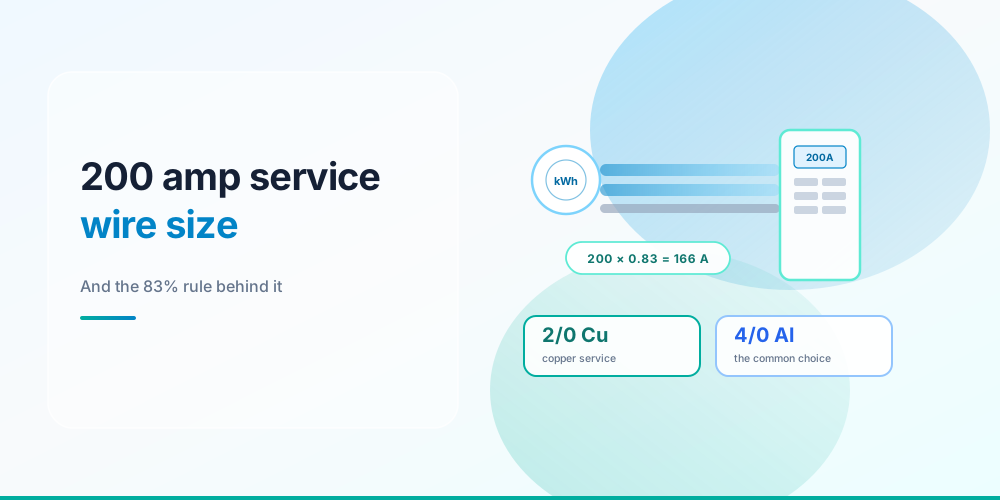
A 200-amp residential service takes 2/0 copper or 4/0 aluminum. If you go looking for those sizes in the ampacity table you won’t find them - 2/0 copper is only rated 175 amps at 75 °C, which looks like it shouldn’t be legal on a 200-amp service.
It is, and the reason is a dedicated table that exists specifically for dwelling services.
The 83% Rule
Where 2/0 comes from
Table 310.12 permits the ungrounded conductors of a dwelling service to have an ampacity of not less than 83% of the service rating. For a 200-amp service:
200 A × 0.83 = 166 A of required ampacity
2/0 copper is 175 A at 75 °C - comfortably above 166. 4/0 aluminum is 180 A. Both qualify.
Size the same service from Table 310.16 at the full 200 amps and you’d need 3/0 copper or 250 kcmil aluminum - one trade size larger in each material, and a meaningful cost difference on a service entrance.
The justification is load diversity. A dwelling’s calculated load already reflects demand factors, and a house rated for 200 amps essentially never draws 200 amps for the three hours that would matter thermally. The code recognizes that in a single table rather than making you argue it.
The Full Table
Table 310.12 - dwelling services
| Service | Copper | Aluminum |
|---|---|---|
| 100 A | 4 AWG | 2 AWG |
| 110 A | 3 AWG | 1 AWG |
| 125 A | 2 AWG | 1/0 AWG |
| 150 A | 1 AWG | 2/0 AWG |
| 175 A | 1/0 AWG | 3/0 AWG |
| 200 A | 2/0 AWG | 4/0 AWG |
| 225 A | 3/0 AWG | 250 kcmil |
| 250 A | 4/0 AWG | 300 kcmil |
| 300 A | 250 kcmil | 350 kcmil |
| 350 A | 350 kcmil | 500 kcmil |
| 400 A | 400 kcmil | 600 kcmil |
Where the Allowance Applies - and Where It Doesn’t
This is the part that causes trouble. Table 310.12 covers:
- A dwelling service - service-entrance conductors for a one-family dwelling, or an individual dwelling unit in a two-family or multifamily building
- A feeder carrying the entire load associated with that dwelling - the meter-main-outside to single-panel-inside arrangement, for instance
It does not cover an ordinary subpanel feeder, a feeder to a detached garage, a commercial service, or any feeder carrying only part of the dwelling’s load. Those all size from Table 310.16. Applying the 83% allowance to a garage subpanel is a real violation, and it’s common enough that it’s worth its own article - What Size Wire for a 100 Amp Sub Panel.
Copper or Aluminum?
Aluminum wins on services, and it’s what most of this work actually gets built with. 4/0 aluminum costs a fraction of 2/0 copper per foot, and the service entrance is one place the trade-offs clearly favor it: the run is short, the terminations are few, accessible, and rated AL/CU, and the lugs are big enough to torque properly.
The usual product is aluminum SER cable for an interior run - commonly 4/0-4/0-2/0 for a 200-amp service, meaning two 4/0 hots and a reduced 2/0 neutral - or SE cable for the exterior portion. For anything underground, SER isn’t rated for wet locations; use USE-2 or another listed underground wiring method.
Where copper still makes sense: very long service runs where voltage drop starts to bite, tight raceways or conduit bodies where 4/0 aluminum won’t make the bend, and terminations that are CU-only.
Either way, use AL-rated or AL/CU-rated lugs, torque to the listed value with a torque screwdriver or wrench, and apply antioxidant compound where the listing calls for it. Aluminum service terminations fail from loose connections far more often than from anything to do with the conductor.
The Grounding Electrode Conductor
GEC size by electrode type
The GEC comes from Table 250.66, keyed to the size of the largest ungrounded service-entrance conductor. With 2/0 copper (or 4/0 aluminum) service conductors, the table gives 4 AWG copper.
Then the caps in 250.66(A) through (C) apply, and they matter:
- Ground rod, pipe, or plate electrode - the GEC need not exceed 6 AWG copper (250.66(A)). This is why nearly every 200-amp service with driven rods uses 6 AWG, not 4.
- Concrete-encased electrode (Ufer) - capped at 4 AWG copper (250.66(B)), which happens to equal the table value here, so 4 AWG.
- Ground ring - need not be larger than the ring conductor itself (250.66(C)).
- Metal water pipe - no cap. The full 4 AWG applies.
Where a service has both rods and a Ufer, size each GEC for the electrode it actually serves.
Don’t confuse this with the equipment grounding conductor for a 200-amp feeder, which comes from Table 250.122 and is 6 AWG copper or 4 AWG aluminum. Different table, different job. Both are handled by the Ground Wire Size Calculator.
The Neutral
The grounded (neutral) service conductor is sized for the maximum unbalanced load per 220.61 - realistically the 120-volt load, since 240-volt loads like a range, dryer, water heater, or A/C put nothing on the neutral. That’s why a reduced neutral is standard: 2/0 aluminum alongside 4/0 hots is the common 200-amp SER configuration.
Two floors on that reduction: the neutral may not be smaller than the required grounding electrode conductor where it serves as the grounding path back to the transformer, and never smaller than the size Table 250.122 would call for. In practice the cable assemblies sold for this purpose already respect both.
Does Voltage Drop Matter on a Service?
Usually not much - service-entrance runs are short, often under 30 feet, and 2/0 copper at 200 amps only drops about 1% over 50 feet. Two cases where it does:
- Long rural services, where the meter or pole is hundreds of feet from the house. Here you’re often better off putting the service at the pole and running a feeder, or moving up a size or two.
- 320/400-amp services feeding two panels, where the higher current makes every foot cost more.
Note that Table 310.12 explicitly does not excuse you from checking drop - the 83% allowance is about thermal capacity, not distance. Run the numbers with the Voltage Drop Calculator; the method is in Voltage Drop.
Common Mistakes
- Using the 83% allowance on a subpanel feeder. Services and whole-dwelling feeders only.
- Sizing from Table 310.16 and overpaying. The reverse error - legal, just a size larger than you needed.
- 4 AWG copper GEC to ground rods. Legal but wasteful; 250.66(A) caps it at 6 AWG.
- Confusing Table 250.66 with Table 250.122. Electrode conductor vs equipment grounding conductor.
- SER cable underground. Not rated for wet locations.
- Untorqued aluminum lugs. The most common cause of service-termination failure. Use a torque tool.
- Assuming 200 A is the right rating. That comes from a load calculation, not from what the neighbors have.
Size the Service
Service & Feeder Wire Size Calculator - dwelling-service toggle for the 83% allowance, plus neutral, GEC, and voltage drop in one pass.
The Service & Feeder Wire Size Calculator applies Table 310.12 when the dwelling-service case fits and falls back to Table 310.16 when it doesn’t, so you can see both answers. To confirm 200 amps is the right rating, run the Service Size Calculator or the Load Calculator for the 220.82 optional method. The general sizing method is in What Size Wire Do I Need, and the full ampacity table in the Wire Size Chart.
Sources & standards: NEC (NFPA 70) 2023 - Table 310.12, Table 310.16, 110.14(C), 220.61, Table 250.66, 250.66(A)–(C), Table 250.122, 230.42, 338.10. Local amendments override the model code, and the AHJ has final say.
FAQ
What size wire is needed for a 200 amp service?
2/0 copper or 4/0 aluminum for a dwelling service, under the 83% allowance in Table 310.12. If the same conductors were sized from Table 310.16 at the full 200 amps you’d need 3/0 copper or 250 kcmil aluminum - which is what applies to a non-dwelling service or an ordinary feeder.
Why is 2/0 copper allowed on a 200 amp service when it’s only rated 175 amps?
Because Table 310.12 lets dwelling service conductors be sized at 83% of the service rating. 200 × 0.83 = 166 amps of required ampacity, and 2/0 copper’s 175 A at 75 °C clears that. The allowance reflects the load diversity already built into a dwelling load calculation.
Can I use 4/0 aluminum for a 200 amp service?
Yes - it’s the most common choice. 4/0 aluminum is 180 A at 75 °C, above the 166 A the 83% rule requires, and it costs far less than 2/0 copper. Use AL-rated or AL/CU lugs, torque them to the listed value, and use antioxidant compound where the listing requires it.
What size ground wire for a 200 amp service?
For the grounding electrode conductor, Table 250.66 gives 4 AWG copper - but 250.66(A) caps it at 6 AWG copper where it runs to a ground rod, pipe, or plate, which covers most installations. A concrete-encased electrode is capped at 4 AWG. The equipment grounding conductor for a 200-amp feeder is a different thing: 6 AWG copper or 4 AWG aluminum, from Table 250.122.
Can the neutral be smaller than the hots on a service?
Yes. The neutral is sized for the maximum unbalanced load per 220.61, and since 240-volt loads put no current on it, a reduction is normal - 2/0 aluminum with 4/0 hots is the standard 200-amp SER configuration. It can’t go below the required grounding electrode conductor size or the Table 250.122 size.
Does the 83% rule apply to a subpanel feeder?
No. Table 310.12 covers a dwelling service and a feeder carrying the entire load of a dwelling. An ordinary subpanel feeder carries only part of the load and sizes from Table 310.16 - so a 100-amp subpanel needs 3 AWG copper, not the 4 AWG the 83% rule would give.