
Do I Need a Panel Upgrade? How to Tell Before Spending $3,000
- 03 Aug, 2026
Panel upgrades are one of the most over-sold jobs in residential electrical work. Not usually dishonestly - it’s that the paper load calculation says a house needs more service than it does, and almost nobody checks the number that would prove otherwise.
There is a code-sanctioned way to use what your house actually draws instead of what it theoretically could. It’s in 220.87, it takes one phone call to your utility, and it regularly turns a $3,000 upgrade into a $300 circuit.
Do you actually need one?
First: A Full Panel Is Not a Maxed-Out Service
These are different problems with different fixes, and conflating them is the single most common reason people are told they need an upgrade.
“No empty breaker spaces” is a physical problem. A 100-amp panel with every slot filled may still have plenty of unused capacity. The fixes are tandem breakers where the panel is listed for them, or a subpanel fed from the existing main - see What Size Wire for a 100 Amp Sub Panel. Neither touches the service.
“The calculated load exceeds the service rating” is a capacity problem, and that’s what an upgrade solves.
Ask which one you have before agreeing to anything. The distinction between service rating, main breaker, and busbar rating is worth understanding here too - it’s covered in What Size Electrical Service Do I Need.
The 220.87 Method
This is the important part of the article.
A standard load calculation is deliberately conservative - it assumes a house might run everything at once. Real houses never do. 220.87 lets you establish the existing load from measured data instead:
Take the maximum demand recorded over the previous 12 months and multiply by 125%.
Where a full year of data isn’t available, 30 days of recorded demand data may be used instead. Most utilities will provide interval or peak-demand data on request, often free, and often through the online account portal.
220.87 worked on a 100 A service
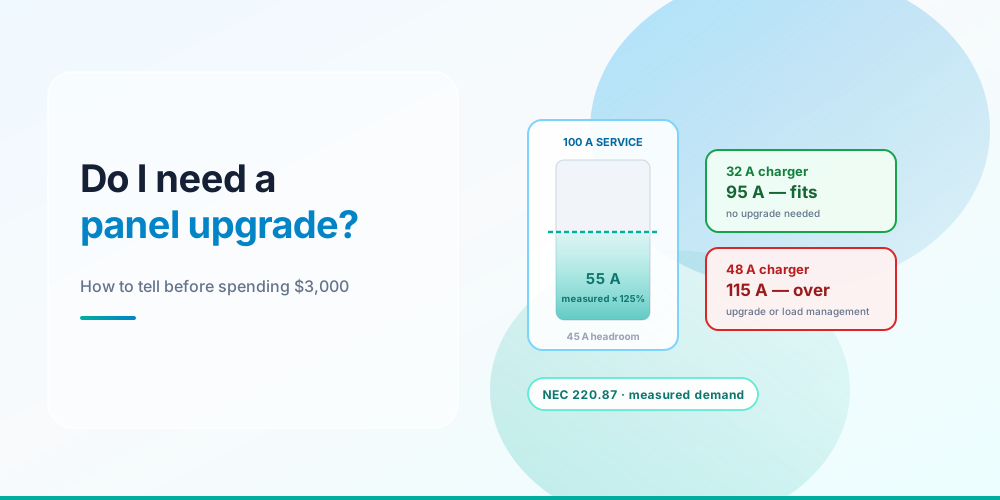
Here’s a real-shaped example. A 1960s house on a 100-amp service, paper calculation around 130 A, homeowner wants an EV charger:
- Utility’s highest recorded demand over 12 months: 44 A
- 220.87 established existing load: 44 × 1.25 = 55 A
- New load - a 32-amp charger, continuous per 625.41, so ×1.25: 40 A
- Total: 95 A on a 100-amp service ✓
It fits, with 5 amps to spare, and no upgrade is needed. Whereas a 48-amp charger would add 60 A for a total of 115 A - over the service, and now you’re either upgrading or adding load management.
Which points at the cheapest fix of all: specify a smaller charger. A 32-amp charger delivers roughly 7.7 kW, or about 25–30 miles of range per hour of charging. For a car that sits on a driveway for ten hours a night, that is comprehensively enough. Most homeowners asking for a 48-amp charger don’t need one.
The other route is a load-management system (Article 750), which lets a large load back off when the rest of the house is busy. Many EVSE units have this built in, and it’s a fraction of an upgrade’s cost.
When You Genuinely Do Need One
The calculation really does exceed the service. Even with 220.87 and a modest charger, some houses are out of room - particularly all-electric homes adding a heat pump and charging.
60-amp service or a fuse box. 230.79(C) requires at least 100 A for a one-family dwelling, so a 60-amp service can’t be extended or meaningfully modified. Fuse boxes also give you nowhere to add the AFCI and GFCI protection modern circuits require.
An obsolete or hazardous panel. Here the equipment is the reason, not the load.
Panels replaced regardless of load
- Federal Pacific Electric (FPE) Stab-Lok, roughly 1950s–1980s. Independent testing has found high failure-to-trip rates. It’s worth being precise: the CPSC investigation closed in the early 1980s without ordering a recall, and there is no federal recall today. But subsequent testing and litigation over the panels’ listing have left most inspectors and insurers treating them as replace-on-sight, and some insurers will decline coverage.
- Zinsco / Sylvania, roughly 1950s–1970s. Breakers can fail to trip, and the aluminum bus is prone to burning and pitting where breakers seat - so a breaker can look fine and no longer make proper contact.
- Challenger and Pushmatic panels draw similar concerns, with Pushmatic mainly suffering from age, no AFCI/GFCI availability, and breakers that stiffen and become unreliable.
Physical warning signs. Scorch marks, melted or discoloured insulation, a burning or fishy smell, a deadfront that’s warm to the touch, breakers that trip with no load explanation, or rust and water staining inside the enclosure. Any of these is a stop-work-and-inspect condition, independent of any calculation.
Aluminum branch-circuit wiring. Small-gauge solid aluminum branch wiring from the mid-1960s to mid-1970s is a known fire risk at terminations. Note this is not a panel problem and a new panel doesn’t fix it - the remedy is proper repairs at the connections (COPALUM crimps or listed connectors). Don’t let a panel upgrade be sold as the solution.
Double-tapped breakers, where two conductors land on a breaker not listed for it, are a code violation but usually a cheap fix - not on their own a reason to replace the panel.
What an Upgrade Actually Involves
If it is needed, this is real scope and it explains the price:
- New service-entrance conductors - 2/0 copper or 4/0 aluminum for 200 A (200 Amp Service Wire Size)
- New meter socket, and often a new mast or riser
- New panelboard and breakers, frequently including AFCI/GFCI devices for circuits that lacked them
- Grounding electrode system brought to current code - usually new rods and often a water-pipe bond
- Permit, inspection, and a utility disconnect and reconnect
- Sometimes drywall repair, and occasionally relocating the panel out of a prohibited space such as a clothes closet or bathroom
The utility side is worth confirming early: whether the serving transformer can support the upgrade, their meter location and clearance requirements, and the lead time for disconnect and reconnect. Those requirements sit outside the NEC and are the usual cause of a project slipping after the quote is signed.
Common Mistakes
- Treating a full panel as a maxed-out service. Subpanel or tandems may be all you need.
- Skipping 220.87. One request to the utility can settle the whole question.
- Defaulting to a 48-amp charger. A 32-amp unit charges any car overnight and often fits the existing service.
- Believing FPE panels were federally recalled. They weren’t - the concern is real, the recall claim isn’t.
- Expecting a new panel to fix aluminum branch wiring. The problem is at the terminations throughout the house.
- Upgrading the panel but not the service conductors. Still a 100-amp service afterwards.
- Leaving the utility until last. Transformer capacity and meter rules can change the whole plan.
Check Before You Quote
Existing Load Calculator - the 220.87 method itself: enter the utility’s 12-month peak and the load you’re adding, and see whether the existing service covers it.
The Existing Load Calculator runs exactly the arithmetic above, including the 125% on both the measured demand and a continuous new load. Compare it against the paper figure from the Load Calculator - if they disagree, 220.87 is the one worth pursuing. Size the EV circuit with the EV Charger Calculator, confirm the service rating with the Service Size Calculator, and if an upgrade really is warranted, price it with the Panel Upgrade Cost Calculator - the line items are in Electrical Panel Upgrade Cost. The method behind the paper number is in Residential Load Calculation.
Sources & standards: NEC (NFPA 70) 2023 - 220.82, 220.83, 220.87, 230.79(C), 240.4, 250.50, 408.36, 625.41, Article 750. CPSC closed its Federal Pacific investigation without ordering a recall; treatment of those panels reflects inspector and insurer practice rather than a federal mandate. Utility requirements vary; local amendments override the model code, and the AHJ has final say.
FAQ
How do I know if I need an electrical panel upgrade?
Two questions settle it. Does the calculated load exceed the service rating - and if so, does 220.87 measured demand still exceed it? And is the panel itself obsolete, damaged, or a known-hazardous type? If the answer to both is no, a full panel usually needs a subpanel or tandem breakers rather than an upgrade.
What is NEC 220.87?
It’s the method for determining an existing load from measured data rather than calculation: take the maximum demand recorded over the previous 12 months and multiply by 125%. Where a year of data isn’t available, 30 days of recorded demand may be used. Because real houses draw far less than they calculate, it frequently proves an existing service is adequate.
Can I add an EV charger without upgrading my panel?
Often, yes. Establish the existing load under 220.87, then add the charger at 125% since 625.41 makes it continuous. A 32-amp charger adds 40 A of calculated load where a 48-amp one adds 60 A - on a 100-amp service with 55 A of established load, the smaller unit fits and the larger doesn’t. A load-management system is the other route.
Do I need to replace a Federal Pacific panel?
There’s no federal recall - the CPSC investigation closed without ordering one. But independent testing has found high failure-to-trip rates in Stab-Lok breakers, and most inspectors and insurers treat these panels as replace-on-sight, with some insurers declining coverage. Replacement is widely recommended and is a judgment call rather than a code requirement.
My panel is full - do I need a bigger service?
Not necessarily. A full panel is a space problem; a maxed service is a capacity problem. If the load calculation still fits within the service rating, tandem breakers where the panel is listed for them, or a subpanel fed from the existing main, solves it for far less than an upgrade.
Does a panel upgrade fix aluminum wiring?
No. Small-gauge aluminum branch-circuit wiring is a hazard at its terminations throughout the house, and replacing the panel does nothing about the connections in every box. The remedy is proper repairs at each termination using listed connectors or COPALUM crimps. Be wary if a panel upgrade is presented as the fix.