
Cost to Rewire a House: Per Square Foot by Age and Access
- 04 Aug, 2026
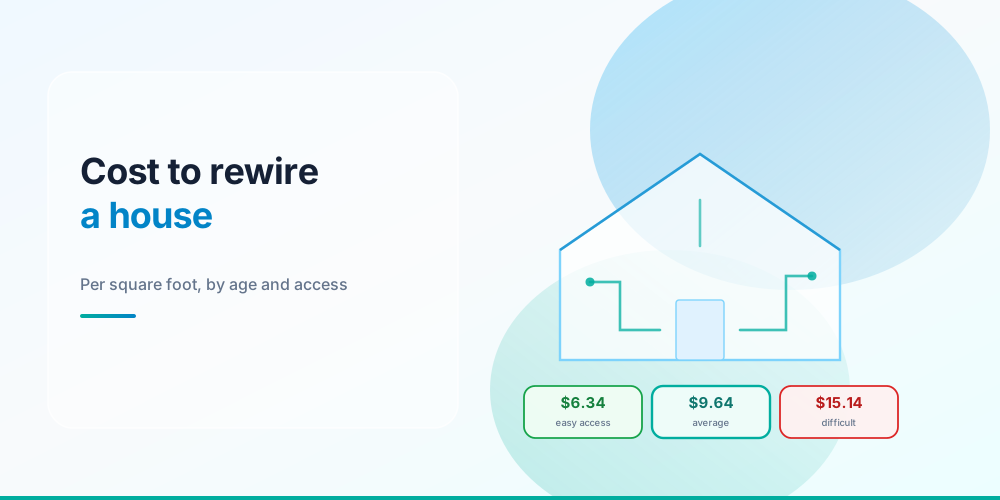
Whole-house rewiring runs about $5 to $17 per square foot in the US. On an 1,800 ft² house that’s anywhere from roughly $9,000 to $30,000 - a range so wide it looks useless until you know what moves it.
The answer is mostly not the wiring. It’s how hard it is to get to.
Access is the biggest variable
| Access | Base rate | 1,800 ft² total | All-in per ft² |
|---|---|---|---|
| Easy - open walls, full basement, accessible attic | $4/ft² | $11,420 | $6.34 |
| Average - some fishing, partial access | $7/ft² | $17,360 | $9.64 |
| Difficult - plaster and lath, no attic or crawlspace | $12/ft² | $27,260 | $15.14 |
A three-fold spread in the base rate, from the same square footage. Rewiring is a labour job, and labour is entirely about whether the electrician can get a cable from A to B without opening a wall.
That’s also why the single cheapest time to rewire is during a renovation that already has the walls open. If you’re gutting anyway, the marginal cost of rewiring is a fraction of doing it as a standalone job.
A Worked Example
An 1,800 ft² rewire, built up
An 1,800 ft² single-storey house from the 1960s, average wall access, new panel:
- Base: 1,800 ft² × $7/ft² = $12,600
- Midcentury multiplier (×1.1): $13,860
- New panel: +$3,000
- Permit: +$500
- Total: $17,360, or $9.64 per square foot
Allowing for normal quoting variation, expect $13,888 to $20,832 for that scope. Figures are 2026 US market ranges, not a quote.
Note the panel is nearly a fifth of the total. A rewire almost always includes one - there’s little sense running new circuits back to a panel that can’t accept AFCI breakers.
What Age Actually Adds
What the age multiplier pays for
Post-1990s (×1.0). NM-B with an equipment grounding conductor throughout. A rewire here is usually about capacity, damage, or a renovation - not safety.
1950s–1970s (×1.1). Cloth-sheathed NM or early plastics, frequently ungrounded two-wire. The insulation goes brittle with age and sheds when disturbed, so you can’t reuse much and you damage what you touch.
Pre-1950s (×1.25). Knob-and-tube. Ungrounded, no cable sheath, individual conductors run through porcelain tubes with air as part of the insulation system - which is why it must not be buried in insulation, and why insulating an old attic often forces the rewire. Removing it adds real labour beyond installing the new circuits.
Two storeys adds roughly 15% on top, because vertical runs between floors are the hardest fishing on any job.
Aluminum branch wiring is a different problem
Small-gauge solid aluminum branch-circuit wiring, common from roughly the mid-1960s to mid-1970s, is a genuine fire risk at its terminations - the connections loosen through thermal cycling and oxidise.
Worth being clear about two things. First, a panel upgrade does not fix it, and it’s sometimes mis-sold as if it does - the hazard is in every box in the house. Second, rewiring genuinely is one of the fixes, alongside proper remediation at each termination using COPALUM crimps or listed connectors like AlumiConn. Which is cheaper depends entirely on access, which brings you back to the table above.
When Not to Rewire the Whole House
A full rewire is often the wrong answer. Cheaper, targeted options:
- Partial rewire. Do the kitchen, bathrooms and any ungrounded circuits serving modern electronics. Leaves lighting circuits that are working alone.
- Add circuits rather than replace them. If the complaint is “not enough outlets” or “the breaker trips,” new dedicated circuits solve it for a fraction of the cost.
- GFCI protection on ungrounded circuits. 406.4(D)(2) permits replacing a non-grounding receptacle with a GFCI, marked “GFCI Protected” and “No Equipment Ground.” That’s a legitimate, code-compliant fix - a GFCI doesn’t need a ground to work, as explained in GFCI vs AFCI.
- Panel-only upgrade. If the wiring is sound and the panel is the problem, see Electrical Panel Upgrade Cost.
Where a full rewire genuinely is warranted: knob-and-tube throughout, aluminum branch wiring with access that makes remediation impractical, cloth insulation that’s actively crumbling, a house being gutted anyway, or documented overheating and damage.
What Else to Budget For
- Drywall and plaster repair - frequently quoted separately, and on a difficult-access job it can be a large number. Ask explicitly.
- Painting after the patching.
- Permit and multi-stage inspection - rough-in and final, so the schedule has two gates in it.
- Somewhere to live. A whole-house rewire in an occupied house is disruptive; some homeowners move out for part of it.
- Bringing everything to current code. New circuits mean current AFCI and GFCI requirements, receptacle spacing under 210.52, and the required dedicated circuits - the kitchen small-appliance, laundry and bathroom circuits covered in 15 Amp vs 20 Amp Circuit.
Price the Job
Rewiring Cost Calculator - set area, access, construction age, storeys, panel and permit; get the total, the per-square-foot figure and a quoting band.
The Rewiring Cost Calculator produced every figure above. If the panel is the real issue rather than the wiring, the Panel Upgrade Cost Calculator prices that instead - and Do I Need a Panel Upgrade helps you tell which problem you have. Contractors pricing rewires should see How to Estimate Electrical Jobs and Electrician Hourly Rate.
Cost figures are 2026 US market ranges and vary substantially by region, access and site conditions - planning aids, not quotes. Code references: NEC (NFPA 70) 2023 - 210.8, 210.12, 210.52, 406.4(D)(2), 394.12 (concealed knob-and-tube limitations). Local amendments override the model code, and the AHJ has final say.
FAQ
How much does it cost to rewire a house?
About $5 to $17 per square foot in the US, so roughly $9,000 to $30,000 on an 1,800 ft² house. A typical midcentury house with average wall access lands near $9.64 per square foot, or about $17,360 including a new panel and permit. Wall access is the single biggest variable.
How much to rewire a 1,500 square foot house?
At the average $7/ft² base rate with a midcentury multiplier, the wiring portion is about $11,550, plus roughly $3,000 for a panel and $500 for permits - around $15,000. Easy access could bring it near $10,000; plaster walls with no attic access could push it past $23,000.
Does rewiring include a new panel?
Usually, and it should. There’s little point running new circuits back to a panel that can’t accept AFCI breakers or has no spare capacity. Budget around $3,000 for the panel within a rewire - it’s close to a fifth of a typical total.
Is knob-and-tube wiring dangerous?
It’s ungrounded and has no cable sheath, and it relies on air circulation as part of its insulation system - which is why burying it in attic insulation is not permitted and is a real hazard. Undisturbed and correctly loaded it can be intact, but insurers frequently decline to cover it and any renovation tends to force replacement.
Can I rewire a house one room at a time?
Yes, and it’s often the sensible approach. Prioritise the kitchen, bathrooms, and any ungrounded circuits serving modern electronics. The trade-off is that you pay mobilisation and patching costs more than once, so it’s more expensive in total than doing it all at once - but far easier to fund.
Does a panel upgrade fix aluminum wiring?
No. Small-gauge aluminum branch wiring is hazardous at its terminations throughout the house, and replacing the panel does nothing about the connections in every box. The remedies are proper repairs at each termination with COPALUM crimps or listed connectors, or a rewire. Be cautious if a panel upgrade is presented as the solution.