
Electrician Hourly Rate: Apprentice, Journeyman, Master
- 04 Aug, 2026
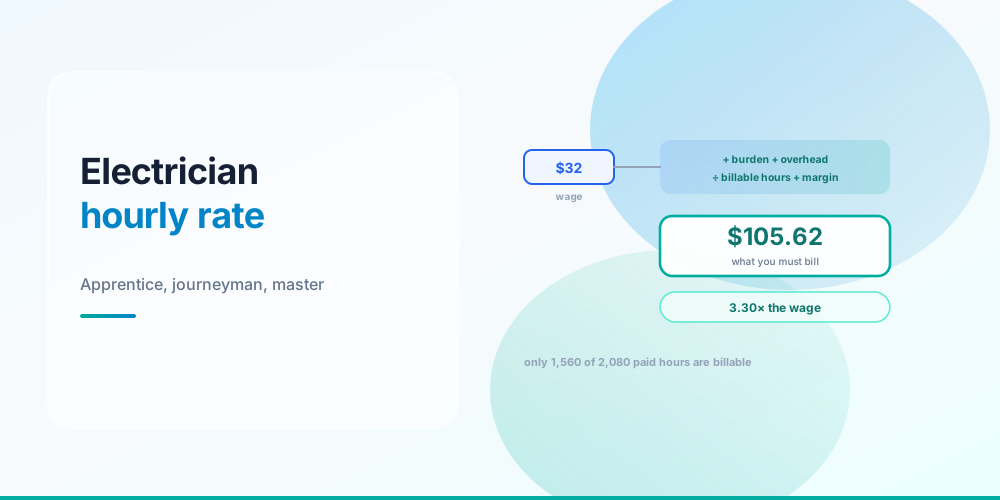
US electricians are typically billed out between $50 and $130 an hour. If you’re a homeowner, that looks like a lot next to what an electrician actually earns. If you’re a contractor, the interesting question is which end of that band you need to be at - and the answer is arithmetic, not confidence.
Both questions have the same answer, so this article works it out once. Short version: a $32/hr wage requires a billing rate around $105/hr, and the gap is not profit.
Where the Rate Comes From
From wage to billing rate
Take a journeyman on $32/hr:
- Annual wage: $32 × 2,080 h = $66,560
- Payroll burden at 35%: +$23,296 → $89,856. This is payroll tax, workers’ comp, liability insurance, holiday and sick pay, and any benefits. 30–40% is normal; workers’ comp for electrical work is not cheap.
- Overhead: +$9,000 → $98,856. Truck, fuel, tools, licensing, software, phone, accounting - and the estimating time on jobs you don’t win.
- Divide by billable hours only: just 1,560 of those 2,080 paid hours are billable at 75% utilisation → $63.37 per billable hour. That’s the break-even. Bill at $63.37 and the business makes exactly nothing.
- Apply a 40% margin: $63.37 ÷ 0.60 = $105.62/hr
That’s a 3.30× multiplier on the wage. Which is why “the electrician only earns $32, why am I paying $105?” has a real answer: the other $73 is employment cost, business cost, unbillable hours, and the margin that keeps the company solvent.
Note the margin is applied by dividing by 0.60, not multiplying by 1.40. Multiplying gives markup, not margin, and it’s a different (smaller) number - the trap is worked through in How to Estimate Electrical Jobs.
The Licence Tiers
Tier, wage, and the rate it supports
Apprentice. Works under supervision, in a registered programme that pairs paid work with classroom hours. Apprentices are typically paid a stepped percentage of journeyman scale - starting around 40–50% and rising each period until they top out at journeyman rate. So the apprentice wage isn’t an independent number; it’s a fraction of the journeyman number in that market.
Journeyman. Licensed to work unsupervised. This is the reference wage every other tier is set against, and the tier most residential service work is performed by.
Master. Pulls permits, signs off work, and supervises others. In most states the master licence is what a contracting business is legally built on, so the premium reflects liability as much as skill.
Running the same maths across those tiers:
| Wage | Required billing rate |
|---|---|
| $22/hr | $75.62 |
| $32/hr | $105.62 |
| $42/hr | $135.62 |
Each $10 of wage adds about $30 to the required rate - the burden, overhead recovery and margin all scale with it. Note the top row lands slightly above the $50–$130 market band, which is a real tension: a master-level wage on a small shop’s overhead is genuinely hard to bill at market rates. That’s usually solved by the master supervising several journeymen rather than turning wrenches.
The Lever Nobody Pulls
Here’s the part that’s actually useful if you run a shop. Of all the inputs above, the one with the most leverage isn’t the wage, the burden, or even the margin. It’s billable utilisation.
Billable hours move the rate more than anything else
| Billable | Billable hours | Required rate |
|---|---|---|
| 60% | 1,248 | $132.02 |
| 70% | 1,456 | $113.16 |
| 75% | 1,560 | $105.62 |
| 85% | 1,768 | $93.19 |
| 90% | 1,872 | $88.01 |
A $44/hr swing on an identical wage. A shop at 60% utilisation has to charge $132 to break even where a shop at 90% charges $88 - and in a competitive market, the second shop wins work the first one can’t touch, while earning the same margin.
Which reframes the whole problem. If your rates feel uncompetitive, the fix is often not cutting margin. It’s the drive time, the unpaid estimating, the return trips for parts, the half-days lost to scheduling gaps. Every unbillable hour is recovered from the billable ones, and there’s no way around that arithmetic.
What Homeowners Are Actually Quoted
Rates in the wild usually aren’t a bare hourly figure:
- Service call / trip fee - typically covers the first hour or a diagnostic window. This exists because mobilisation is real cost that a pure hourly rate can’t recover on short jobs.
- Flat rate by task - common for service work. The homeowner gets a known price; the contractor absorbs the variance. Often works out higher per hour on quick jobs and lower on difficult ones.
- Time and materials - hourly plus parts, usually with a materials markup. Normal on unpredictable work.
- After-hours and emergency - 1.5× to 2× is standard, reflecting overtime wage and the disruption.
Getting three quotes is worth doing, but comparing bare hourly rates between them is close to meaningless - one contractor’s $95/hr with a $150 trip fee and 20% materials markup can easily beat another’s $75/hr. Compare the total for the job.
Common Mistakes
- Billing at twice the wage. A common rule of thumb, and it loses money at normal utilisation. 3× is closer.
- Forgetting unbillable hours. The single biggest error. 2,080 paid hours are not 2,080 billable hours.
- Leaving overhead out of the rate. Then it comes out of margin, invisibly.
- Multiplying by 1.40 for a 40% margin. That’s markup and gives you 29%.
- Ignoring burden on a “cheap” hire. A $28/hr helper costs about $37.80 loaded before any overhead.
- Cutting the rate to win work. Raising utilisation achieves the same competitiveness without giving up margin.
- Comparing quotes on hourly rate alone. Trip fees, minimums and materials markup change the total more than the rate does.
Work Out Your Rate
Labor Rate Calculator - enter wage, paid hours, burden, billable percentage, annual overhead and target margin; get your loaded cost, required billing rate and the multiplier.
The Labor Rate Calculator produced every figure in this article - put your own numbers in and it will tell you what you have to bill. Then price jobs with it using the Estimate Calculator, and see How to Estimate Electrical Jobs for the full method. For the two jobs most often quoted, Electrical Panel Upgrade Cost and Cost to Rewire a House.
Wage figures are illustrative points used to make the arithmetic concrete, not survey data; the billing rates are computed from them. The $50–$130/hr band reflects 2026 US market reporting and varies substantially by region, licence tier and work type - planning aids, not quotes.
FAQ
How much does an electrician charge per hour?
Typically $50 to $130 an hour in the US, depending on region, licence tier and work type. That figure is a billing rate, not a wage - a journeyman earning $32/hr has to be billed near $105/hr once payroll burden, overhead, unbillable hours and margin are covered.
Why do electricians charge so much more than they earn?
Because the billing rate covers far more than the wage. On a $32/hr wage: payroll burden adds about 35%, annual overhead adds several thousand more, and only about 75% of paid hours are billable - so all of that cost is recovered across 1,560 hours rather than 2,080. Break-even lands near $63/hr before any profit at all.
What multiplier should I use on wage to get my billing rate?
Around 3×, not 2×. At a 35% burden, 75% billable utilisation and a 40% margin, a $32 wage supports $105.62 - a 3.30× multiplier. Billing at twice the wage loses money at normal utilisation. Your own multiplier depends mostly on your billable percentage.
How much does an apprentice electrician make?
Apprentices are normally paid a stepped percentage of journeyman scale in their market - commonly starting around 40–50% and rising each period until reaching journeyman rate. So the figure depends entirely on the local journeyman wage rather than being an independent number.
What is a good billable percentage for an electrical business?
75% is a reasonable working assumption and 85–90% is strong. It matters more than most owners realise: at 60% billable you need $132/hr to earn the same margin a 90%-billable shop earns at $88/hr. Cutting drive time, return trips and unpaid estimating is usually more effective than raising prices.
Should I charge flat rate or hourly?
Flat rate gives the customer certainty and rewards you for efficiency, but you absorb the variance - it works best on repeatable service tasks you have good time data for. Time and materials suits unpredictable work like troubleshooting or retrofit. Many shops use flat rate for service and T&M for anything opened up in a wall.