
Wire Size Chart: Amps to AWG for Copper and Aluminum
- 03 Aug, 2026
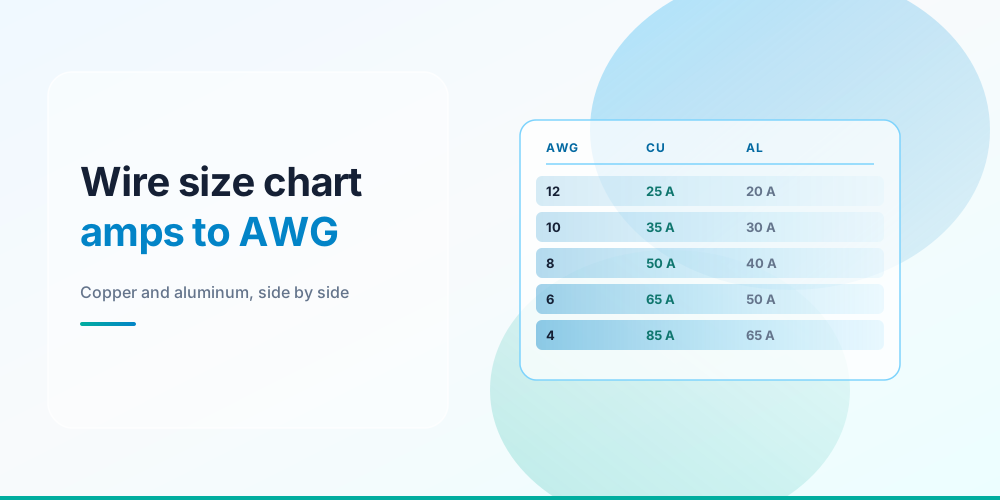
This is the chart everyone looks up, reproduced in full below. But a wire size chart is only as good as your understanding of which of its three columns applies to the job in front of you - pick the wrong one and you’ll get a confidently wrong answer from correct data.
So: the table first, then the four things that change what you’re allowed to do with it.
NEC Table 310.16 - Allowable Ampacity
Ampacities for insulated conductors rated up to 2,000 V, not more than three current-carrying conductors in a raceway, cable, or direct-buried, at an ambient of 30 °C (86 °F).
| Size | Cu 60 °C | Cu 75 °C | Cu 90 °C | Al 60 °C | Al 75 °C | Al 90 °C |
|---|---|---|---|---|---|---|
| 14 AWG | 15 | 20 | 25 | - | - | - |
| 12 AWG | 20 | 25 | 30 | 15 | 20 | 25 |
| 10 AWG | 30 | 35 | 40 | 25 | 30 | 35 |
| 8 AWG | 40 | 50 | 55 | 35 | 40 | 45 |
| 6 AWG | 55 | 65 | 75 | 40 | 50 | 55 |
| 4 AWG | 70 | 85 | 95 | 55 | 65 | 75 |
| 3 AWG | 85 | 100 | 115 | 65 | 75 | 85 |
| 2 AWG | 95 | 115 | 130 | 75 | 90 | 100 |
| 1 AWG | 110 | 130 | 145 | 85 | 100 | 115 |
| 1/0 | 125 | 150 | 170 | 100 | 120 | 135 |
| 2/0 | 145 | 175 | 195 | 115 | 135 | 150 |
| 3/0 | 165 | 200 | 225 | 130 | 155 | 175 |
| 4/0 | 195 | 230 | 260 | 150 | 180 | 205 |
| 250 kcmil | 215 | 255 | 290 | 170 | 205 | 230 |
| 300 kcmil | 240 | 285 | 320 | 195 | 230 | 260 |
| 350 kcmil | 260 | 310 | 350 | 210 | 250 | 280 |
| 400 kcmil | 280 | 335 | 380 | 225 | 270 | 305 |
| 500 kcmil | 320 | 380 | 430 | 260 | 310 | 350 |
| 600 kcmil | 350 | 420 | 475 | 285 | 340 | 385 |
Ampacity at 75 °C, copper vs aluminum
Which Column Applies
Picking the right temperature column
The 75 °C column is the working answer for most installations. Under 110.14(C), a circuit is limited by the lowest temperature rating among its terminations, and breakers, lugs, and receptacles in ordinary residential and light commercial gear are rated 75 °C. Your THHN may be 90 °C wire, but it lands on 75 °C hardware, so 75 °C is what you may use.
Use the 60 °C column for NM-B cable. This one catches people out. 334.80 requires NM-B ampacity to be taken from the 60 °C column, even though the conductors inside are 90 °C rated. That’s why 12/2 Romex is a 20-amp cable and 10/2 is a 30-amp cable, full stop.
You never finish on the 90 °C column - but don’t dismiss it, because derating starts there. When you apply ambient correction or bundling adjustment, you apply it to the 90 °C base and then check the result against the 75 °C termination limit. Starting from 90 °C is often what saves a size on a hot roof or in a crowded raceway. The Ampacity Calculator does exactly this sequence.
The Breaker Caps That Override the Table
Small conductors carry a separate restriction. 240.4(D) limits overcurrent protection to 15 A for 14 AWG copper, 20 A for 12 AWG copper, and 30 A for 10 AWG copper - 15 A and 25 A for 12 and 10 AWG aluminum - regardless of the table figures.
Where the chart and the breaker disagree
This is why 12 AWG copper reads 25 A in the chart yet always sits on a 20-amp breaker in the field, and it’s the single most-asked question about this table - unpacked properly in 12 Gauge Wire Amps.
Three Things That Shrink These Numbers
The table figures assume three current-carrying conductors, 30 °C ambient, and no length penalty. Break any of those assumptions and the usable figure drops.
Ambient temperature. Above 30 °C you multiply by a correction factor from 310.15(B)(1). An attic at 45 °C costs a 90 °C conductor 13% of its rating; at 55 °C it’s down 24%.
More than three current-carrying conductors. 310.15(C)(1) applies an adjustment factor: 80% for 4–6 conductors, 70% for 7–9, 50% for 10–20. Neutrals count when they carry current; equipment grounds never do.
Length. The table says nothing about distance. A conductor that passes ampacity can still lose too much voltage over a long run - the second half of sizing, covered in Voltage Drop and What Size Wire Do I Need.
The Dwelling Service Exception
One place the chart legitimately doesn’t apply: Table 310.12 permits conductors for a dwelling service, or for the single feeder carrying the entire load of a one-family dwelling, to be sized at 83% of the rating. A 200-amp service takes 2/0 copper under 310.12 where 310.16 would demand 3/0.
The scope is narrow - it is not a general permission to shrink feeders. Details in 200 Amp Service Wire Size, and the subpanel case where it does not apply in What Size Wire for a 100 Amp Sub Panel.
Look It Up Automatically
Wire Size Calculator - reads this table for you, applies the 240.4(D) caps, and checks voltage drop for your run length.
The Wire Size Calculator and the Ampacity Calculator both read from this same table, so the numbers you see there match the numbers above. Use the ampacity tool when you know the conductor and want its derated rating; use the wire-size tool when you know the load and want the conductor.
For the table on its own - all six columns plus circular mils, and every other lookup table alongside it - see the NEC Tables Reference. The formulas that use it are collected on the Electrical Formula Reference.
Sources & standards: NEC (NFPA 70) 2023 - Table 310.16, Table 310.12, 110.14(C), 240.4(D), 310.15(B)(1), 310.15(C)(1), 334.80. Local amendments override the model code, and the AHJ has final say.
FAQ
How many amps can 12 gauge wire carry?
Table 310.16 lists 12 AWG copper at 20 A in the 60 °C column, 25 A at 75 °C, and 30 A at 90 °C. But 240.4(D) caps the breaker at 20 A, so in practice 12 AWG copper is a 20-amp conductor. In aluminum, 12 AWG is capped at 15 A.
Which temperature column should I use?
75 °C for most installations, because that’s the rating of ordinary breakers and lugs and 110.14(C) limits you to the lowest-rated termination. Use 60 °C for NM-B cable, as 334.80 requires. The 90 °C column is only a starting point for derating, never a final answer.
Is this chart the same for THHN and Romex?
The conductors are both 90 °C rated, but the cable assembly changes what you may use. THHN in a raceway lands on 75 °C terminations, so you read the 75 °C column. NM-B is restricted to the 60 °C column by 334.80 regardless of the wire inside it, so 12 AWG Romex is a 20-amp cable rather than 25.
Why is aluminum wire rated lower than copper?
Aluminum has roughly 61% of copper’s conductivity, so the same cross-section carries less current before reaching the same temperature. That works out to about 20% less ampacity at any given size, which is why aluminum runs one to two trade sizes larger for the same load.
Do these numbers change if I have more than three wires in a conduit?
Yes. Table 310.16 assumes at most three current-carrying conductors. Beyond that, 310.15(C)(1) applies an adjustment: 80% for 4–6 conductors, 70% for 7–9, and 50% for 10–20. Equipment grounding conductors don’t count toward the total.
What size wire do I need for 100 amps?
3 AWG copper or 1 AWG aluminum by Table 310.16 at 75 °C. If it’s a dwelling service or the single feeder carrying an entire house, Table 310.12 allows 4 AWG copper or 2 AWG aluminum instead - but that allowance doesn’t extend to an ordinary subpanel.