
100 Amp vs 200 Amp Service: Which Does Your Home Actually Need?
- 03 Aug, 2026
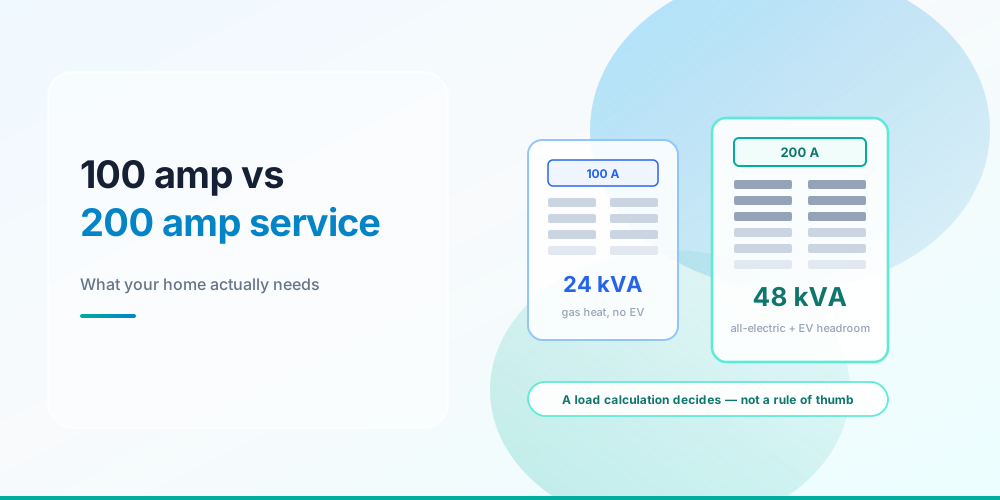
The honest answer is that neither square footage nor the age of your house decides this. A load calculation does - and the useful thing is that it’s arithmetic you can follow in about five minutes.
Short version: a 100-amp service gives you roughly 24 kVA, a 200-amp service about 48 kVA, and the moment a house has an electric range, an electric water heater, and either a heat pump or an EV charger, 100 amps stops being enough.
Both figures are the rating multiplied by 240 V, because a dwelling service is a single centre-tapped winding giving 120 V to neutral and 240 V across the two legs - the arrangement explained in Split-Phase 120/240 V.
What each service gives you
Run the Calculation
Most residential work uses the 220.82 optional method, which is considerably simpler than the standard method and gives a slightly more generous result. Four steps:
- General load - 3 VA per square foot of living area, plus 1,500 VA for each of the two required small-appliance circuits, plus 1,500 VA for the laundry circuit, plus the nameplate VA of every fastened-in-place appliance
- Apply the demand factors (220.82(B)) - the first 10,000 VA at 100%, everything above that at 40%
- Add heating or cooling (220.82(C)) - the largest of the options at its stated percentage; A/C or a heat pump at 100%, central electric heat at 65%
- Divide by 240 to get amps
Here it is on a 2,000 ft² house with an electric range, dryer, water heater, and dishwasher:
The 220.82 method, worked
That house lands on 101.2 amps. Which is a genuinely awkward number, because it means a 100-amp service is not legal for it - you’d be over by a hair - and the next standard rating is 125 A.
Notice how much work the demand factors do. The connected load is 33,200 VA, but only 24,280 VA is calculated, because the code accepts that you will never run the range, dryer, water heater, and dishwasher flat out simultaneously. That’s why a house that feels like it needs 200 amps often calculates to half that.
What Pushes You Over
The loads that decide it
Add a 48-amp EV charger to the house above and the answer moves decisively:
- Treated conservatively at 100% - 24,280 + 11,520 = 35,800 VA = 149 A
- Given the 40% remainder treatment - 120 A
Worth knowing that the treatment of EV charging load is genuinely contested. 220.57 requires EVSE to be calculated at 7,200 VA or nameplate, whichever is larger, and whether that figure then gets the 220.82(B) 40% discount is something AHJs interpret differently. It doesn’t matter much here - both readings land well past 100 amps, so the conclusion holds either way. When you’re near a boundary, ask your inspector and use the conservative number.
The loads that most often force the decision:
- EV charging - the biggest single driver of upgrades today, and continuous by rule (625.41)
- Heat pump or electric furnace - resistance heat especially, which can be 15–20 kW
- Electric range - 12 kVA on its own
- Hot tub - 40–50 amps, frequently the load that tips a marginal panel
- Electric water heater, particularly tankless, which can pull 100+ amps on its own and is a common reason a 200-amp service still isn’t enough
- Workshop equipment - welders, compressors, dust collection
When 100 Amps Is Genuinely Fine
Don’t upgrade reflexively. 100 amps remains a perfectly legal, perfectly adequate service for:
- A house with gas heat, gas range, and gas water heater - the appliance load is tiny
- Smaller homes, condos, and townhouses
- Houses with no EV and no plans for one
A 100-amp service that calculates comfortably under its rating is not a problem to be fixed. Plenty are upsold an upgrade they don’t need.
The Method That Can Save You an Upgrade
If you’re adding load to an existing house, you have two better options than recalculating from scratch.
220.83 is the optional method for additional loads in an existing dwelling - it lets you work from the existing plus new load with demand factors, and it’s usually kinder than 220.82 for a retrofit.
220.87 is the one people don’t know about, and it’s the strongest card in the deck. It lets you determine the existing load from actual metered data: take the maximum demand recorded over the previous 12 months and multiply by 125%. Where a year of data isn’t available, 30 days of recorded demand data can be used instead.
Why this matters: real houses use far less than they calculate. A house that computes to 140 amps on paper may show a 12-month peak of 45 amps. Add 125% and you’re at 56 amps - leaving nearly 45 amps of headroom on a 100-amp service, which is plenty for an EV charger. Most utilities will provide interval data on request, and an inspector who accepts a 220.87 calculation has just saved the homeowner several thousand dollars.
This is the first thing to check before quoting a panel upgrade, not the last.
Panel Spaces Are Not Service Capacity
These get conflated constantly. Service capacity is how much current the conductors and main breaker can carry. Panel spaces are how many breakers physically fit.
They’re independent. A full 100-amp panel may have plenty of unused capacity - you might just need a subpanel or tandem breakers, not a service upgrade. Equally, a 200-amp panel with twelve empty spaces can be at its calculated limit.
If the complaint is “no room for another breaker,” the fix may be a subpanel - see What Size Wire for a 100 Amp Sub Panel. If the complaint is “the calculation exceeds the service,” that’s an upgrade.
What an Upgrade Involves
A 100-to-200-amp upgrade is not just a bigger panel. It typically means new service-entrance conductors (2/0 copper or 4/0 aluminum - see 200 Amp Service Wire Size), a new meter socket, a new panel, grounding electrode work to current code, a permit, an inspection, and a utility disconnect and reconnect. Bringing existing circuits up to current AFCI and GFCI requirements often gets swept in too.
If you’re going to the trouble, consider whether 200 A is enough or whether a 320/400-amp service makes sense - for a large all-electric house with two EVs, it may.
Common Mistakes
- Sizing by square footage. 3 VA/ft² is one line of the calculation, not the answer.
- Adding up nameplate ratings. Without the 220.82 demand factors you’ll overshoot badly.
- Confusing full panel spaces with a maxed-out service. Different problems, different fixes.
- Skipping 220.87. Metered data frequently proves no upgrade is needed.
- Forgetting the EV charger is continuous. 625.41 means 125%.
- Assuming 200 A covers anything. Tankless electric water heaters and dual EVs can exceed it.
- Upgrading the panel but not the service conductors. A 200-amp panel fed by 100-amp conductors is still a 100-amp service.
Size the Service
Load Calculator - runs the 220.82 optional method and returns calculated VA, amps, and the minimum standard service.
The Load Calculator is the tool that answers this question properly - it’s the source of the worked example above. The Service Size Calculator takes it further into which standard rating to install, and the Service & Feeder Wire Size Calculator sizes the conductors once you’ve decided. If an upgrade is on the cards, the Panel Upgrade Cost Calculator prices it, and the EV Charger Calculator sizes the circuit that started the whole conversation.
Sources & standards: NEC (NFPA 70) 2023 - 220.12, 220.14, 220.57, 220.82, 220.82(B), 220.82(C), 220.83, 220.87, 230.42, 625.41, Table 310.12. Local amendments override the model code, and the AHJ has final say.
FAQ
Is 100 amp service enough for a house?
It can be. A house with gas heat, a gas range, and gas water heating typically calculates well under 100 amps, and plenty of smaller homes run fine on it. What settles it is a 220.82 load calculation - a 2,000 ft² house with an electric range, dryer, and water heater calculates to about 101 amps, which is already over.
How do I know if I need a 200 amp service?
Run the load calculation. Add the general load at 3 VA/ft², the small-appliance and laundry circuits at 1,500 VA each, and the nameplate VA of your fastened appliances; apply 100% to the first 10,000 VA and 40% to the rest; add the larger of heating or cooling; divide by 240. If the result exceeds 100 amps you need more service - though check 220.87 with metered data first.
Can I add an EV charger to a 100 amp service?
Often yes, and 220.87 is how you prove it. Real houses use far less than they calculate, so if the utility’s 12-month peak demand times 125% leaves enough headroom for the charger, the existing service can stay. Load-management devices that pause charging during peak household use are another route. A full 48-amp charger on a 100-amp service usually does need one of these approaches.
What’s the difference between 100 amp and 200 amp service?
Capacity: about 24 kVA against about 48 kVA at 240 volts. Practically, 200 amps covers an all-electric house - range, dryer, water heater, heat pump - with room for EV charging, while 100 amps suits a house where heating, cooking, and hot water are gas.
Does a full electrical panel mean I need a service upgrade?
No - those are separate problems. A panel with no free spaces may still have unused service capacity, in which case a subpanel or tandem breakers solves it. You need a service upgrade when the calculated load exceeds the service rating, which is a different test entirely.
How much does it cost to upgrade from 100 to 200 amp service?
It varies widely with the meter location, the service conductor run, whether the panel moves, grounding work, and local permit and utility fees. The Panel Upgrade Cost Calculator breaks the line items down for your situation rather than quoting a national average that won’t match your job.