
Panel Is Full: Tandem Breakers, Subpanels, and What's Actually Legal
- 05 Aug, 2026
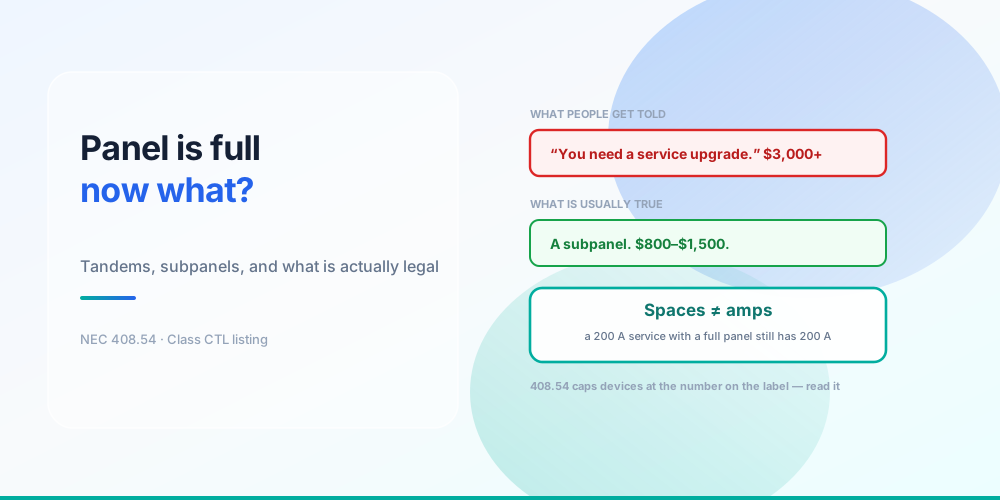
The most expensive sentence in residential electrical work is “your panel is full, so you need a service upgrade.”
It is usually wrong, and the reason is a distinction almost nobody draws clearly: running out of panel spaces and running out of service capacity are completely separate problems. A 200 A service with a full 20-space panel has run out of places to land wires. It has not run out of amps. It still has 200 of them.
The fix for the first problem is a subpanel - $800 to $1,500. The fix for the second is a service upgrade - $3,000 and up. Diagnosing the wrong one is a four-figure error.
Three Numbers, Kept Apart
Three numbers, and they are not the same number
Spaces are physical mounting positions on the busbar.
Poles - usually printed on the label as “circuits” - are overcurrent devices. A single-pole breaker is one of each. A tandem is one space and two poles. A two-pole 240 V breaker is the reverse: two spaces and two poles, protecting one circuit.
The device limit is the number the panel is listed for. This is the one people don’t know exists, and it is the one that binds. NEC 408.54 says a panelboard shall not be supplied with more overcurrent devices than the number for which it was designed, rated and listed.
Note what that section does not do. It does not calculate the limit, derive it, or give you a formula. The number comes from the panel’s listing and is printed on the label inside the door. 408.54 simply makes exceeding it a violation.
So for a 30-space / 40-circuit panel with 24 full-size breakers and 3 tandems fitted:
spaces used   = 24 + 3        = 27 of 30, so 3 free
poles used    = 24 + (3 × 2)  = 30 of 40, so 10 free
ceiling       = min(40 listed, 30 spaces + 10 tandem gain) = 40
available     = 40 − 30       = 10 more poles
A panel can run out of poles with spaces still empty, or out of spaces with poles still available. Check both.
What the Designation Actually Tells You
The gap between the two numbers is the tandem allowance
| Designation | Spaces | Device limit | Tandem slots | Max poles |
|---|---|---|---|---|
| 12-space, 12-circuit | 12 | 12 | none | 12 |
| 20-space, 20-circuit | 20 | 20 | none | 20 |
| 20-space, 30-circuit | 20 | 30 | 10 | 30 |
| 30-space, 40-circuit | 30 | 40 | 10 | 40 |
| 40-space, 40-circuit | 40 | 40 | none | 40 |
| 42-space, 42-circuit | 42 | 42 | none | 42 |
The gap between the two numbers is the tandem allowance. A “20-space, 30-circuit” panel has twenty positions and permits ten of them to carry tandems. A “40-space, 40-circuit” panel accepts no tandems at all, which routinely surprises people who assume a larger panel is more flexible.
Class CTL: Why the Tandem Won’t Fit
CTL stands for circuit total limiting, and it is a UL 67 listing requirement, not an NEC term. The NEC gets there indirectly: 110.3(B) makes listing and labelling instructions enforceable, which carries the tandem restriction into the code.
A CTL panelboard uses physical rejection features - a notch or tab arrangement on the busbar stab - so a tandem breaker will only seat in a position rated to accept one. This exists precisely because 408.54 is otherwise unenforceable by inspection: nobody can tell by looking whether a panel has too many devices, but a rejection feature makes the wrong installation physically difficult.
Which leads to the failure mode. If a tandem is sitting in a slot that should reject it, someone filed the tab off the breaker. That is not a shortcut; it is a defeated safety device, an instant inspection failure, and a busbar carrying more connections than it was designed and tested for.
Tandem, quad, and what they’re not
A tandem - also called twin, duplex, or slimline - puts two independent single-pole breakers in one space, both on the same bus stab.
A quad occupies two spaces and provides two two-pole circuits, with the outer poles handle-tied and the inner pair handle-tied. It is how you fit two 240 V circuits into the footprint of one, and it is a different device with a different listing. A panel accepting one does not automatically accept the other.
Neither is inferior. A tandem is a normally listed overcurrent device tested to the same standards as a full-size breaker. Every real problem attributed to tandems traces back to exceeding the listed device count or forcing one into a rejected slot - the device is not the hazard.
The Fix, in Order of Cost
A full panel is a space problem, not an amps problem
1. Tandems, where the panel is listed for them - $15–$30 each
Read the label. If it shows tandem-capable positions and you are under the device limit, this is the whole answer.
2. Pigtail a double-tap - under $10
Two conductors under one lug is the most-written-up item on home inspections, and it is usually a defect rather than an opportunity. Fixing it frees no space, but it costs almost nothing and it removes a genuine hazard: a single-conductor lug cannot reliably clamp two wires, so one works loose, heats, and eventually arcs.
Some breakers are listed for two conductors - certain Square D models among them - and say so on the breaker itself. Absent that marking, join both conductors to a single tail with an approved connector and land the tail.
3. A subpanel - $800–$1,500
The usual answer. Two spaces in the existing panel feed a two-pole breaker, and the new panel brings back twelve to twenty-four. Net gain of ten to twenty-two positions for a fraction of an upgrade.
Size the feeder properly - that is a genuinely separate calculation, and the widely repeated “4 AWG for a 100 A subpanel” answer is wrong for an ordinary garage or shop subpanel. See Sub Panel Sizing for why.
4. A service upgrade - $3,000 and up
Only when the calculated load genuinely exceeds the service. That is a load question with a load answer, and it deserves evidence before anyone quotes it.
NEC 220.87 is the strongest evidence available: twelve months of the utility’s recorded peak demand at 125% establishes the existing load. Most houses peak far below what people assume - a 100 A service commonly shows a 44 A peak, which becomes 55 A established. The method is worked through in NEC 220.87: Using Utility Data, and the wider question in Do I Need a Panel Upgrade?.
While You’re In There
A few things worth checking whenever a panel is open for this reason.
The circuit directory. 408.4(A) requires a legible directory identifying each circuit’s specific purpose, and “lights” is not a specific purpose. It is free to fix and it is the single most useful thing you can leave behind.
Multi-wire branch circuits. If two circuits share a neutral, 210.4(B) requires a means to disconnect all ungrounded conductors simultaneously - a handle tie or a two-pole breaker. Replacing a two-pole breaker with two tandems on a shared-neutral pair breaks that requirement, and it is an easy mistake to make while chasing spaces.
AFCI and GFCI obligations. Adding circuits brings 210.12 and 210.8 into play for the new work.
Panel brand. If the label says FPE Stab-Lok, Zinsco or Sylvania, the conversation changes. There was never a federal recall of FPE panels - the CPSC investigation closed in the early 1980s without ordering one - but independent testing found high failure-to-trip rates, most inspectors treat them as replace-on-sight, and some insurers decline coverage. Adding breakers to one of these is not the right project.
Common Mistakes
- Treating a full panel as a full service. They are different questions with a four-figure gap between the answers.
- Adding tandems past the listed device limit. 408.54 makes it a violation regardless of whether they fit.
- Filing the rejection tab off a tandem. Defeats a listing safety feature and fails inspection on sight.
- Assuming a bigger panel takes more tandems. A 40/40 panel takes none.
- Double-tapping to free a space. A defect, not a technique, unless the breaker is listed for two conductors.
- Replacing a 2-pole breaker with tandems on a shared neutral. 210.4(B) requires simultaneous disconnect.
- Quoting a service upgrade without a load calculation. 220.87 measured demand usually removes the need.
- Confusing a tandem with a quad. Different devices, different listings.
- Leaving the directory wrong. 408.4(A) requires specific purposes, and it costs nothing.
Check Your Panel
Panel Spaces & Tandem Breaker Calculator - enter the spaces, the listed device limit and the tandem-capable slots from the panel label, plus what is fitted, and it returns how many more poles you can legally add. It flags a panel already over its device limit or carrying more tandems than it is listed for, and separates “no spaces free” from “no poles available”, which are different situations.
If it says the panel is genuinely out of room, size a subpanel feeder with the Service & Feeder Wire Size Calculator - and before anyone quotes an upgrade, run the Existing Load Calculator.
Sources & standards: NEC (NFPA 70) 2023 - 408.54 (a panelboard shall not be supplied with more overcurrent devices than the number for which it was designed, rated and listed), 408.4(A) (circuit directory), 110.3(B) (listing and labelling instructions enforceable), 210.4(B) (simultaneous disconnect for multi-wire branch circuits), 210.8 and 210.12 for GFCI and AFCI on new circuits, and 220.87 for establishing existing load from measured demand. Class CTL is a UL 67 listing requirement rather than an NEC term - the physical rejection features that enforce tandem placement come from the listing standard, and the code reaches them through 110.3(B). The device limit and which positions accept a tandem are specific to each panel and must be read from its label or catalogue number. Panel replacement costs are 2026 US market planning figures. Local amendments override the model code and the AHJ has final say. Have panel work performed by a licensed electrician under permit.
FAQ
My panel is full - can I just add tandem breakers?
Only if the panel is listed for them and only in the positions that accept them. NEC 408.54 forbids installing more overcurrent devices than the number the panel was designed, rated and listed for, and that figure is printed on the label inside the door. A “30-space, 40-circuit” panel has thirty spaces and a forty-device limit, so ten positions accept tandems. Once you reach forty poles it is full, however many spaces look empty.
What is a Class CTL panelboard?
CTL means circuit total limiting, and it is a UL 67 listing requirement rather than an NEC term. A CTL panelboard uses physical rejection features on the busbar stabs so a tandem breaker will only seat in a position rated for one. It exists because 408.54 is otherwise unenforceable by inspection. A tandem sitting where it should be rejected means the rejection tab was filed off, which is a defeated safety feature.
Does a full panel mean I need a service upgrade?
Almost never. Panel spaces and service capacity are separate questions - a 200 A service with a full panel has run out of places to land wires, not out of amps. The usual fix is a subpanel at $800 to $1,500, fed from a two-pole breaker, which trades two spaces for twelve to twenty-four. Only a load calculation showing the calculated load exceeds the service justifies an upgrade, and NEC 220.87 measured demand usually shows the opposite.
What is the difference between spaces, circuits, and poles?
Spaces are physical mounting positions on the busbar. Poles - normally printed as “circuits” - are overcurrent devices. A single-pole breaker is one space and one pole. A tandem is one space and two poles. A two-pole 240 V breaker is two spaces and two poles protecting one circuit. That is why a panel label carries two different numbers, and why a panel can run out of one while the other still has room.
Is a tandem breaker the same as a quad breaker?
No. A tandem puts two independent single-pole breakers in one space on the same bus stab. A quad occupies two spaces and provides two two-pole circuits, with the outer poles handle-tied and the inner pair handle-tied - it is how two 240 V circuits fit into the footprint of one. They are different devices with different listings, and a panel accepting one does not automatically accept the other.
Can I put two wires under one breaker to free up a space?
Not unless the breaker is listed for two conductors, and most are not. Double-tapping is among the most commonly written-up home inspection defects, because a single-conductor lug cannot reliably clamp two wires - one works loose, heats, and eventually arcs. Some breakers, including certain Square D models, are listed for two conductors and say so. Otherwise, pigtail both conductors to a single tail with an approved connector.
How do I know how many tandems my panel accepts?
Read the label inside the door. It gives the manufacturer’s catalogue number, the maximum number of overcurrent devices, and usually a diagram of which positions are tandem-capable - often only part of the bus. If the label is gone, the catalogue number will resolve it from manufacturer literature. Do not infer it from whether a tandem physically fits, because on a CTL panel that test is exactly what the rejection feature answers.
Are tandem breakers safe?
Yes, installed where the panel is listed for them. A tandem is a normally listed overcurrent device tested to the same standards as a full-size one, and there is nothing inferior about it. Every real problem attributed to tandems traces back to exceeding the panel’s listed device count or forcing one into a rejected position - both of which put more connections on a busbar than it was designed and tested to carry. The device is not the hazard.