
Standby Generator Installation Cost: Unit, ATS, Gas, Pad, Permit
- 05 Aug, 2026
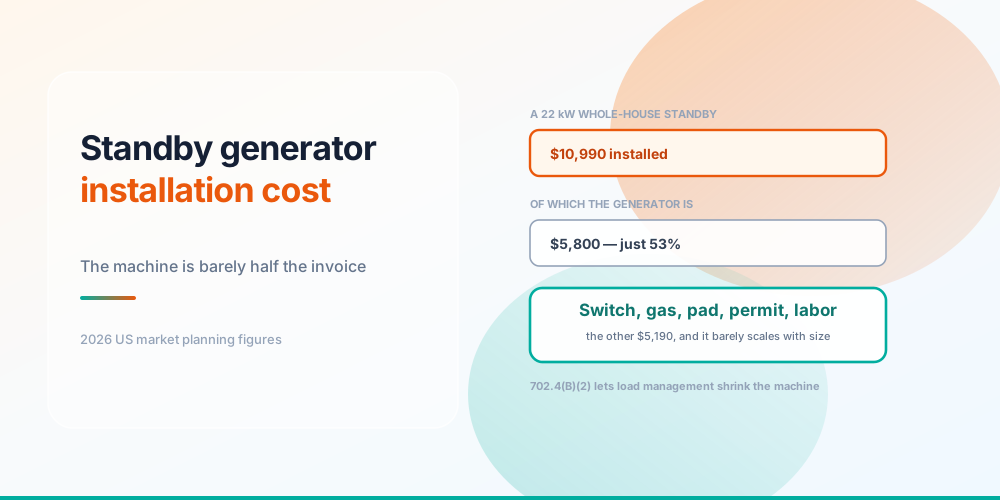
A 22 kW whole-house standby generator costs around $10,990 installed. The generator itself is $5,800 of that - 53%.
That ratio is the thing worth internalising, because it explains why two quotes for the same machine can differ by $4,000 and why comparing bids on the model number tells you nothing. A standby generator is not a product purchase with some labour attached. It is an electrical job, a gas job and a concrete job that happen to include a machine.
The Six Lines
A 22 kW whole-house standby: $10,990
| Line | Basis | Cost |
|---|---|---|
| Generator set | 22 kW air-cooled | $5,800 |
| Transfer switch | 200 A service-rated | $1,600 |
| Labor | 16 h × $95 | $1,520 |
| Gas run | 40 ft × $28/ft | $1,120 |
| Pad | precast composite | $600 |
| Permits | electrical + gas | $350 |
| Total | $10,990 |
At a ±15% quoting band that is $9,342 to $12,638, which is about right for a straightforward suburban job with the gas meter on the same side of the house as the panel.
Two lines deserve a closer look, because they are where quotes diverge most.
The transfer switch ranges from $700 to $3,200 - a wider spread, proportionally, than the generators themselves. The gas run is plumbing, priced per foot, and it is entirely a function of where the set can legally sit. Discovering at install that clearance rules push the generator forty feet further from the meter is a $1,100 surprise.
Small Generators Are Poor Value
Fixed costs do not scale down with the machine
Hold the installation constant and change only the machine:
| Size | Set | Installation | Total | Install share | Cost per kW |
|---|---|---|---|---|---|
| 10 kW | $3,200 | $5,190 | $8,390 | 62% | $839 |
| 14 kW | $4,200 | $5,190 | $9,390 | 55% | $671 |
| 18 kW | $5,000 | $5,190 | $10,190 | 51% | $566 |
| 22 kW | $5,800 | $5,190 | $10,990 | 47% | $500 |
| 26 kW | $7,400 | $5,190 | $12,590 | 41% | $484 |
| 36 kW | $11,500 | $5,190 | $16,690 | 31% | $464 |
| 48 kW | $15,000 | $5,190 | $20,190 | 26% | $421 |
Halving the generator does not halve the job. Going from 22 kW to 10 kW saves $2,600 on the machine and nothing at all on the gas run, the pad, the permit or the day on site. Cost per kilowatt doubles at the small end: $839/kW at 10 kW against $421/kW at 48 kW.
The practical consequence is that 10 kW standby units rarely make sense. If the budget only reaches that far, a quality portable generator with a listed interlock does more for less - see below. If a permanent standby is the goal, the 18–22 kW range is where the fixed costs stop dominating.
There is one genuine cliff in the table. Between 26 kW and 36 kW the machine changes from air-cooled to liquid-cooled - a different class of equipment, not a bigger version of the same one. That step costs $4,100 for 10 kW, and it is worth serious effort to stay below it.
The Transfer Switch Decision
The switch decision usually sets the generator size
A service-rated whole-house switch transfers everything and doubles as the service disconnect. It is the default on most quotes and it costs $1,600 at 200 A, $3,200 at 400 A.
An essential-circuits switch backs up eight or ten selected circuits - refrigerator, furnace, sump pump, some lighting and outlets - for $700 to $900. It is not a lesser product; it is a different design decision, and for many households it covers everything that genuinely matters during an outage.
The switch choice matters far beyond its own price tag, because it usually decides the generator size. Committing to whole-house transfer commits you to a machine that can start the air conditioner, and motor starting is what drives standby sizing far more than running load does. A house drawing 9.2 kW running can need a 20 kW set purely for the AC inrush - the arithmetic is worked through in What Size Generator Do I Need.
The option most quotes never mention
NEC 702.4(B)(2) permits a generator with insufficient capacity for the full load, provided automatic load management sheds what it cannot carry. Load-shed modules cost a few hundred dollars and let a smaller machine serve a whole house by simply refusing to run the AC and the range simultaneously.
This is frequently the single largest saving available on a standby job, and it is absent from most quotes because it is easier to sell the bigger machine. A soft starter on the air conditioner does something similar from the other direction, cutting the starting surge enough to drop a generator size for a few hundred dollars.
Natural Gas or Propane
Natural gas wins wherever the street has it.
The pipe run costs about the same either way - $28 per foot against $32 - but propane adds a buried tank at roughly $1,200, plus deliveries, plus a slight derate against the generator’s natural-gas rating. Most importantly, a natural gas supply has no runtime limit, which is precisely what matters in the multi-day outage a standby exists for. A 500-gallon LP tank runs a 22 kW set for two or three days at moderate load, and refills during a regional outage are not guaranteed.
Propane wins only where there is no gas main - which is common enough, and often the same rural properties where outages last longest.
Placement Decides More Than You Expect
Quote the placement before quoting the price. Three separate constraints stack:
- Manufacturer clearances, made enforceable by NEC 110.3(B), require distance from openable windows, doors and combustible walls. These are typically 5 ft from openings and 18 inches from the structure, but read the specific installation manual.
- Local ordinances frequently add property-line setbacks and noise limits, and a standby’s weekly exercise cycle is loud enough for neighbours to have opinions about.
- Gas and electrical routing both run from wherever the set ends up, so placement sets two per-foot lines at once.
A set that has to go around the back of the house instead of beside the meter can add $1,000 to $1,500 in gas and conductor alone.
Permits and What Comes After
Expect two permits and often three: electrical, gas or plumbing, and in many jurisdictions a mechanical or zoning review for placement. Two inspections is normal. The $350 in the example above is a mid-range figure; some jurisdictions are half that and some are triple.
Then there are the costs no install quote shows:
- Annual service at $200 to $500 - oil, filters, plugs, valve clearance.
- Fuel for the weekly self-test, typically 10 to 20 minutes of running.
- Batteries every three to five years.
Over a fifteen-year life, maintenance totals a meaningful fraction of the original purchase. Worth raising with a client before they sign rather than after.
The Portable Alternative
A quality portable generator, an inlet box and a listed panel interlock kit comes to roughly $1,500 to $3,000 installed - a fifth of a standby.
What you give up is real: someone has to be home to start it, refuel it every few hours, and it will not carry a whole house. What you keep is the ability to run a refrigerator, a furnace and some lights through an outage for a fraction of the money.
The safety point is not negotiable. The interlock must be listed for that specific panel. A homemade interlock or, far worse, a double-male “suicide cord” backfeeds the utility line and can kill a lineman working to restore your power. This is the one part of the cheap option where there is no cheap version.
Common Mistakes
- Comparing quotes on the generator model. The machine is about half the job; the other half is where bids differ.
- Choosing the machine before the transfer switch. Whole-house transfer commits you to a bigger set.
- Never mentioning 702.4(B)(2). Load management often saves more than every other line combined.
- Sizing on running load. Motor starting usually governs, and by a wide margin.
- Buying a 10 kW standby. Worst value per kilowatt; a portable with an interlock does more for less.
- Crossing 26 to 36 kW without checking. That is air-cooled to liquid-cooled, a $4,100 step.
- Pricing before confirming placement. Clearances and setbacks set both per-foot lines.
- Forgetting the second and third permit. Gas and mechanical are separate from electrical.
- Omitting maintenance from the conversation. $200–$500 a year, plus batteries, plus test fuel.
- Any interlock that isn’t listed for the panel. Backfeeding the utility can kill someone.
Price the Job
Standby Generator Installation Cost Calculator - pick the generator size, transfer switch, fuel type and run length, pad, permit and labour, and it builds the total line by line with a regional multiplier and a ±15% quoting band. It also shows what share of the total the machine actually represents, which is the number that makes a quote defensible to a client.
Get the size right first with the Generator Sizing Calculator, check whether the existing service has room using the Existing Load Calculator, and price the whole job with the Estimate Calculator. For the pricing method behind that, see How to Estimate Electrical Jobs.
Sources & standards: costs are 2026 US market planning figures, not quotes - equipment pricing, gas piping rates, permit fees and labour rates vary widely by region. Code references: NEC (NFPA 70) 2023 Article 702 for optional standby systems, including 702.4(B)(2), which permits a generator with capacity below the full load where automatic load management is provided, and 702.7 for required signage; Articles 700 and 701 cover emergency and legally required standby systems, which are different systems with stricter rules; 110.3(B) makes the manufacturer’s installation instructions - including placement clearances - enforceable. Transfer equipment must be listed for the application, and a service-rated switch is required where it serves as the service disconnect. Gas piping is governed by the fuel gas code adopted locally, not the NEC, and usually requires separate licensing. Local amendments and the AHJ have final say.
FAQ
How much does it cost to install a standby generator?
A whole-house air-cooled standby typically runs $8,000 to $15,000 installed. A representative 22 kW job - 200 A service-rated transfer switch, 40 ft of natural gas, a precast pad, permits and 16 hours of labour - comes to about $10,990, with a ±15% quoting band of $9,342 to $12,638. Small essential-circuits systems start near $6,500, and liquid-cooled sets above 26 kW pass $20,000 quickly.
Why is generator installation so expensive relative to the machine?
Because it is three trades in one job. The transfer switch runs $700 to $3,200, the gas run is plumbing at around $28 per foot, there is a pad and usually two or three permits with multiple inspections, and the labour spans electrical and gas work over one to two days. On a 22 kW job that installation totals $5,190 against a $5,800 machine - 47% of the invoice.
Is a bigger generator better value?
Per kilowatt, yes, and dramatically so. Fixed installation costs do not scale down, so a 10 kW standby works out at about $839 per kilowatt while a 48 kW set is $421. That is why the smallest standby units rarely make sense - the 18 to 22 kW range is where fixed costs stop dominating. Watch the 26 to 36 kW step, though: that is air-cooled to liquid-cooled and costs $4,100 for 10 kW.
Do I need a whole-house transfer switch?
Not necessarily. A service-rated whole-house switch costs $1,600 to $3,200 and transfers everything; an essential-circuits switch backs up eight or ten selected circuits for $700 to $900. The choice matters beyond its own price because whole-house transfer commits you to a generator that can start the air conditioner. NEC 702.4(B)(2) offers a third route - a smaller machine with automatic load management shedding what it cannot carry.
Natural gas or propane for a standby generator?
Natural gas if the street has it. The pipe costs about the same, but propane adds a buried tank at roughly $1,200 plus deliveries, and generators derate slightly on LP. The decisive difference is runtime: natural gas has no limit, while a 500-gallon LP tank runs a 22 kW set for two or three days and refills are not guaranteed during a regional outage. Propane wins only where there is no gas main.
What permits does a standby generator need?
Usually two and often three - electrical, gas or plumbing, and in many jurisdictions a mechanical or zoning review for placement. Expect at least two inspections. Placement rules are stricter than most people anticipate: manufacturer clearances from openable windows, doors and combustible walls are enforceable through NEC 110.3(B), and local ordinances frequently add property-line setbacks and noise limits.
What does a standby generator cost to maintain?
Budget $200 to $500 a year for annual service - oil, filters, spark plugs and a valve check - plus the fuel burned by the weekly self-test, typically 10 to 20 minutes of running. Batteries need replacing every three to five years. None of this appears in an installation quote, and across a fifteen-year life the total is a meaningful fraction of the original purchase price.
Is a portable generator with an interlock cheaper than standby?
Much cheaper - roughly $1,500 to $3,000 for a quality portable, an inlet box and a listed interlock kit, against $11,000 for standby. The trade-offs are that someone must be present to start and refuel it, and it will not carry a whole house. The critical requirement is that the interlock be listed for that specific panel: a homemade interlock or a double-male cord backfeeds the utility line and can kill a lineman.