
Markup vs Margin: How Electrical Contractors Price Jobs
- 05 Aug, 2026
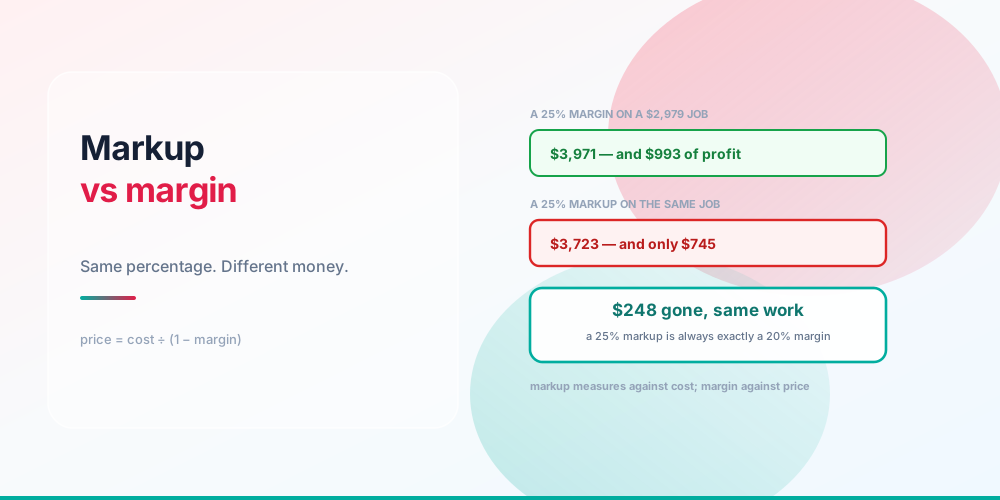
A 25% markup is a 20% margin. Always, exactly, and not approximately.
That single sentence is worth more to a small electrical contractor than most business advice, because the two are used interchangeably in conversation and they are not the same number. Say “I add 25%” and mean it as markup, and you are taking home a fifth of the job rather than a quarter - every job, all year.
On a $2,979 break-even, the difference is $248.
The Same Job, Two Ways
Same job, same "25%", $248 apart
Take an ordinary job: twelve hours at $95, $600 of fixtures, $850 of material.
direct cost   = 1,140 + 600 + 850   = $2,590
overhead 15%                        = $389
break-even                          = $2,979
Now price it two ways, both using the number 25.
As a margin - divide by (1 − 0.25):
$2,979 ÷ 0.75 = $3,971 → profit $993As a markup - multiply by 1.25:
$2,979 × 1.25 = $3,723 → profit $745Identical work, identical cost, and $248 less in the bank. The markup version is not a 25% anything from the customer’s side; it is a 20.0% margin.
The reason is what each percentage measures against. Markup is a percentage of cost. Margin is a percentage of price. Since price is always larger than cost, the same percentage means less money when it is measured against the bigger number.
The Conversion, Both Directions
Every markup is a smaller margin
| Markup applied | Margin achieved | Points short |
|---|---|---|
| 10% | 9.1% | 0.9 |
| 15% | 13.0% | 2.0 |
| 20% | 16.7% | 3.3 |
| 25% | 20.0% | 5.0 |
| 30% | 23.1% | 6.9 |
| 40% | 28.6% | 11.4 |
| 50% | 33.3% | 16.7 |
| 75% | 42.9% | 32.1 |
| 100% | 50.0% | 50.0 |
Three pairs are worth committing to memory: 25 → 20, 50 → 33, 100 → 50.
Notice that the gap widens as the numbers grow. At a 10% markup the error is under a point and barely matters. At a 50% markup you are seventeen points adrift. The mistake costs most on exactly the jobs where the stakes are highest - the specialist work you quoted a big number on because it was difficult.
Going the other way
Decide the margin, then find the markup
| Target margin | Markup needed | Or multiply cost by |
|---|---|---|
| 10% | 11.1% | × 1.111 |
| 15% | 17.6% | × 1.176 |
| 20% | 25.0% | × 1.250 |
| 25% | 33.3% | × 1.333 |
| 30% | 42.9% | × 1.429 |
| 35% | 53.8% | × 1.538 |
| 40% | 66.7% | × 1.667 |
| 50% | 100.0% | × 2.000 |
Honestly, the simplest habit is to skip markup thinking entirely. Divide break-even by (1 − margin) and you never need the conversion table at all.
Overhead Has to Be Inside Break-Even
Here is the second error, and it compounds with the first.
A margin applied to direct cost pays for the job. It does not pay for the van, the insurance, the phone, the accountant, the truck stock, or the hours spent quoting work you did not win. Those are overhead, and they have to be inside the number you apply margin to.
The order matters:
direct cost → + overhead → break-even → ÷ (1 − margin) → priceApply a 25% margin to $2,590 of direct cost and you get $3,453. That looks like a healthy job and it is $518 short of covering the same overhead and profit.
How much overhead? Take last year’s total overhead and divide by total direct cost. Most small electrical businesses land somewhere between 12% and 25%. The 15% in the example is a middle figure, not a recommendation - use your own, and revisit it annually.
For the labour side specifically, the loaded cost per billable hour is its own calculation involving burden and utilisation, worked through in Electrician Hourly Rate. That number matters more than margin does: at a fixed $32 wage, moving billable utilisation from 60% to 90% swings the required rate from $132 to $88 an hour.
What Margin Should You Actually Target?
There is no single right answer, but there are useful anchors.
20–30% gross margin is a common band for residential service electrical work. Below 20% there is no room for a job that goes wrong, and something goes wrong on maybe one job in ten. Above 35% you are either doing specialist work, working in an expensive market, or losing bids you should be winning.
Vary it deliberately rather than uniformly:
- Higher margin on small jobs (fixed costs dominate), emergency and out-of-hours work, difficult access, unfamiliar work, and anything where the scope is vague.
- Lower margin on large predictable jobs, repeat commercial clients, and work that fills a genuinely slow week - a job at 15% beats an empty van at 0%.
Material and labour can carry different margins. Many contractors run a higher percentage on material than on labour, on the reasoning that material ties up cash and carries handling and warranty exposure. Whether that is right for you depends on your mix, but treating them separately is more informative than one blended figure.
Common Mistakes
- Using markup and calling it margin. A 25% markup is a 20% margin, and $248 on a $3,000 job.
- Applying margin to direct cost. Overhead must be inside break-even first, or the office is unpaid.
- Guessing at the overhead rate. Last year’s overhead ÷ last year’s direct cost. It is a real number.
- Blending material and labour into one percentage. They behave differently and deserve separate treatment.
- Using one margin for every job. Small, urgent, and vague-scope work should all carry more.
- Forgetting unbilled hours. Quoting, driving and warranty calls are overhead, not free.
- Cutting margin to win work when the van is already full. That is not competing; that is discounting.
- Never revisiting the number. Material and insurance costs move. Last year’s overhead rate is last year’s.
Price a Job
Electrical Estimate Calculator - enter labour hours and rate, fixtures, material and your overhead percentage, and it builds direct cost, overhead, break-even and the price at your target margin. It shows the profit both ways, so the markup-versus-margin gap on your own numbers is visible rather than theoretical.
Get the underlying hourly figure right with the Labor Rate Calculator, and see the whole estimating workflow in How to Estimate Electrical Jobs. For where the hours themselves come from, see Electrical Labor Units, and for the pricing model question, Flat Rate vs Time and Materials.
Sources & standards: this is business arithmetic rather than code - no NEC section governs pricing. The relationships are exact: margin = markup ÷ (1 + markup), markup = margin ÷ (1 − margin), and price = break-even cost ÷ (1 − margin). The example figures are the TradesQuote Electrical Estimate Calculator’s defaults and are illustrative rather than benchmarks; overhead percentages, labour rates and target margins vary widely by market, business size and work mix. Derive your own overhead rate from your own accounts. Nothing here is accounting or tax advice.
FAQ
What is the difference between markup and margin?
Markup is a percentage of cost; margin is a percentage of price. Because price is always the larger number, the same percentage yields less money as a margin - or put the other way, a given markup always produces a smaller margin. A 25% markup is exactly a 20% margin. Multiplying cost by 1.25 and dividing cost by 0.75 feel like the same operation and are not.
How do you convert markup to margin?
Margin = markup ÷ (100 + markup). So a 25% markup gives 25 ÷ 125 = 20% margin, a 50% markup gives 50 ÷ 150 = 33.3%, and a 100% markup gives 100 ÷ 200 = 50%. Going the other way, markup = margin ÷ (100 − margin), so a 30% margin needs a 42.9% markup. The gap between the two figures widens as the numbers grow.
What margin should an electrical contractor aim for?
Commonly 20% to 30% gross on residential service work, though it varies widely by market and work mix. Below 20% leaves no room for the roughly one job in ten that goes wrong. Above 35% usually means specialist work, an expensive market, or bids being lost. Vary it deliberately - higher on small, urgent, difficult-access or vague-scope jobs, lower on large predictable work and repeat clients.
Should margin be applied before or after overhead?
After. Overhead has to be inside the number you apply margin to, or the margin is paying for the van, insurance and office rather than being profit. The order is direct cost, then overhead, then break-even, then divide by (1 − margin). Applying a 25% margin to direct cost alone on a $2,590 job leaves you $518 short of covering the same overhead and profit.
How do I work out my overhead percentage?
Divide last year’s total overhead by last year’s total direct cost. Overhead is everything not attributable to a specific job: vehicles, insurance, phones, accounting, truck stock, tools, advertising, and the unbilled hours spent quoting work you did not win. Most small electrical businesses land between 12% and 25%. Recalculate it annually - insurance and material costs move.
Why does a 25% markup only give 20% profit?
Because the two percentages are measured against different bases. Marking a $2,979 cost up by 25% gives a $3,723 price with $745 of profit. That $745 is 25% of the cost but only 20% of the price, and the price is what the customer pays. Anyone talking about profitability means margin - a percentage of revenue - so a markup quoted as though it were a margin overstates what the business actually keeps.
Should material and labour carry the same margin?
Not necessarily, and separating them is more informative than one blended figure. Many contractors run a higher percentage on material than labour, reasoning that material ties up cash and carries handling, delivery and warranty exposure. Labour is more predictable but its true cost is easy to underestimate, because burden and unbillable time inflate it well beyond the wage.
Is a bigger markup always better?
No - an empty van earns nothing. A job at 15% margin in a slow week beats no job at all, provided it genuinely covers its own direct cost and a share of overhead. What is worth avoiding is cutting margin when you are already busy, which is discounting rather than competing, and quoting below break-even in the hope of volume, which loses money faster the more of it you win.