
Electrical Labor Units: NECA MLU vs Your Own Job History
- 04 Aug, 2026
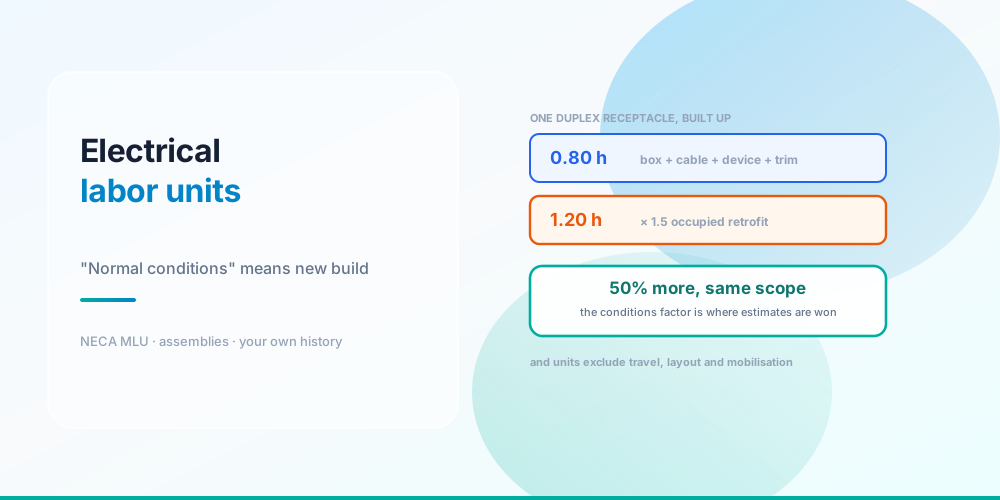
A labour unit is the hours one worker needs to install one item under normal conditions. NECA publishes them in the Manual of Labor Units, estimating software ships with them, and every serious electrical estimate is built on them.
The phrase doing all the work is “normal conditions,” and it means new construction with clear access, material at the work face, and no one else in the building. That describes almost nothing in service and retrofit work.
Here’s what it costs to miss that. A receptacle assembly is 0.80 hours by the book. In an occupied retrofit with high ceilings it’s 1.56 hours - nearly double, for identical scope, because conditions factors multiply rather than add.
Building an Assembly
One receptacle, four labour units
| Component | Hours |
|---|---|
| 4-square box with bracket | 0.25 |
| 12/2 NM cable, 25 ft at 0.01 h/ft | 0.25 |
| Duplex device and plate | 0.20 |
| Trim and test | 0.10 |
| Assembly total | 0.80 |
The box and the cable pull are the two biggest components at 31% each - not the device, which is what everyone pictures when they think about installing a receptacle. That’s worth knowing because it tells you where to look for savings: shortening runs and reducing box count moves an estimate far more than faster device work.
An assembly is the productivity trick. Rather than estimating each box, each foot of cable and each device separately on every job, you build the assembly once and then count assemblies during takeoff. “Forty-two duplex receptacles at 0.80 h” is one line instead of a hundred and sixty.
Build a library of them: duplex receptacle, GFCI receptacle, single-pole switch, 4-inch recessed can, 2×4 troffer, 20 A circuit home run, panel termination. Most residential and light commercial takeoffs are a dozen assemblies counted repeatedly.
Conditions Factors Are Where Estimates Are Won and Lost
The same 0.80 h assembly under six conditions
| Conditions | Factor | Hours per device |
|---|---|---|
| New construction, open frame | ×1.00 | 0.80 |
| New construction, tight schedule | ×1.15 | 0.92 |
| Occupied retrofit | ×1.50 | 1.20 |
| High ceilings, over 12 ft | ×1.30 | 1.04 |
| Hazardous or classified area | ×1.50 | 1.20 |
| Occupied retrofit + high ceiling | ×1.95 | 1.56 |
Factors multiply. An occupied retrofit in a warehouse with 16-foot ceilings isn’t 1.5 + 0.3; it’s 1.5 × 1.3 = 1.95. That compounding is the single largest source of underbidding in the trade, because the individual factors each look modest.
What actually drives them:
Occupied buildings - protecting finishes, working around people and furniture, restricted hours, noise limits, and the constant interruption of being asked questions. 1.5× is not conservative.
Height - every trip up and down a ladder or lift is unproductive time, and material handling gets slower.
Congestion and trade stacking - waiting for the ceiling grid, working above someone else’s ductwork, or sharing a lift.
Classified areas - sealing fittings, permits to work, and procedures.
Weather and temperature - outdoor winter work in the north is a real factor and frequently ignored.
Crew skill and size - a two-person crew on a job that suits one person, or an apprentice-heavy mix, changes productivity meaningfully.
Note the factors above are illustrative planning values. NECA publishes its own guidance, and your own history is better than either.
What a Unit Doesn’t Include
A labour unit is narrower than people assume
Inside the unit: handling material at the work face, measuring, cutting, drilling, mounting, making up, terminating, normal breaks and a fatigue allowance, and cleaning up that work.
Not in the unit: travel to and from site, mobilisation and demobilisation, layout and coordination, supervision and foreman time, permits, inspections and punch-list work.
Those exclusions are where small contractors quietly lose money, because they’re real hours that never appear on a takeoff line. On a one-outlet service call the travel can exceed the installation.
The fix isn’t complicated - it’s just to be consistent. Either:
- Put them in as separate line items (a trip charge, a layout line, supervision as a percentage of field hours, permits as a direct cost), or
- Bury them in overhead and make sure your overhead percentage is derived from actual accounts rather than guessed.
What you cannot do is exclude them from the labour units and forget to add them anywhere else, which is the default failure mode. The overhead-and-margin arithmetic is in How to Estimate Electrical Jobs.
Why Your Own History Beats Any Book
Published units are averages across the industry. Your crew, in your market, on your kind of work, is not the average - and the gap is usually 20–30% in one direction or the other.
Building your own history is unglamorous and cheap:
- Log actual field hours against actual counts. Not “the job took 40 hours” but “40 hours produced 28 receptacles, 6 switches and 340 ft of cable.”
- Do it for ten jobs of the same type. Fewer than that and you’re measuring noise.
- Compare against the book units and derive your own factor.
- Split by job type. Your new-construction factor and your service factor will differ substantially.
The payoff is large because of how estimates are composed: labour is around 90% of direct cost on small electrical work (see Cost to Install an Outlet), so a 20% error in labour units is roughly an 18% error in the job cost - which is most of a typical margin.
And track hours against the estimate on every job, not just the ones that went wrong. Jobs that came in well under are as informative as the ones that overran, and they’re the ones nobody reviews.
Turning Hours Into Money
Labour units give you hours. Two more numbers turn them into a price:
Your loaded labour cost, which is not the wage. $32/hour of wage becomes $63.37/hour of loaded cost once you add 35% burden, overhead and - critically - divide by billable hours rather than paid hours. The full derivation is in Electrician Hourly Rate.
Your billable utilisation, which is the most under-appreciated number in the business. At a fixed $32 wage, moving from 60% to 90% billable hours changes the required bill rate from $132.02 to $88.01 - a $44/hour swing. Raising utilisation beats cutting margin.
Common Mistakes
- Adding conditions factors instead of multiplying them. 1.5 and 1.3 is 1.95, not 1.8.
- Using new-construction units on retrofit work. “Normal conditions” means open frame and clear access.
- Forgetting the exclusions. Travel, layout, supervision and permits are real hours outside the unit.
- Never comparing actuals to estimates. Without that loop, published units never become your units.
- Reviewing only the jobs that overran. The ones that came in under are equally informative.
- Estimating components instead of assemblies. Assemblies make takeoff faster and more consistent.
- Treating the device as the work. The box and the cable pull are each larger.
- Applying one factor to a whole job. Different areas of the same building have different conditions.
- Dividing by paid hours instead of billable hours when converting to a rate.
Turn Units Into a Price
Labor Rate Calculator - turns a wage into a loaded cost and a bill rate, using burden, overhead and billable hours. That rate is what multiplies your labour units.
Then use the Estimate Calculator to add material, overhead and margin. See How to Estimate Electrical Jobs for the full takeoff-to-price method, Electrician Hourly Rate for the rate derivation, and Flat Rate vs Time and Materials for how to present it.
Sources & standards: NECA’s Manual of Labor Units is the industry reference for published labour units; the figures used here are illustrative planning values rather than quotations from it, and conditions factors vary by publisher and by market. Your own logged history is more accurate than any published table for your crew and your work type.
FAQ
What is an electrical labor unit?
The number of hours one worker needs to install one item under normal conditions - 0.25 hours to set a 4-square box, 0.01 hours per foot to pull 12/2 NM cable, 0.20 hours to make up and mount a duplex device. NECA publishes them in the Manual of Labor Units and estimating software ships with them. “Normal conditions” means new construction with clear access, which is the assumption that catches people out.
What is NECA MLU?
The National Electrical Contractors Association’s Manual of Labor Units, the industry’s standard reference for how long electrical installation tasks take. It’s the basis most estimating software uses. Like any published table it describes an industry average under stated conditions, so it needs a conditions factor for the job in front of you and calibration against your own crew’s history.
How do I apply conditions factors?
Multiply them, don’t add them. An occupied retrofit at 1.5 combined with high ceilings at 1.3 gives 1.95, not 1.8 - so a 0.80 hour assembly becomes 1.56 hours. Treating factors as additive is one of the largest sources of underbidding, because each individual factor looks modest while the product is nearly double.
What is an assembly in electrical estimating?
A bundle of labour units and materials for a complete installed item, estimated once and counted many times during takeoff. A duplex receptacle assembly might be a box, 25 feet of cable, the device and plate, plus trim and test - 0.80 hours total. Counting “42 receptacle assemblies” is one takeoff line instead of a hundred and sixty component entries.
Do labor units include travel time?
No. Labour units cover work at the work face only - handling material there, installing it, terminating it and cleaning up. Travel, mobilisation, layout, supervision, permits and punch-list work are all excluded and must be captured either as separate line items or within your overhead percentage. On a small service call, travel can exceed the installation time.
Should I use published labor units or my own?
Start with published units and calibrate them with your own history. Log actual field hours against actual installed counts for ten jobs of the same type, compare against the book figures, and derive your own factor - separately for new construction and service work, because they’ll differ substantially. The gap between industry average and any specific crew is usually 20–30%.
How much does a labour unit error cost?
More than any other estimating error, because labour is roughly 90% of direct cost on small electrical work. A 20% error in labour units is about an 18% error in the job cost, which is most of a typical margin. That leverage is why calibrating units against actuals is the highest-return administrative task in a small electrical business.
How do labour units become a price?
Multiply hours by your loaded labour cost, add material, add overhead, then divide by (1 − margin) to get the price. The loaded cost is not the wage: a $32/hour wage with 35% burden plus overhead, divided by billable rather than paid hours, comes out around $63.37/hour of cost and a $105.62 bill rate at a 40% margin.