
Flat Rate vs Time and Materials for Electrical Service Work
- 04 Aug, 2026
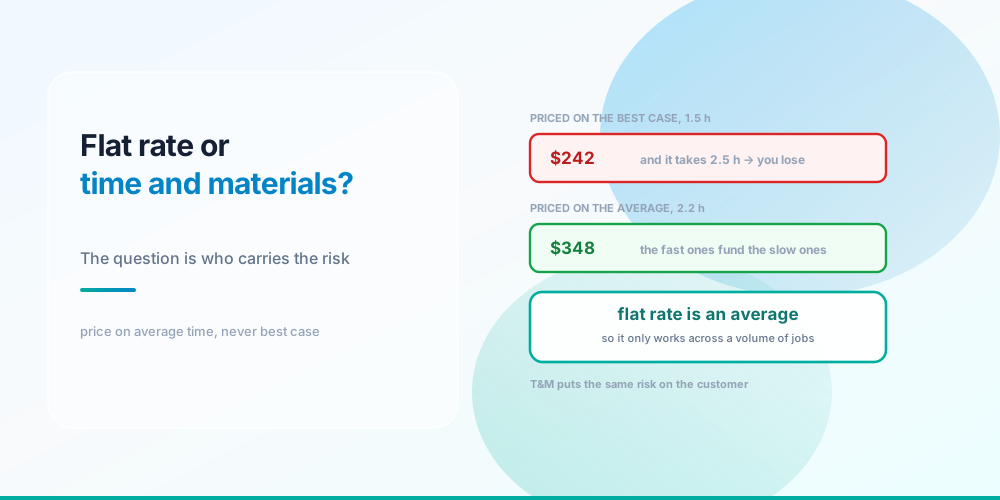
The flat-rate-versus-T&M argument is usually framed as a marketing question. It isn’t. It’s a decision about who absorbs the gap between the hours you estimated and the hours the job actually took.
Under flat rate, that’s you. Under time and materials, that’s the customer.
Everything else - the price certainty, the incentive to work fast, the arguments about the invoice - follows from that one transfer. And it leads to the mistake that sinks most flat-rate systems: pricing on the job as it usually goes, rather than on the job as it averages.
Who Carries the Risk
It's a risk allocation, not a preference
| Flat rate | Time and materials | |
|---|---|---|
| Who absorbs an overrun | The contractor | The customer |
| Who benefits from speed | The contractor | The customer |
| Price known before work starts | Yes | No - an estimate only |
| Rewards investing in tools and skill | Yes | No - faster means less revenue |
| Needs accurate labour data | Critically | Less so |
| Works on unknown scope | Badly | Well |
| Invites argument about hours | No | Frequently |
The row worth dwelling on is “rewards investing in tools and skill.” Under T&M, buying a better tool or training a technician reduces your revenue on every job - you bill fewer hours for the same work. Under flat rate, the saving is yours. That perverse incentive is the strongest structural argument for flat rate, and it’s why service-heavy shops migrate to it as they grow.
The row that stops people is “needs accurate labour data.” Flat rate without job history is gambling.
The Mistake That Sinks Flat-Rate Systems
Ten times you did "the same job"
Here are ten logged instances of “add a receptacle”: 1.2, 1.4, 1.5, 1.5, 1.6, 1.8, 2.0, 2.5, 3.2, 5.3 hours.
The commonest figure is 1.5 hours. The mean is 2.2 hours - because the tail is short but heavy. One job hit a masonry wall, one needed a panel space freed up, one had a customer who wanted to talk.
| Priced on | Hours | Price | Margin across ten jobs |
|---|---|---|---|
| The common case | 1.5 h | $242 | −$310 |
| The mean | 2.2 h | $348 | $752 |
Price on the mode and you lose money across the ten jobs. Every fast job earns a little and the 5.3-hour job wipes out several of them. Price on the mean and the fast jobs fund the slow ones, which is exactly what a flat rate is supposed to do.
Two consequences:
Flat rate needs volume. With three jobs a month, the average may not show up before the bad one hurts. The law of large numbers is the mechanism, and it needs large numbers.
Flat rate needs logged hours. Not “that usually takes an hour and a half” - actual recorded times across at least ten instances, per task, per job type. Building that history is the subject of Electrical Labor Units.
Building a Flat Rate
Work outward from cost, not inward from what feels sellable:
1. Establish your loaded labour cost. Not the wage. A $32/hour wage with 35% burden plus overhead, divided by billable hours rather than paid hours, is $63.37/hour of cost. The derivation is in Electrician Hourly Rate.
2. Take the mean hours from your own history for that specific task, with a conditions factor for the kind of property you work in.
3. Add material at cost, plus your material handling markup.
4. Add overhead as a percentage of direct cost - 15% in the worked examples here.
5. Divide by (1 − margin), not multiply by markup. This matters more than people expect: on the $2,979 break-even in the Estimate Calculator, a 25% margin gives $3,971 and $993 of profit, while a 25% markup gives $3,723 and only $745 - $248 less on the same job. A 25% markup is always a 20% margin.
6. Publish it and hold it. A flat rate you discount on the doorstep is a T&M price with extra steps.
Note what step 2 implies: your flat rate is not portable. Another shop’s price book reflects their crew, their market and their property stock. Buying one and using it unadjusted is how flat-rate systems fail quietly.
Which Model Fits Which Work
The dividing line is scope certainty, not job size
Flat rate fits repeatable tasks you’ve done twenty times, service calls where the scope is visible from the doorway, device and fixture swaps, and anything where a customer wants a firm number before agreeing.
T&M fits troubleshooting, and this is the important case. Diagnosing an intermittent fault has genuinely unknown scope - it could be a loose terminal found in ten minutes or a damaged cable inside a wall found in six hours. Flat-rating that means either padding heavily (and losing bids) or absorbing catastrophic overruns. The diagnostic work in AFCI and GFCI Nuisance Tripping is exactly this shape.
T&M also fits old buildings with hidden conditions, work sequenced behind other trades, and emergency callouts.
The hybrids are where most good practice sits:
- A flat diagnostic fee, then a flat-rate repair. The customer buys a defined answer, then a defined fix. This is the standard service model and it works because it splits the unknown part from the known part.
- T&M with a not-to-exceed cap. The customer gets a ceiling, you get paid for actual time below it. Fair, and it closes deals.
- Flat rate for defined scope plus T&M for extras, with the change-order rate agreed in writing before work starts.
- Per-point pricing on repetitive rough-in - $X per device point - which is flat rate applied at the assembly level.
Presenting Either One Honestly
With flat rate, quote the price and the scope, and be explicit about what triggers an extra charge. The complaint customers have about flat rate is discovering the price was for a narrower scope than they assumed.
With T&M, quote the rate and an estimate, and say clearly that it’s an estimate. Then - and this is the part people skip - call before you exceed it. Almost every T&M dispute is about a customer who was surprised by an invoice, not about a rate they thought was too high.
Don’t hide the rate. A shop that won’t say its hourly rate reads as a shop with something to hide. The market band for electricians runs roughly $50–$130/hour, and being at the top of it is fine if you can say why.
Charge for diagnosis. Free troubleshooting is the fastest way to lose money in service work, because it’s the highest-skill, most variable-duration activity you do. Charge a diagnostic fee, and credit it against the repair if that helps close the sale.
Common Mistakes
- Pricing a flat rate on the common case. Use the mean; the tail is what decides it.
- Adopting a flat rate without logged hours. Ten instances minimum, per task.
- Buying someone else’s price book and using it unadjusted. It reflects their crew and market.
- Using markup where you meant margin. 25% markup is a 20% margin and less profit.
- Flat-rating troubleshooting. Unknown scope belongs on T&M or behind a diagnostic fee.
- Discounting a published flat rate on the doorstep. It stops being a system.
- Quoting T&M without a written estimate. And without calling before you exceed it.
- Free diagnosis. The highest-variability work you do, given away.
- Running flat rate at low volume. The average needs the volume to show up.
Set the Numbers First
Labor Rate Calculator - turns a wage into a loaded cost and a bill rate using burden, overhead and billable hours. Note the utilisation effect: at a fixed $32 wage, moving from 60% to 90% billable changes the required rate from $132.02 to $88.01.
Estimate Calculator - builds a price from hours, material, overhead and margin, and shows the profit at that margin so you can see what a markup would have cost instead.
See Electrician Hourly Rate for the rate, Electrical Labor Units for the hours, How to Estimate Electrical Jobs for the method, and Cost to Install an Outlet for worked prices.
Sources & standards: all figures are computed from the estimate and labor rate calculators’ arithmetic and are illustrative planning values, not market quotations. The ten logged job durations are an illustrative distribution demonstrating the mean-versus-mode point. Labour rates vary by region by a factor of two or more.
FAQ
What is the difference between flat rate and time and materials?
Flat rate quotes one price for a defined task regardless of how long it takes. Time and materials bills the actual hours plus material at an agreed rate. The substantive difference is who absorbs the gap between estimated and actual hours - the contractor under flat rate, the customer under T&M.
Is flat rate better than time and materials?
Neither is better in general; they suit different work. Flat rate suits repeatable tasks with visible scope, gives the customer price certainty, and rewards you for working efficiently. T&M suits troubleshooting and hidden-condition work where scope genuinely can’t be known in advance. Most successful shops use both, with a written rule about which applies.
How do I set a flat rate price?
Start from your loaded labour cost - not the wage - multiply by the mean hours from your own logged history for that task, add material and a handling markup, add overhead as a percentage of direct cost, then divide by (1 − your target margin). Publish it and hold it. The critical input is the mean rather than the typical duration.
Why should I use the average time and not the usual time?
Because the distribution has a tail. Ten logged instances of the same job might run 1.2, 1.4, 1.5, 1.5, 1.6, 1.8, 2.0, 2.5, 3.2 and 5.3 hours - a mode of 1.5 but a mean of 2.2. Priced on 1.5 hours you lose money across the ten, because the one 5.3-hour job wipes out several fast ones. Priced on the mean, the fast jobs fund the slow ones, which is what flat rate is for.
Should I flat-rate troubleshooting?
Generally no. Diagnosing an intermittent fault has genuinely unknown scope - it could be a loose terminal found in ten minutes or damaged cable inside a wall found in six hours. Flat-rating it means either padding heavily and losing bids, or absorbing severe overruns. Use a flat diagnostic fee for a defined amount of investigation, then flat-rate the repair once the scope is known.
Can I use someone else’s flat rate price book?
Only as a starting point. A price book reflects the productivity of the crew that generated it, the property stock in that market and that shop’s overhead structure. Using one unadjusted is how flat-rate systems fail quietly - the prices look professional and lose money. Calibrate it against your own logged hours before you rely on it.
What’s the difference between markup and margin in pricing?
Markup is a percentage added to cost; margin is a percentage of the selling price. On $2,979 of cost, a 25% markup gives $3,723 and $745 of profit, while a 25% margin gives $3,971 and $993 - $248 more on the same job. A 25% markup is always a 20% margin. Divide by (1 − margin) rather than multiplying by (1 + markup).
Should I tell customers my hourly rate?
Yes. A shop that won’t state its rate reads as one with something to hide, and the question comes up anyway. The electrician market band runs roughly $50 to $130 per hour, and being toward the top is defensible if you can explain what the customer gets for it. What matters more is quoting T&M as an explicit estimate and calling before you exceed it - nearly every T&M dispute is about surprise, not about the rate.