
The 10 NEC Violations Inspectors Flag Most
- 04 Aug, 2026
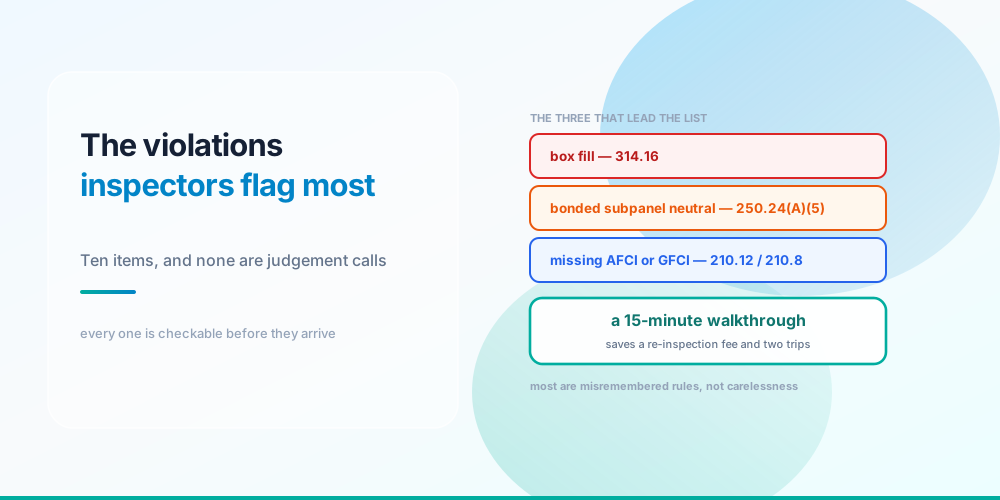
The striking thing about flagged electrical violations is how few distinct ones there are. The same ten items account for most of what gets written up, and almost none of them are carelessness.
They’re rules learned slightly wrong. Box fill counts a device yoke twice and all the grounds once - remember it as “count everything once” and you’ll fail. Exactly one neutral-to-ground bond belongs in a system - remember it as “bond the neutral” and every subpanel is wrong. 240.4(D) caps 14 AWG at 15 A - except when 240.4(G) says it doesn’t.
Which is good news, because a misremembered rule is fixable by reading it once properly.
The Ten
Ten items, and the misremembered rule behind each
| # | Violation | Code | The rule people get wrong |
|---|---|---|---|
| 1 | Box fill exceeded | 314.16 | Device yokes count twice; all grounds count once collectively |
| 2 | Neutral bonded in a subpanel | 250.24(A)(5) | Exactly one bond, at the service |
| 3 | Missing AFCI or GFCI | 210.12 / 210.8 | Dual-function needed where both apply |
| 4 | Conductor and OCPD mismatch | 240.4(D) | 14 AWG → 15 A, 12 → 20 A, 10 → 30 A |
| 5 | No neutral at a switch box | 404.2(C) | Required in most locations, not just for dimmers |
| 6 | Cable support and staples | 334.30 | Within 12 in of a box, then every 4½ ft |
| 7 | Backfed breaker unsecured | 408.36(D) | Needs a fastener requiring more than a pull |
| 8 | Panel not legibly labelled | 408.4(A) | Every circuit, durably, at the panel |
| 9 | No disconnect at a detached building | 225.31 | A garage subpanel needs a main breaker |
| 10 | Working space obstructed | 110.26 | 30 in wide × 36 in deep × 6 ft 7 in high, kept clear |
This is a practitioner’s list rather than a ranked survey - your AHJ will have its own favourites, and asking an inspector what they see most is a genuinely useful conversation.
Number One, Worked
The number-one failure, worked
Two 12/2 NM cables into a single-gang box with internal clamps and one duplex receptacle:
| What’s in the box | How it counts | Volume |
|---|---|---|
| 4 × 12 AWG conductors | one each | 9.00 in³ |
| All equipment grounds | once total, however many | 2.25 in³ |
| Internal cable clamps | once total, however many | 2.25 in³ |
| One duplex device | twice for the yoke | 4.50 in³ |
| Pigtails inside the box | zero | 0.00 in³ |
| Total | 18.00 in³ |
That needs the 3″ × 2″ × 3½″ device box at exactly 18.0 in³ - sitting precisely on the limit with nothing spare. Add one more conductor and you’re over.
The grouping rules are the whole difficulty, and they’re genuinely unintuitive:
- Clamps: once, regardless of how many.
- All equipment grounding conductors together: once, regardless of how many.
- Each device yoke: twice - a two-gang box with two devices counts four.
- Pigtails that don’t leave the box: nothing at all.
- Each conductor entering and terminating: once. A conductor passing through unbroken also counts once.
Full treatment in Box Fill Calculation.
The Rest, and Why Each Recurs
2 - Bonded subpanel neutral. The most consequential one on the list, because it’s a live safety defect rather than a paperwork issue. Bond the neutral twice and load current starts returning through grounding conductors - 250.6 objectionable current - which is also the leading cause of unexplained GFCI and AFCI trips. Grounding vs Bonding.
3 - Missing AFCI or GFCI. Two rules with overlapping scope: 210.12 for most dwelling living areas, 210.8 for wet and earth-contact locations. Kitchens and laundry areas typically need both, hence dual-function devices. Note that the recent expansions in 210.8(D) and 210.8(F) are widely amended out, so this is one to confirm locally rather than assume. Where GFCI Protection Is Required.
4 - Conductor and OCPD mismatch. Usually a 20 A breaker on 14 AWG somewhere in a mixed-gauge circuit, where the smallest conductor governs the whole circuit. Worth knowing the legitimate exception so you don’t flag your own correct work: 240.4(G) exempts motor and A/C circuits, which is why a 35 A breaker on 14 AWG feeding a motor is correct. Motor Circuit Sizing and 10 Gauge Wire Amps.
5 - No neutral at a switch box. 404.2(C) requires a grounded conductor at most switch locations so smart switches and dimmers can be added later without opening a wall. Easy to miss on three-way and travelling circuits.
6 - Cable support. Boring and frequently written up. 334.30: secure within 12 inches of every box and at intervals not exceeding 4½ feet.
7 - Backfed breaker clip. 408.36(D) requires an additional fastener on a backfed plug-in device, because a backfed breaker stays energised when snapped out of the bus. A cheap clip, constantly missing. Main Breaker vs Main Lug Panels.
8 - Panel labelling. 408.4(A) requires legible, durable circuit identification. Pencil on masking tape doesn’t survive, and “lights” isn’t identification.
9 - Detached-building disconnect. 225.31 requires a disconnecting means at a separate structure, so an MLO subpanel in a garage fed only from the house panel doesn’t comply. Use a main-breaker panel.
10 - Working space. 110.26 requires 30 inches of width, 36 inches of depth and 6 ft 7 in of height at equipment likely to be worked on energised - and it must be kept clear, not merely clear on inspection day. Panels behind shelving, in closets and above appliances all fail.
Three More Worth Watching
Not in the top ten but genuinely common:
Derating ignored in a bundle. More than three current-carrying conductors in a raceway, or cables bundled over 24 inches, triggers Table 310.15(C)(1). Six 12 AWG conductors at 40 °C derate to 21.84 A - legal on 20 A, but only if you started from the 90 °C column. Wire Derating Explained.
Terminations not torqued. 110.14(D) requires a calibrated tool and the manufacturer’s value. Nobody does it on copper, and a loose terminal at 20 A dissipating 200 W is what an AFCI is detecting. Ohm’s Law Explained.
Unlisted or wrong-location equipment. Interior devices outdoors, non-wet-rated conductors in a wet raceway, NM cable where it isn’t permitted. THHN vs NM-B vs MC Cable.
The Walkthrough
Fifteen minutes, ordered by where you stand
At the panel - subpanel neutrals isolated, backfed breaker clip fitted, every circuit labelled, breakers matching conductors, 110.26 space clear.
At each box - box fill within Table 314.16, neutral present at switch boxes, cable clamped, grounds made up, right box for the device count.
Along the runs - staples within 12 inches of boxes then every 4½ feet, protection where exposed, derating checked in bundles, right cable type for the location.
At the devices - AFCI and GFCI where required, tamper-resistant where required, covers fitted, terminations torqued, detached buildings with a disconnect.
Ordered by where you physically stand, not by code article - which is the difference between a checklist that gets used and one that gets filed. It takes about fifteen minutes and it saves a re-inspection fee plus two trips. Electrical Permits and Inspections covers the process around it.
One Caveat About “Violations”
Two things worth saying plainly.
Sometimes the inspector is wrong. 240.4(G) motor circuits are the classic case - a 35 A breaker on 14 AWG feeding a motor is correct and does occasionally get written up. The productive response is to ask which section and look it up together, not to argue from memory.
And sometimes the code isn’t what you remember. The rooftop ambient adder was largely removed in the 2017 cycle. Island receptacles stopped being required in 2023. The six-handle panel ended in 2020. Check which edition your jurisdiction enforces - NEC Adoption by State and NEC 2023 vs 2026.
Check Before They Arrive
Box Fill Calculator - the number-one failure, with the grouping rules applied correctly: conductors counted individually, grounds and clamps once each, device yokes twice.
Also worth running before an inspection: the Ampacity Calculator for derating in bundles, the Breaker Size Calculator for conductor-and-OCPD matching, and the Ground Wire Size Calculator for EGC sizing. The NEC Tables reference has the underlying data.
Sources & standards: NEC (NFPA 70) 2023 - 110.14(D), 110.26, 210.8 and 210.8(D) and (F), 210.12, 225.31, 240.4(D) and 240.4(G), 250.6, 250.24(A)(5), 310.15(C)(1), 314.16 and Table 314.16, 334.30, 404.2(C), 408.4(A), 408.36(D). This is a practitioner’s list compiled from the requirements most often misremembered, not a ranked statistical survey of inspection records - your AHJ’s own list will differ, and asking is worthwhile. The AHJ has final say on interpretation.
FAQ
What is the most common electrical code violation?
Box fill - exceeding the cubic-inch capacity permitted by Table 314.16. It leads because the counting rules are unintuitive: each device yoke counts twice, all equipment grounding conductors count once collectively however many there are, all internal clamps count once, and pigtails that stay inside the box count nothing. A common single-gang case lands on exactly 18.00 in³, which is precisely the limit of an 18.0 in³ device box.
How do I calculate box fill correctly?
Count each conductor entering and terminating once, at the volume in Table 314.16 for its size - 2.25 in³ for 12 AWG. Then add one conductor volume for all equipment grounds together, one for all internal clamps together, and two for each device yoke. Pigtails wholly inside the box count zero. Two 12/2 cables plus clamps plus one duplex gives 18.00 in³.
Why is bonding the neutral in a subpanel a violation?
Because 250.24(A)(5) permits exactly one neutral-to-ground connection in the system, at the service. A second bond gives load current an alternative return path through the equipment grounding conductors - objectionable current under 250.6 - which makes grounding conductors carry current they were never intended to carry and causes unpredictable GFCI and AFCI tripping.
Can a 20 amp breaker ever protect 14 AWG wire?
Not on a general-purpose circuit - 240.4(D) caps 14 AWG at 15 A. The genuine exception is 240.4(G), which routes motor and air-conditioning circuits to Articles 430 and 440, where the breaker is sized for starting inrush and a separate overload device protects the conductor. That’s why a 35 A breaker on 14 AWG feeding a motor is correct, and it’s occasionally written up in error.
What is the working space requirement for a panel?
NEC 110.26 requires 30 inches of width, 36 inches of depth measured from the live parts, and 6 ft 7 in of headroom at equipment likely to be examined or serviced while energised. Crucially it must be kept clear, not just clear on inspection day - which is why panels behind shelving, inside closets and above appliances get flagged.
Do I need a neutral at every switch box?
In most locations, yes. 404.2(C) requires a grounded conductor to be provided at switch locations so that smart switches, dimmers and occupancy sensors requiring a neutral can be installed later without opening a wall. There are exceptions where a raceway allows a neutral to be added later, but the default expectation is that it’s there - and three-way circuits are where it gets missed.
What happens if I fail an electrical inspection?
You correct the items and call for a re-inspection, usually with a fee. The real cost is the schedule: two extra trips and a delay that can hold up drywall, occupancy or a closing date. Since all ten of the common failures are checkable in advance, a fifteen-minute walkthrough against a location-ordered checklist is the cheapest insurance available.
Is the inspector always right?
No, and the useful response when you believe otherwise is to ask which section and read it together. The 240.4(G) motor exemption is the classic case where correct work gets flagged. Equally, sometimes the code isn’t what you remember - the rooftop ambient adder was largely removed in 2017, island receptacles stopped being required in 2023, and the six-handle service panel ended in 2020.