
Wire Derating Explained: Ambient Temperature and Conductor Bundling
- 04 Aug, 2026
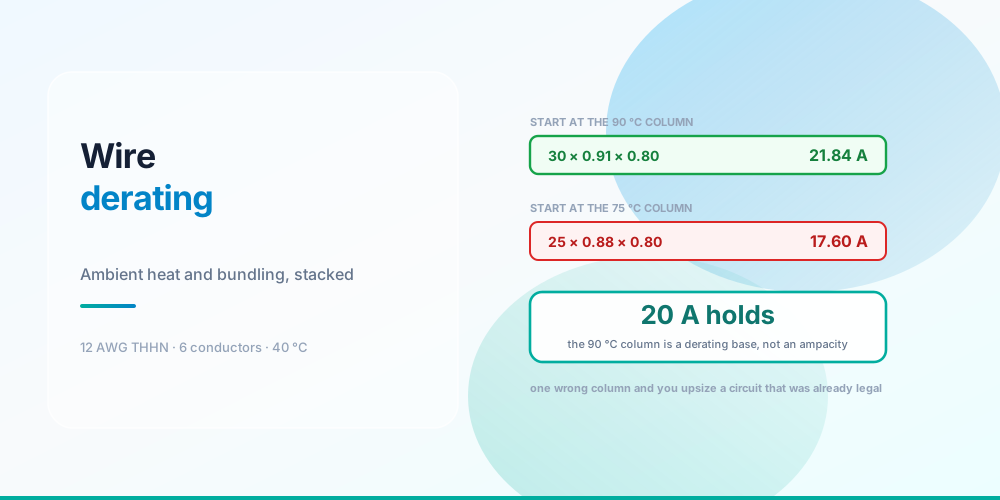
Derating is where most wire sizing goes wrong, and it usually goes wrong in the conservative direction - which sounds harmless until you realise it means paying for a conductor size you never needed on every circuit in the job.
Here is the case that separates people who understand the rule from people who have memorised a table. Six 12 AWG copper THHN conductors share a raceway in a 40 °C attic, on 20 A breakers. Is that legal?
Yes: 30 × 0.91 × 0.80 = 21.84 A, which comfortably holds 20 A. Get the starting number wrong and the same circuit computes to 17.60 A, fails, and sends you to 10 AWG for nothing.
Start at the Conductor’s Column, Not the Terminal’s
Derate from the conductor's column, not the terminal's
The 90 °C column of Table 310.16 is not an ampacity you are allowed to load a conductor to. It is a derating base. That distinction is the whole rule:
- 310.15 derates from the conductor’s own insulation rating. THHN, THWN-2 and XHHW-2 are 90 °C insulations, so their correction and adjustment factors apply to the 90 °C column - 30 A for 12 AWG copper.
- 110.14(C) then caps the finished number at the temperature rating of the terminations, which for ordinary breakers and lugs is 75 °C. For 12 AWG copper that ceiling is 25 A.
- 240.4(D) separately caps the overcurrent device for 14, 12 and 10 AWG regardless of any of the above.
So there are two limits and they do different jobs. You derate from 90 and you are capped at 75. Applying the 75 °C figure as the starting point double-counts the termination limit, and that is the single commonest derating error in the trade.
One nuance worth knowing about that termination cap: 110.14(C)(1)(a) actually defaults circuits rated 100 A or less to the 60 °C column unless the equipment is listed and identified for a higher temperature. Virtually all modern breakers, panelboards and receptacles are marked 60/75 °C, which is why 75 °C is the practical number - but it is a marking on the equipment, not an assumption, and on genuinely old gear it may not be there.
The Two Corrections
Two independent factors reduce ampacity, and they multiply.
Ambient temperature correction - Table 310.15(B)(1)(1). Table 310.16 assumes 30 °C (86 °F). Hotter than that and you multiply down; colder and you may actually multiply up.
| Ambient | 60 °C | 75 °C | 90 °C |
|---|---|---|---|
| ≤ 10 °C | 1.29 | 1.20 | 1.15 |
| 21–25 °C | 1.08 | 1.05 | 1.04 |
| 26–30 °C | 1.00 | 1.00 | 1.00 |
| 31–35 °C | 0.91 | 0.94 | 0.96 |
| 36–40 °C | 0.82 | 0.88 | 0.91 |
| 41–45 °C | 0.71 | 0.82 | 0.87 |
| 46–50 °C | 0.58 | 0.75 | 0.82 |
| 51–55 °C | 0.41 | 0.67 | 0.76 |
| 56–60 °C | - | 0.58 | 0.71 |
Notice that the 90 °C column is punished least. A conductor with more thermal headroom loses proportionally less of it, which is the second reason 90 °C insulation is worth specifying even when the terminals cap you at 75.
Conductor bundling adjustment - Table 310.15(C)(1). More than three current-carrying conductors in a raceway, or cables bundled together for more than 24 inches, and heat can no longer escape freely.
| Current-carrying conductors | Factor |
|---|---|
| 1–3 | 1.00 |
| 4–6 | 0.80 |
| 7–9 | 0.70 |
| 10–20 | 0.50 |
| 21–30 | 0.45 |
| 31–40 | 0.40 |
| 41 or more | 0.35 |
The jump from 0.70 to 0.50 at ten conductors is brutal and catches people out - going from nine to ten conductors costs you 29% of what was left, not 3%.
How Far the Bundle Actually Goes
Where a 20 A circuit stops surviving the bundle
| Current-carrying conductors | Factor | Adjusted ampacity | 20 A? |
|---|---|---|---|
| 3 | 1.00 | 27.30 A | holds |
| 6 | 0.80 | 21.84 A | holds |
| 9 | 0.70 | 19.11 A | fails |
| 12 | 0.50 | 13.65 A | fails |
| 24 | 0.45 | 12.29 A | fails |
| 40 | 0.40 | 10.92 A | fails |
Six current-carrying conductors is the practical ceiling for 20 A circuits in a hot raceway - three circuits with individual neutrals. That is a far more useful number than the fill capacity of the conduit, because it binds first: 3/4-inch EMT accepts sixteen 12 AWG conductors on fill, and derating stops you at a fraction of that. The full comparison is in How to Calculate Conduit Fill.
Notice too that nine conductors do pass at 30 °C - 30 × 1.00 × 0.70 = 21.00 A. The 40 °C ambient is what pushes them under. Which is the next problem.
Both Corrections at Once
Neither correction means anything on its own
| 30 °C | 40 °C | 50 °C | |
|---|---|---|---|
| 3 conductors | 30.00 A | 27.30 A | 24.60 A |
| 6 conductors | 24.00 A | 21.84 A | 19.68 A |
| 9 conductors | 21.00 A | 19.11 A | 17.22 A |
The failure boundary runs diagonally. Six conductors are fine at 30 °C and 40 °C and fail at 50 °C - by 0.32 A. Nine conductors are fine only at 30 °C. That is why “four to six conductors is fine” is not a rule you can carry around, and why the honest answer to “how many circuits can I put in this pipe?” always starts with “how hot does it get?”
For reference, common ambients that beat 30 °C: a vented attic in a hot climate runs 50–60 °C in summer, an unconditioned garage or industrial ceiling 35–45 °C, and direct sun on a wall-mounted raceway anywhere with a real summer.
What Counts as Current-Carrying
This is the other half of getting the answer right, and the rules are not intuitive.
- The equipment grounding conductor never counts. It carries no current except during a fault. Neither does an isolated bonding jumper.
- A neutral that carries only unbalanced current does not count. In a two-pole 120/240 V multiwire branch circuit - two hots sharing one neutral - you count two, not three. The neutral only ever carries the difference.
- A neutral in a 4-wire three-phase wye feeder with significant nonlinear load does count. Triplen harmonics from electronic ballasts, LED drivers, VFDs and computer power supplies add in the neutral rather than cancelling, so 310.15(E)(2) makes you count it.
- Everything else that carries load current counts, including a conductor sitting idle on a de-energised circuit if it’s part of a live circuit.
Contrast this with conduit fill, where everything in the pipe counts including the ground. The two calculations count different things, which is why running them from the same number is wrong.
The Exemptions Worth Knowing
Three real escape hatches:
Short nipples. A raceway not exceeding 24 inches in length is exempt from the bundling adjustment altogether - and Chapter 9 Table 1, Note 4 simultaneously allows it to be filled to 60%. Both concessions at once, which is why a short nipple between two adjacent panels can be packed in a way a 40-foot run never could.
Cables not bundled for more than 24 inches. The adjustment applies to cables “bundled together for more than 24 inches without maintaining spacing.” Cables fanning out from a panel, or crossing each other, are not bundled. Cables strapped together along a joist for ten feet are.
Underground and outdoor entries. Conductors entering from outside are exempt from the adjustment for the length inside where they are not bundled with others.
There is also a rule that used to exist and often still gets quoted: the rooftop temperature adder. Older code cycles added up to 33 °C to the ambient for a raceway exposed on a roof. That adder was largely removed in the 2017 cycle, so whether it applies to you depends on which cycle your jurisdiction has adopted - see NEC Adoption by State.
Where This Actually Bites
Two cases from real work where derating changes the answer:
A 30 A circuit fails where a 20 A circuit passes. Six 10 AWG copper THHN conductors at 40 °C give 40 × 0.91 × 0.80 = 29.12 A, which does not hold a 30 A breaker - it misses by less than an amp. The 12 AWG on 20 A in the same raceway passes with 1.84 A to spare. The proportions are not the same at every size, so you cannot reason from one circuit to another.
With NM cable the penalty is the ceiling, not the derating. This one is widely got wrong in both directions. NEC 334.80 holds NM cable’s ampacity to the 60 °C column - but it explicitly permits the 90 °C rating to be used for the correction and adjustment calculations, provided the final derated ampacity doesn’t exceed the 60 °C value.
So six 10 AWG NM conductors at 40 °C derate exactly like THHN: 40 × 0.91 × 0.80 = 29.12 A, then capped at the 60 °C figure of 30 A, which doesn’t bind. Identical arithmetic. What differs is the undereated ceiling - NM’s 10 AWG stops at 30 A where THHN in conduit reaches 35 A - and that gap is what changes conductor sizes on larger circuits. The ladder is worked through in THHN vs NM-B vs MC Cable.
Common Mistakes
- Derating from the 75 °C column. Start at the conductor’s insulation rating; 110.14(C) caps the answer separately.
- Counting the ground. It never counts for derating. It always counts for fill.
- Counting the neutral of a multiwire branch circuit. Two hots and a shared neutral is two current-carrying conductors, not three.
- Not counting the neutral on a wye feeder with electronic loads. Harmonics don’t cancel; 310.15(E)(2) makes you count it.
- Forgetting the 0.70 → 0.50 cliff at ten conductors. One extra conductor can cost 29%.
- Applying only one factor. Ambient and bundling multiply. Six conductors at 50 °C fails; either condition alone passes.
- Assuming fill capacity is the limit. Derating almost always binds first in a hot raceway.
- Ignoring the 24-inch nipple exemption. It exempts you from bundling and allows 60% fill.
- Reasoning from one wire size to another. 12 AWG on 20 A survives six bundled conductors at 40 °C; 10 AWG on 30 A does not.
- Deriving NM cable’s factors from the 60 °C column. 334.80 caps the result at 60 °C but lets you compute from 90 °C. Starting at 60 °C is needlessly conservative.
Run the Numbers
Ampacity Calculator - pick a size, material, insulation rating, ambient temperature and conductor count. It applies Table 310.15(B)(1)(1) and Table 310.15(C)(1) to the correct base column, imposes the 110.14(C) termination cap and the 240.4(D) small-conductor limit, and shows each step.
Every figure in this article is that calculator’s output. For the sizing question that comes before derating, start with What Size Wire Do I Need and the Wire Size Chart; for the 12 AWG case in detail see 12 Gauge Wire Amps; and for the other constraint that grows conductors on long runs, Voltage Drop.
Sources & standards: NEC (NFPA 70) 2023 - 110.14(C), 240.4(D), 310.15(B)(1) and Table 310.15(B)(1)(1), 310.15(C)(1) and Table 310.15(C)(1), 310.15(E), Table 310.16, 334.80, Chapter 9 Table 1 Note 4. Local amendments override the model code and the AHJ has final say. Have electrical work designed and installed by a licensed electrician under permit.
FAQ
What is wire derating?
It is reducing a conductor’s table ampacity to account for conditions hotter than the table assumes. Table 310.16 is based on a 30 °C ambient with no more than three current-carrying conductors together. A hotter ambient gets a correction factor from Table 310.15(B)(1)(1), and more than three conductors gets an adjustment factor from Table 310.15(C)(1). The two multiply.
Do I derate from the 75 °C or the 90 °C column?
From the column matching the conductor’s insulation, which for THHN, THWN-2 and XHHW-2 is 90 °C. The 75 °C termination rating is applied afterwards as a ceiling on the finished number under 110.14(C). Deriving the factors from the 75 °C column double-counts that limit - on six 12 AWG conductors at 40 °C it turns a legal 21.84 A into a failing 17.60 A.
How many current-carrying conductors can I put in one conduit?
For 20 A circuits on 12 AWG THHN in a 40 °C ambient, six - which is three circuits with individual neutrals. Six conductors derate to 21.84 A and hold 20 A; nine derate to 19.11 A and do not. At a 30 °C ambient nine just pass at 21.00 A. The conduit’s fill capacity is usually much higher than this, so derating is normally the binding limit.
Does the ground wire count for derating?
No. Equipment grounding conductors and bonding jumpers are not counted, because they carry no current except during a fault. They do count for conduit fill, which is a different calculation with different rules - everything physically in the raceway counts for fill.
Does the neutral count as a current-carrying conductor?
It depends on the circuit. In a 120/240 V multiwire branch circuit with two hots sharing one neutral, no - the neutral carries only the unbalance. In a 4-wire three-phase wye feeder supplying significant nonlinear load such as LED drivers or VFDs, yes - triplen harmonics add rather than cancel in the neutral, and 310.15(E)(2) requires it to be counted.
When do I not have to apply the bundling adjustment?
Three main cases: a raceway nipple not exceeding 24 inches in length, cables that are not bundled together for more than 24 inches without maintaining spacing, and conductors entering a building from outside for the portion where they are not bundled. The 24-inch nipple also gets 60% fill under Chapter 9 Table 1, Note 4.
Does Romex derate worse than THHN in conduit?
No - the derating arithmetic is identical, and this is widely misunderstood. NEC 334.80 caps NM cable’s ampacity at the 60 °C column but explicitly permits the 90 °C rating to be used for the correction and adjustment calculations. Six 10 AWG NM conductors at 40 °C give 40 × 0.91 × 0.80 = 29.12 A, exactly as THHN does, then get capped at the 60 °C figure of 30 A, which doesn’t bind. What NM loses is the undereated ceiling: 10 AWG NM stops at 30 A where THHN in conduit reaches 35 A.
Can derating factors ever be greater than 1?
Yes, for ambient correction below 30 °C. At 10 °C or under, a 90 °C conductor gets 1.15 and a 60 °C conductor 1.29. It is legitimate and occasionally useful for cold-climate outdoor and unheated-space runs, though the 110.14(C) termination cap and the 240.4(D) small-conductor limits still apply and usually absorb the gain.