
The 80% Rule for Circuits: Continuous Load, Explained
- 04 Aug, 2026
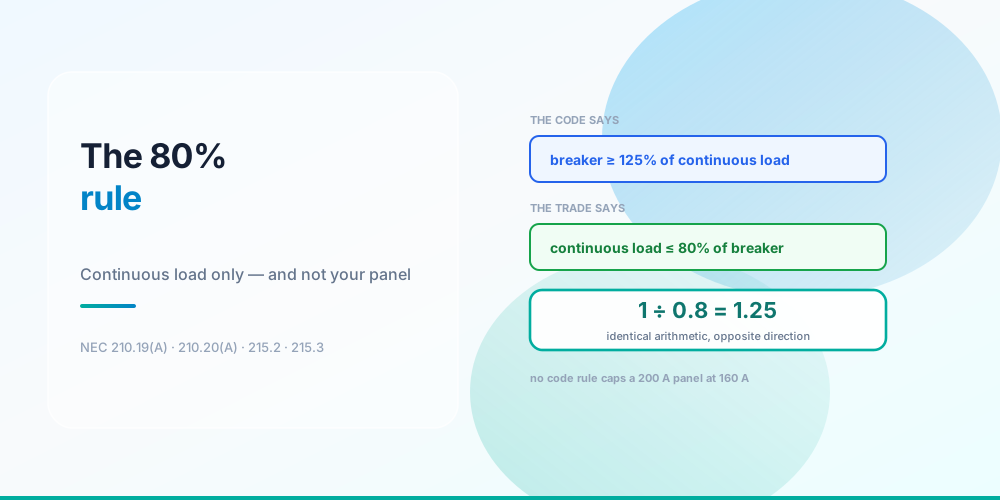
There is no section of the NEC called “the 80% rule.” What exists is a requirement to size the conductor and the overcurrent device at 125% of the continuous load - and 1 ÷ 0.80 = 1.25, so the trade’s shorthand is arithmetically identical to the code’s requirement.
That would make this a short article, except that three genuinely different claims travel under the same name, and two of them are wrong. The expensive one is “never load a panel past 80% of its rating,” which is not a code rule and which talks people into service upgrades they don’t need.
The Same Rule, Read Two Ways
Two ways to say the same thing
The code text you actually want is in two places that say the same thing:
- 210.19(A)(1) - branch-circuit conductors shall have an ampacity not less than the noncontinuous load plus 125% of the continuous load.
- 210.20(A) - the overcurrent device shall have a rating not less than the noncontinuous load plus 125% of the continuous load.
215.2(A)(1) and 215.3 repeat it for feeders, and 230.42(A) for service conductors. Note that both the conductor and the device get the factor - people often apply it to one and forget the other.
So: a 40 A continuous load needs 40 × 1.25 = 50 A of device and conductor. Read backwards, a 50 A device permits 50 × 0.80 = 40 A of continuous load. Same statement.
Prefer working up from the load. Sizing up lands you on a standard 240.6(A) rating; sizing down from a breaker gives you a number that may not correspond to anything you can buy, and it’s easier to fool yourself about which loads counted.
Why the factor exists at all
Not because breakers are weak. A standard molded-case breaker is tested and marked for 100% of its rating - in free air. The problem is the assembly: the breaker inside an enclosure, surrounded by other breakers, terminating on lugs, generating heat with nowhere to go. Standard panelboard assemblies are not listed for continuous operation at 100% of rating, so the code builds in the 25% margin.
Which means there’s an exception, and it’s real: where the assembly including the overcurrent device is listed for operation at 100% of its rating, the 125% factor doesn’t apply. 100%-rated devices and switchboards exist, they’re mostly large frame sizes in commercial work, and they’re specified precisely to avoid oversizing a 3,000 A service by 25%. You will essentially never meet one in a house.
What Counts as Continuous
This is where the rule is actually decided, and the definition is narrower than most people assume.
Article 100 defines a continuous load as one where the maximum current is expected to continue for three hours or more. Three hours. Not “runs a lot” - three hours of sustained maximum current.
| Load | Continuous? |
|---|---|
| Commercial or industrial lighting | Yes - that’s the classic case |
| EV charging | Yes - 625.41 requires it |
| Electric water heating | Usually treated as continuous |
| Electric space heating | Usually treated as continuous |
| Sign and outline lighting | Yes |
| Electric range | No - cycles |
| Clothes dryer | No - runs under an hour at full draw |
| Dishwasher, disposal | No |
| Residential general lighting and receptacles | Generally not |
Most dwelling branch circuits have no continuous load at all, which is why a 20 A kitchen receptacle circuit is not restricted to 16 A. The 80% figure simply doesn’t enter the calculation. That surprises people who’ve been told it applies universally.
Two entries deserve a note. EV charging is continuous by rule, not by judgement - 625.41 requires EVSE load to be treated as continuous, which is exactly why a 48 A charger needs a 60 A circuit rather than a 50 A one. That ladder, and the reason 48 A is the sweet spot, is in What Size Wire for an EV Charger. And water and space heating are conventionally treated as continuous even though a thermostat cycles them, because the design case assumes sustained demand.
The Full Ladder
What each breaker allows, and what each load demands
| Device | Continuous load allowed | A continuous load of that size needs |
|---|---|---|
| 15 A | 12 A | 18.8 A → 20 A |
| 20 A | 16 A | 25.0 A → 25 A |
| 30 A | 24 A | 37.5 A → 40 A |
| 40 A | 32 A | 50.0 A → 50 A |
| 50 A | 40 A | 62.5 A → 70 A |
| 60 A | 48 A | 75.0 A → 80 A |
| 100 A | 80 A | 125.0 A → 125 A |
| 200 A | 160 A | 250.0 A → 250 A |
The right-hand column is the one worth internalising: a continuous load numerically equal to a breaker’s rating always needs the next device up.
50 A is the awkward row. 50 × 1.25 = 62.5 A, and 62.5 A is not a standard rating under 240.6(A), so it jumps to 70 A - two steps, not one. That single discontinuity is why a 50 A EV charger costs so much more to install than a 48 A one: 48 A needs a 60 A breaker on 6 AWG, and 50 A needs a 70 A breaker on 4 AWG. Two amps, one breaker size and two wire sizes.
What the Rule Is Not
”Never load a panel past 80% of its rating”
There is no such rule in the NEC. A 200 A service that calculates to 200 A under Article 220 is a compliant 200 A service. The load calculation is the mechanism that decides whether a service is adequate, and it already contains the demand factors - plus the 125% continuous factor where it applies - that account for real-world diversity.
This myth costs real money, because it’s used to justify a service upgrade for a house whose calculated load is 170 A. The honest test is a load calculation, and the strongest version of it is NEC 220.87, which lets you establish existing load from the utility’s own 12-month peak demand × 125%. Almost nobody offers this. See Do I Need a Panel Upgrade and NEC 220.87.
Two adjacent things are real and get confused with it. Panel spaces are a genuine limit - a full panel may need a subpanel or tandem breakers, which has nothing to do with the service’s ampacity. And busbar rating is a genuine limit, separately from the main breaker and the service rating; those are three independent numbers and the smallest governs, as covered in What Size Electrical Service Do I Need.
”Never load any circuit past 80%”
Wrong for the same reason: the factor attaches to continuous load. A 20 A circuit may carry 20 A of non-continuous load all day. 210.23(A) does impose real limits on branch circuits - a single portable appliance may not exceed 80% of the circuit rating, and equipment fastened in place is limited to 50% where the circuit also serves lighting or receptacles - but those are different rules with different numbers, and they’re about appliances rather than about continuity.
”A breaker will trip at 80%”
Also wrong, and worth saying because it’s the intuition behind the other two. A thermal-magnetic breaker is designed to carry 100% of its rating indefinitely and to trip on a time-current curve - typically holding 135% for a while and clearing higher overloads faster. Whether a breaker holds 80% has nothing to do with why the code requires 125%.
Worked Examples
A 1,500 W bathroom heater on a 20 A circuit. 1,500 ÷ 120 = 12.5 A. Space heating is treated as continuous, so 12.5 × 1.25 = 15.6 A. A 20 A circuit handles it comfortably; a 15 A circuit does not.
Commercial lighting, 2,400 VA on 120 V. 20 A of continuous load. 20 × 1.25 = 25 A, so you need a 25 A device and conductors rated 25 A - which is 10 AWG, not 12 AWG, because 240.4(D) caps 12 AWG at 20 A. This is the case the rule was written for, and it’s the one that regularly catches people converting a residential habit to commercial work.
A 48 A EV charger. Continuous by rule. 48 × 1.25 = 60 A, a standard rating, on 6 AWG copper in conduit. Ask for 50 A and you’re at 62.5 A → 70 A → 4 AWG.
A 4,500 W water heater. 18.75 A × 1.25 = 23.4 A → a 25 A device minimum. 30 A on 10 AWG is conventional and legal; there is no need to go to 8 AWG. See 10 Gauge Wire Amps.
Common Mistakes
- Applying the factor to non-continuous loads. It only attaches to loads sustained three hours or more.
- Believing a panel is capped at 80% of its rating. No such rule. Do a load calculation.
- Applying it to the device but not the conductor. 210.19(A)(1) and 210.20(A) both require 125%.
- Forgetting that 62.5 A isn’t a standard rating. A 50 A continuous load takes a 70 A device.
- Forgetting EV charging is continuous by rule. 625.41 makes it so regardless of usage pattern.
- Assuming a breaker trips at 80%. It’s an assembly heating limit, not a trip characteristic.
- Confusing it with 210.23(A). Those are separate limits - 80% for one portable appliance, 50% for fastened-in-place equipment sharing a circuit.
- Ignoring the 100%-rated assembly exception. Real, and it matters on large commercial services.
- Mixing continuous and non-continuous incorrectly. Add 100% of non-continuous to 125% of continuous - don’t apply 125% to the total.
Size a Circuit Properly
Breaker Size Calculator - enter the load, mark whether it’s continuous, and it applies the 125% factor, adds any non-continuous load at 100%, rounds to the next standard 240.6(A) rating and returns the matching conductor with the 240.4(D) limits applied.
For the panel-capacity question the myth is really about, use the Existing Load Calculator (NEC 220.87) or the Load Calculator (220.82). See What Size Breaker Do I Need for the sizing method end to end, and 15 Amp vs 20 Amp Circuit for where the two common residential ratings differ.
Sources & standards: NEC (NFPA 70) 2023 - Article 100 definition of Continuous Load, 210.19(A)(1), 210.20(A) and its exception, 210.23(A), 215.2(A)(1), 215.3, 230.42(A), 240.4(D), 240.6(A), 625.41, and Article 220 for load calculations. Local amendments override the model code and the AHJ has final say. Have electrical work designed and installed by a licensed electrician under permit.
FAQ
What is the 80% rule in electrical work?
It’s the trade’s shorthand for the NEC’s requirement that a conductor and overcurrent device be sized at 125% of the continuous load - 1 ÷ 0.80 = 1.25, so the two statements are identical. A 50 A breaker permits 40 A of continuous load; a 40 A continuous load requires a 50 A breaker. It applies only to loads sustained for three hours or more.
Is the 80% rule actually in the NEC?
Not by that name or in that form. The code states it as a 125% multiplier in 210.19(A)(1) and 210.20(A) for branch circuits, 215.2(A)(1) and 215.3 for feeders, and 230.42(A) for services. The 80% version is the same arithmetic inverted, and it’s a perfectly sound way to think about it as long as you remember it attaches to continuous load only.
Can I load a 200 amp panel to 200 amps?
Yes, if the load calculation supports it. There is no NEC rule capping a panel at 80% of its rating - that’s a persistent myth, and it’s used to sell unnecessary service upgrades. Article 220 sizes the service, and its demand factors already account for diversity. What is real is that continuous loads within that calculation get the 125% factor, and that the busbar rating and available spaces are separate limits.
What counts as a continuous load?
Article 100 defines it as a load whose maximum current is expected to continue for three hours or more. Commercial lighting is the classic example. EV charging is continuous by rule under 625.41. Water heating and space heating are conventionally treated as continuous. Ranges, dryers, dishwashers and ordinary residential lighting and receptacles generally are not.
Why does a 50 amp continuous load need a 70 amp breaker?
Because 50 × 1.25 = 62.5 A, and 62.5 A is not a standard overcurrent device rating under 240.6(A), so you round up to the next one - which is 70 A, skipping past 60 A. This single discontinuity is why a 50 A EV charger is markedly more expensive to install than a 48 A one: 48 A lands exactly on a 60 A breaker and 6 AWG, while 50 A needs 70 A and 4 AWG.
Does the 80% rule apply to residential circuits?
Rarely, because most dwelling circuits carry no continuous load. A 20 A kitchen receptacle circuit is not limited to 16 A. Where it does apply in a house is EV charging, electric water and space heating, and occasionally a large lighting installation. Note that 210.23(A) imposes separate limits - 80% of the circuit for a single portable appliance, 50% for fastened-in-place equipment sharing the circuit with lighting or receptacles.
Will a 20 amp breaker trip at 16 amps?
No. A thermal-magnetic breaker is designed to carry 100% of its rating indefinitely, and typically holds well above it for a period before tripping on its time-current curve. The 125% code factor exists because a breaker inside a crowded enclosure can’t shed heat the way it does in the free-air test, not because the breaker is unreliable at 80%.
What is a 100% rated breaker?
One installed in an assembly listed for continuous operation at 100% of the device’s rating, which under the exception to 210.20(A) removes the 125% continuous-load factor. They are mostly large-frame devices in commercial switchgear, specified to avoid oversizing a large service by 25%. You will not encounter one in residential work.