
Standard vs Optional Load Calculation: Which Method to Use
- 05 Aug, 2026
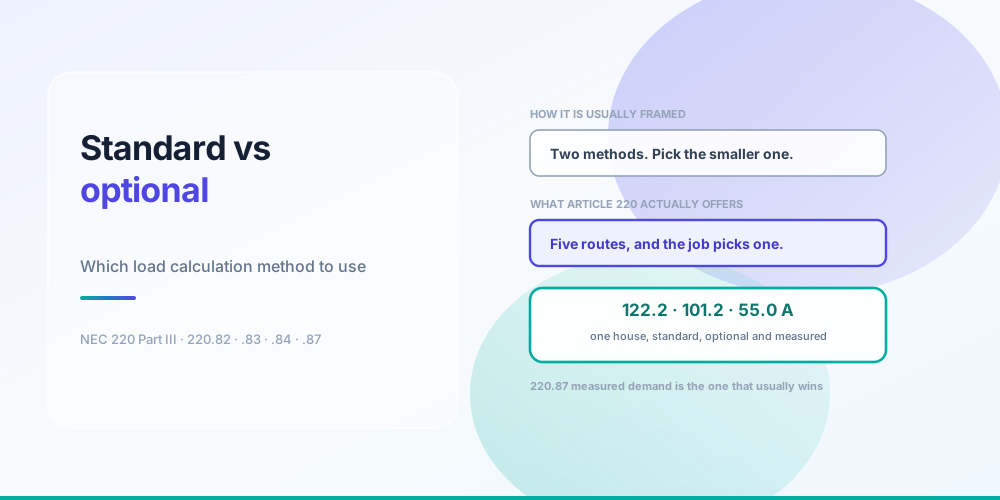
“Standard or optional?” is the wrong question, and it produces wrong answers.
Article 220 does not offer two methods. It offers five, and in most real situations the job picks one for you before preference enters into it. Choosing between 220.82 and Part III when the house already exists and the utility has twelve months of demand data means both of them are the wrong tool.
This post is about which method to reach for. If you want one house worked through both calculations side by side, that is Residential Electrical Load Calculation.
The Five Routes
Five methods, and the situation usually picks one
| Section | Method | Applies to |
|---|---|---|
| 220 Part III | Standard | Any dwelling; the only method for non-dwellings |
| 220.82 | Optional, new dwelling | One-family dwelling or individual unit, served at 100 A or more |
| 220.83 | Optional, adding load | Adding to an existing dwelling with existing loads in place |
| 220.84 | Optional, multifamily | Three or more units meeting the section’s conditions |
| 220.87 | Measured existing load | An existing service with 12 months of utility demand data |
The single most important structural fact: the optional methods are permissions, not obligations. 220.82 says it “shall be permitted”. The standard method is always legal, always available, and is the fallback whenever an optional method’s conditions aren’t met.
Choosing, in practice
New construction, one dwelling → 220.82. It is faster and usually gives a smaller answer. Fall back to Part III if the service will be under 100 A, which for a one-family dwelling it cannot be anyway - 230.79(C) sets 100 A as the minimum.
Adding load to an existing dwelling → 220.83, not 220.82. This is the most commonly missed choice on the list. 220.83 is written specifically for the “existing dwelling gaining a heat pump / EV charger / induction range” situation, and it handles existing loads properly instead of pretending the house is new. It has two sub-cases: (A) where no additional heating or air conditioning is being added, and (B) where it is.
An existing service with utility data → 220.87. See below; this is usually the argument that ends the conversation.
Three or more units → 220.84, if its conditions are met - including that no unit is supplied by more than one feeder, and that each unit has electric cooking. Otherwise Part III with Tables 220.55 and 220.54, worked through in Range and Dryer Demand Factors.
Anything that is not a dwelling → Part III, full stop. There is no commercial optional method. See Commercial Load Calculation.
One House, Three Answers
The same house, three ways
Take a 2,000 ft² all-electric house - range, dryer, water heater, dishwasher, 5 kVA of air conditioning:
| Method | Result | Of the standard result |
|---|---|---|
| Standard, 220 Part III | 29,325 VA = 122.2 A | 100% |
| Optional, 220.82 | 24,280 VA = 101.2 A | 83% |
| Measured, 220.87 | 55.0 A | 45% |
The two calculations sit 21% apart - a real gap, but a modest one. The measured figure is less than half of either, and that is the number worth internalising.
220.87 is not a calculation at all. It takes the utility’s recorded peak demand over twelve months - 44 A here - multiplies by 125%, and that is the existing load. No assumptions about how many appliances run together, because the meter already answered that. Thirty days of recorded data is permitted where a year is unavailable.
Every calculation method is a model of a house’s behaviour. 220.87 is a measurement of it. On an existing service, the measurement wins, and it is why the method is the strongest argument against an unnecessary panel upgrade - worked through in NEC 220.87: Using Utility Data.
When Does the Method Change the Answer?
The method matters more often than the anchor case suggests
Here is the thing frequently stated too confidently. On the anchor house above, both calculations round to the same 125 A service - 122.2 A and 101.2 A both land in the 100-to-125 band. From which people conclude the method rarely matters.
That conclusion is wrong, and the reason is that the anchor house got lucky.
Sweep the optional result across a range and apply the same 21% gap:
| Optional | Standard | Service by optional | Service by standard | Same? |
|---|---|---|---|---|
| 80 A | 97 A | 100 A | 100 A | yes |
| 90 A | 109 A | 100 A | 125 A | no |
| 101 A | 122 A | 125 A | 125 A | yes |
| 110 A | 133 A | 125 A | 150 A | no |
| 120 A | 145 A | 125 A | 150 A | no |
| 130 A | 157 A | 150 A | 200 A | no |
| 145 A | 175 A | 150 A | 200 A | no |
| 160 A | 193 A | 200 A | 200 A | yes |
| 180 A | 217 A | 200 A | 225 A | no |
Same service in three of nine cases. A 21% gap is wide enough to straddle a service boundary most of the time, because the standard ratings are spaced roughly 20–25% apart in this range.
So the honest guidance is: the method usually does matter, and where the optional method is available it is worth running, because it is both quicker and more likely to keep you inside a service rating. What is not true is the folk claim that the two always agree.
Where the Difference Comes From
The two methods diverge because they claim diversity in structurally different places.
The standard method applies a specific demand factor to each category - Table 220.42 to lighting, Table 220.55 to the range, Table 220.54 to the dryer, 220.53’s 75% to four or more fixed appliances, and 220.60 to non-coincident loads. Every reduction is individually justified.
The optional method does one thing: general loads at nameplate, then first 10 kVA at 100% and the remainder at 40%, with the largest HVAC term added separately at 100%. One factor, applied once.
Three consequences follow:
- The optional method rewards a lot of appliances. Everything after the first 10 kVA is discounted 60%, so the more connected load a house has, the better 220.82 looks against Part III.
- The standard method rewards a sparse house. With few appliances the 220.53 75% factor never engages, and the optional method’s 10 kVA at 100% is a bigger share of a smaller total.
- HVAC is treated the same either way - largest of heating or cooling, at 100%, because they are non-coincident.
Never mix them. Applying Table 220.55 to the range and then the 40% remainder factor double-counts the diversity and undersizes the service. The tables belong to Part III; 220.82 takes nameplates.
Common Mistakes
- Treating it as a two-way choice. There are five methods, and 220.83 and 220.87 are the two most often missed.
- Using 220.82 when adding load to an existing dwelling. 220.83 is written for exactly that.
- Skipping 220.87 on an existing service. A measurement beats a model, and it is usually far smaller.
- Combining Table 220.55 with the 40% remainder factor. Double-counts diversity; undersizes the service.
- Assuming both methods always land on the same service. They agree perhaps a third of the time.
- Looking for a commercial optional method. There isn’t one. Part III is the calculation.
- Forgetting the optional methods have conditions. 220.84 in particular has several; the standard method is the fallback.
- Reading “optional” as “less rigorous”. It is a permitted alternative, equally valid, with different arithmetic.
Run Both
Residential Load Calculator - runs the NEC 220.82 optional method with every term visible: general lighting, small appliance, laundry, appliance nameplates, the 10 kVA-then-40% split, and the largest HVAC term. It returns the calculated load in VA and amps and the service rating that follows.
For an existing service, start instead with the Existing Load Calculator - 220.87 measured demand - and take the result into the Service Size Calculator. If the answer is that a panel upgrade is being proposed, Do I Need a Panel Upgrade? is the consumer-facing version of the argument.
Sources & standards: NEC (NFPA 70) 2023 - Article 220 Part III (the standard method), including Table 220.42, 220.53, Table 220.54, Table 220.55 and 220.60; Part IV optional calculations, comprising 220.82 (dwelling unit), 220.83 (existing dwelling unit adding load, with sub-cases (A) and (B)), 220.84 (multifamily dwelling, subject to its own conditions) and 220.87 (determining existing loads from a 12-month maximum demand record at 125%, or 30 days where a year is unavailable); 230.79(C) for the 100 A minimum one-family dwelling service. The optional methods are permissions rather than requirements - the standard method is always available. The worked figures are for one 2,000 ft² all-electric dwelling and are illustrative; the boundary analysis applies that house’s ratio across other loads to show how often a method choice crosses a service rating, which is not a general rule about any particular house. Local amendments override the model code and the AHJ has final say.
FAQ
Should I use the standard or optional load calculation method?
Whichever fits the situation, and usually the situation decides. New one-family construction takes 220.82. Adding load to an existing dwelling takes 220.83. An existing service with twelve months of utility data takes 220.87, which beats both. Three or more units may take 220.84. Anything that is not a dwelling takes the Part III standard method, because there is no commercial optional method.
Is the optional method always smaller than the standard method?
Not always, but usually for a typical modern house. The optional method discounts everything after the first 10 kVA by 60%, so the more connected appliance load a house has the better it looks. A sparse house with few appliances can come out closer, because 220.53’s 75% factor never engages under the standard method and the optional method’s first 10 kVA at 100% is a larger share of a smaller total.
Do the two methods give the same service size?
Often not. On one 2,000 ft² all-electric house the standard method gives 122.2 A and the optional 101.2 A, and both round to 125 A - but that is coincidence. Applying the same 21% gap across a range of loads, the two land on the same standard service rating in only about a third of cases, because service ratings are spaced roughly 20–25% apart in this range.
What is NEC 220.83 and when do I use it?
It is the optional method for an existing dwelling unit that is gaining additional load - a heat pump, an EV charger, an induction range. It handles the existing loads properly rather than treating the house as new construction, which is what 220.82 does. It has two sub-cases: (A) where no additional heating or air conditioning is being installed, and (B) where it is. It is the most frequently missed method on the list.
What is the difference between 220.83 and 220.87?
220.83 is a calculation - it works out the existing load from the installed equipment and adds the new load. 220.87 is a measurement - it takes the utility’s recorded maximum demand over twelve months, multiplies by 125%, and that is the established existing load. Where the data exists, 220.87 is almost always the smaller and stronger answer, because a meter reflects how the house is actually used.
Can I mix the two methods?
No, and doing so undersizes the service. Tables 220.55 and 220.54 belong to the Part III standard method and already contain their diversity. The 220.82 optional method takes appliance nameplates at full value and applies its own single reduction - first 10 kVA at 100%, remainder at 40%. Applying a range demand factor and then the 40% remainder counts the same diversity twice.
Is there an optional method for commercial buildings?
No. NEC 220.82 is titled “Optional Calculations - Dwelling Unit” and there is no non-dwelling equivalent. Part IV contains a few narrow optional methods for specific occupancies such as schools and restaurants, each with its own conditions, but they are exceptions rather than a general shortcut. For an ordinary commercial building the Part III standard method is the calculation.
Does an inspector care which method I used?
Only that it is applied correctly and completely. The optional methods are permissions written into the code, so using one is not a shortcut in any pejorative sense. What draws attention is a calculation that mixes methods, omits a required term, or applies an optional method whose conditions are not met - 220.84 in particular has several conditions that are easy to overlook. Show the method used on the submittal.