
Amps to Watts: Conversion With Voltage and Power Factor
- 04 Aug, 2026
The formula:
- DC: watts = volts × amps
- AC single-phase: watts = volts × amps × power factor
- AC three-phase: watts = 1.732 × volts × amps × power factor
Two things about that are worth more than the formula itself. First, amps × volts does not give you watts - it gives you volt-amperes, and only a power factor of 1.0 makes the two equal. Second, if you are converting a breaker rating to watts to work out what you can plug in, the honest answer is 80% of what the multiplication says.
The Three Forms - and the VA Underneath Them
Amps × volts always gives VA. Watts only equal VA at unity power factor.
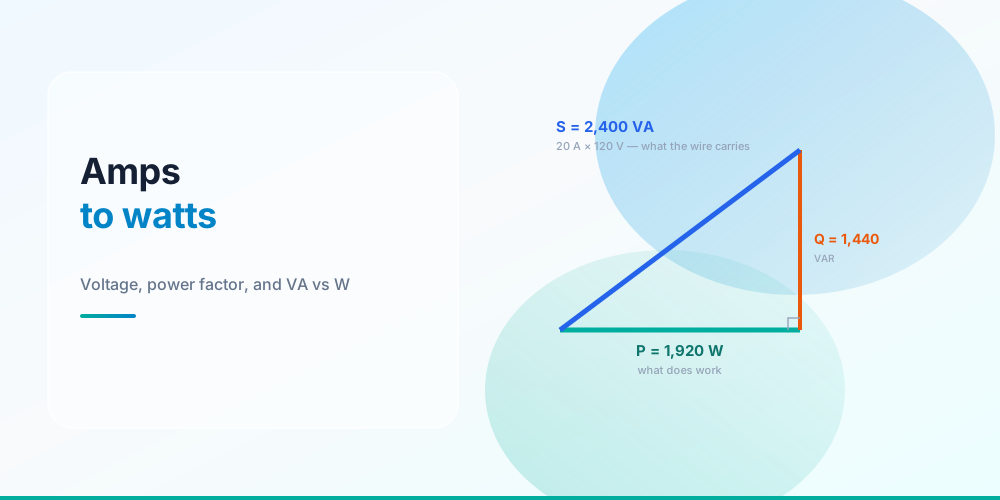
20 A at 120 V is 2,400 VA. Whether that’s 2,400 W or 1,920 W depends entirely on what’s plugged in - and the conductor carries 20 A either way. That asymmetry is the reason the distinction matters:
- Volt-amperes (VA) are what the conductors, breaker and transformer have to be sized for.
- Watts (W) are what does work, and what the utility’s energy meter bills.
- The gap between them is reactive power, in volt-amperes reactive (VAR).
Which is why generators and transformers are rated in kVA, not kW. The manufacturer doesn’t know your power factor, so they rate the equipment for the current it can carry. Sizing a transformer from a load list in watts will undersize it on any load that isn’t resistive - the relationship is worked through on the kVA Calculator.
For the NEC’s purposes, note that load calculations are done in VA, not watts - 220.82’s 3 VA/ft², the 1,500 VA small-appliance circuits, the 8,000 VA Table 220.55 range figure. That’s deliberate: the code sizes conductors, so it works in the units conductors care about.
Where the Watts Go
20 A at 120 V is 2,400 VA - whatever the power factor
At a power factor of 0.8, 20 A at 120 V delivers 1,920 W of real power out of 2,400 VA, with 1,440 VAR circulating and doing nothing useful. The phase angle is 36.9°.
The practical consequences, in order of how often they matter:
- The wire doesn’t care. It carries 20 A regardless. Size conductors from amps or VA - never from watts.
- Your residential energy bill doesn’t care either. A residential meter bills kWh, which is real power. Poor power factor costs a homeowner nothing directly.
- Commercial bills care a great deal. Many commercial tariffs bill demand in kVA, or apply a power-factor penalty below about 0.9. Correcting 0.75 to 0.95 on a 100 kW load takes roughly 55 kVAR of capacitance and cuts the demand charge - see the Power Factor Calculator.
- Generators care most of all. A three-phase set rated “20 kW” is normally rated at 0.8 power factor, so it’s a 25 kVA machine. Load it with 25 kVA of motors at 0.8 PF and it’s at capacity even though only 20 kW of work is being done. Single-phase residential air-cooled sets are usually rated at unity, so their kW and kVA figures match - a difference worth checking on the spec sheet before you size one, as What Size Generator Do I Need covers.
Reasonable power factors, when a nameplate doesn’t tell you: 1.0 for resistance heat, water heaters, ovens, incandescent lamps; 0.9–0.95 for modern LED drivers and switch-mode supplies with correction; 0.8–0.9 for induction motors at full load - and much worse lightly loaded, which is one of the arguments for not oversizing motors.
Converting a Breaker Rating to Watts
What each breaker rating is worth in watts
This is what most people actually want, so here is the table with both numbers:
| Circuit | On paper | Continuous limit |
|---|---|---|
| 15 A @ 120 V | 1,800 W | 1,440 W |
| 20 A @ 120 V | 2,400 W | 1,920 W |
| 30 A @ 240 V | 7,200 W | 5,760 W |
| 40 A @ 240 V | 9,600 W | 7,680 W |
| 50 A @ 240 V | 12,000 W | 9,600 W |
| 60 A @ 240 V | 14,400 W | 11,520 W |
| 100 A @ 240 V | 24,000 W | 19,200 W |
| 200 A @ 240 V | 48,000 W | 38,400 W |
The right-hand column comes from NEC 210.20(A): an overcurrent device must be rated for 125% of the continuous load it serves, which inverted means a continuous load may not exceed 80% of the breaker rating. That’s the whole of the famous “80% rule”. It bites on space heaters, EV chargers and commercial lighting; it doesn’t bite on a toaster, a range, or a dryer, because those cycle rather than running for three hours straight.
Two cautions on the bottom two rows. A 200 A service is not a 48 kW house. Add up the nameplate of everything in a modern all-electric home and you will pass 48 kW easily - a 12 kW range, 5 kW dryer, 4.5 kW water heater, 5 kW of air conditioning and 11.5 kW of EV charging is already 38 kW before lighting. Nothing is wrong; those loads don’t all run at once, which is exactly what the NEC’s demand factors model. A 2,000 ft² all-electric house with that appliance list calculates to 24,280 VA - 101 A under 220.82, not 200 A. The method is worked step by step in Residential Load Calculation, and the service-rating decision in 100 Amp vs 200 Amp Service.
And the second number is not a licence to load a circuit to 80% of its rating as a habit. For non-continuous loads the constraints are different ones: 210.23(A)(1) caps a single portable appliance at 80% of the circuit, and 210.23(A)(2) caps fastened-in-place equipment at 50% where the circuit also serves lighting or receptacles.
Worked Examples
| Current | Supply | Watts | VA | Reactive |
|---|---|---|---|---|
| 15 A, PF 1 | 120 V | 1,800 W | 1,800 VA | 0 VAR |
| 20 A, PF 1 | 120 V | 2,400 W | 2,400 VA | 0 VAR |
| 20 A, PF 0.8 | 120 V | 1,920 W | 2,400 VA | 1,440 VAR |
| 30 A, PF 1 | 240 V | 7,200 W | 7,200 VA | 0 VAR |
| 50 A, PF 1 | 240 V | 12,000 W | 12,000 VA | 0 VAR |
| 100 A, PF 1 | 240 V | 24,000 W | 24,000 VA | 0 VAR |
| 30 A, PF 0.85 | 480 V 3φ | 21,200 W | 24,942 VA | 13,139 VAR |
| 30 A, PF 0.85 | 208 V 3φ | 9,187 W | 10,808 VA | 5,693 VAR |
| 10 A | 12 V DC | 120 W | 120 VA | n/a |
The two three-phase rows make the voltage point sharply: the same 30 A draws 21.2 kW at 480 V and only 9.2 kW at 208 V. Nothing about the conductor changes - 30 A is 30 A - but the work done more than doubles.
Common Mistakes
- Calling amps × volts “watts”. It’s VA. They only coincide at unity power factor.
- Multiplying a VA nameplate by power factor to get amps. The VA figure already includes it.
- Sizing wire from watts. Convert to amps first, on the actual supply voltage.
- Treating a breaker’s paper wattage as usable. Continuous loads get 80% of it.
- Applying the 80% rule to cycling loads. A range on a 50 A circuit is fine at 12,000 W; a 12 kW EV charger is not.
- Sizing a generator or transformer in kW. Both are kVA machines. A “20 kW” three-phase set at 0.8 PF is 25 kVA.
- Assuming poor power factor raises a residential bill. It doesn’t - residential meters bill kWh. Commercial demand tariffs are another matter.
- Adding nameplate watts to size a service. That’s connected load, not calculated load, and the difference is roughly a factor of two.
Do the Conversion
Amps to Watts Calculator - enter amps, choose DC, single-phase or three-phase, set voltage and power factor. Returns real power in W and kW, the apparent power in VA, the reactive component, and the maximum continuous current for a device of that rating.
Every figure above is that calculator’s output. Going the other way, Watts to Amps covers the conversion plus the breaker and conductor it leads to; for apparent power specifically use the kVA Calculator, and for the V-I-R-P relationships underneath everything, the Ohm’s Law Calculator. All of it on one page in the Electrical Formulas Cheat Sheet.
Sources & standards: NEC (NFPA 70) 2023 - 210.20(A), 210.23(A), 220.82, Table 220.55, 240.6(A). Power-factor conventions for generator and transformer ratings follow manufacturer practice, not the NEC. Local amendments override the model code, and the AHJ has final say.
FAQ
How do I convert amps to watts?
Multiply volts × amps on DC. On AC single-phase, multiply volts × amps × power factor; on balanced three-phase, 1.732 × volts × amps × power factor. Use a power factor of 1.0 for resistive loads, 0.8–0.9 for motors, and check the nameplate where one is given.
How many watts is 20 amps?
2,400 W at 120 V, or 4,800 W at 240 V, at unity power factor. But a 20 A circuit may only carry 1,920 W of continuous load, because NEC 210.20(A) requires the breaker to be rated for 125% of any load running three hours or more.
How many watts can a 15 amp circuit handle?
1,800 W on paper at 120 V, and 1,440 W of continuous load. That’s why two 750 W items on one 15 A circuit are fine intermittently but will trip it if left running - the classic case being a space heater plus anything else.
What’s the difference between watts and volt-amperes?
Volt-amperes are apparent power - volts × amps - and are what the conductors, breaker and transformer must be sized for. Watts are real power, the part that does work and gets billed on a kWh meter. They’re equal only when power factor is 1.0; a 0.8 power factor load draws 2,400 VA to deliver 1,920 W.
Does power factor change how much current flows?
No - it’s the other way round. The current is set by the load; power factor describes how much of the resulting apparent power does useful work. A 0.8 power factor load at 20 A still needs conductors and a breaker sized for 20 A.
How many watts is a 200 amp service?
48,000 W at 240 V on paper, and 38,400 W of continuous load. That figure is much smaller than the total nameplate of a modern all-electric home, which is normal - the NEC’s demand factors exist because those loads don’t run simultaneously. A 2,000 ft² all-electric house typically calculates to about 101 A.
Why are generators rated in kW but transformers in kVA?
Both are really kVA machines; the generator’s kW figure just assumes a power factor. Single-phase residential standby sets are normally rated at unity power factor, so kW and kVA match. Three-phase sets are usually rated at 0.8, so a “20 kW” set is 25 kVA - worth confirming on the spec sheet before sizing.