
Heat Pump vs Gas Furnace: Which Is Cheaper to Run?
- 24 Feb, 2026
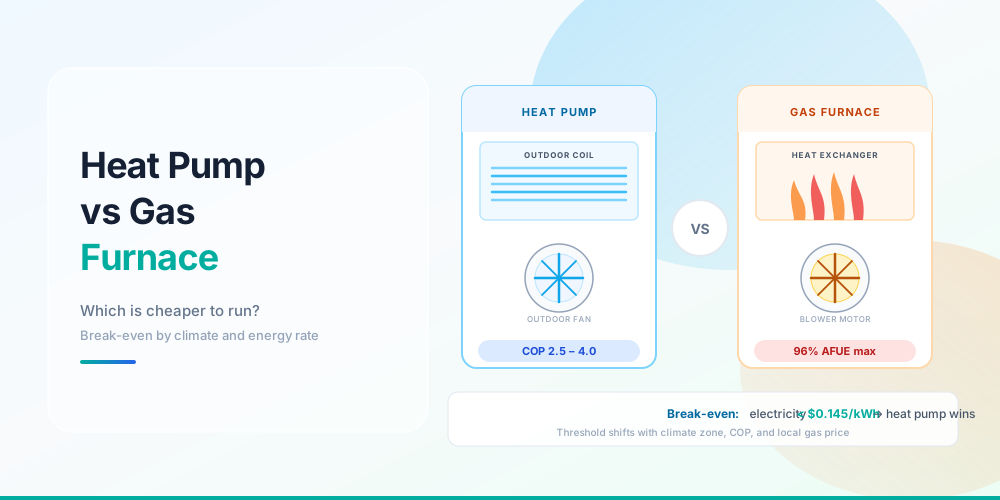
A heat pump is cheaper to run than a gas furnace when electricity costs less than roughly $0.145/kWh - but that threshold shifts depending on your climate, the COP at your typical outdoor temperature, and your local gas price. This article works through the numbers so you can check your own situation.
The Right Metric: Cost per BTU Delivered
Comparing “cost per unit of fuel” misleads you. A gas furnace wastes some fuel up the flue; a heat pump moves heat rather than generating it. The only fair comparison is cost per 100,000 BTU of heat actually delivered to your living space. This is the same delivered-cost methodology we use to break down the cost to run central AC on the cooling side.
Gas furnace example: A 96% AFUE furnace at $1.20/therm delivers 96,000 BTU per therm. Cost per 100,000 BTU delivered = ($1.20 / 96,000) x 100,000 = $1.25. (Whether that 96% furnace is worth its price premium in the first place is a separate question - we cover it in is a 95% AFUE furnace worth it.)
Heat pump example: A modern heat pump at 47°F outdoor temperature runs a COP of about 3.0 - meaning it delivers 3 units of heat for every 1 unit of electricity consumed. One kWh = 3,412 BTU, so at COP 3.0 it delivers 10,236 BTU/kWh.
- At $0.10/kWh: cost per 100,000 BTU = $0.98
- At $0.13/kWh: cost per 100,000 BTU = $1.27
- At $0.20/kWh: cost per 100,000 BTU = $1.95
At $0.13/kWh the heat pump and furnace are essentially tied. Below that the heat pump wins; above that the furnace wins - at 47°F outdoor temperature.
Cost per 100,000 BTU delivered
How COP Drops with Cold Temperatures
Heat pump efficiency falls as outdoor temperatures drop because there is less heat in the air to extract.
| Outdoor Temperature | Typical COP (standard HP) | Cold-Climate Model COP |
|---|---|---|
| 47°F | 3.0 | 3.2–3.5 |
| 17°F | 2.0 | 2.4–2.8 |
| 0°F | 1.5 | 1.8–2.2 |
| -13°F | ~1.2 (efficiency floor) | ~1.8 (rated low-temp) |
Cold-climate heat pumps (sometimes called hyper-heat or cold-climate models) maintain a COP around 1.8 even at -13°F, which is their rated minimum operating point. Standard models may lock out or run far less efficiently below 5–10°F. Getting the capacity right is critical in these conditions - see what size heat pump you need in cold climates before specifying equipment.
At COP 2.0 and $0.13/kWh, cost per 100,000 BTU = $1.90 - more expensive than the 96% furnace at $1.25. This is why climate matters.
COP declines in cold weather
Break-Even Electricity Price
For a heat pump to match a 96% AFUE furnace at $1.20/therm, you need the cost-per-BTU to be equal:
Break-even electricity price = (Gas price per therm / AFUE) / COP x (kWh per 100,000 BTU)
At COP 2.5 and $1.20/therm gas: break-even electricity = approximately $0.145/kWh.
At COP 2.0 (cold outdoor temps): break-even drops to about $0.116/kWh.
If you are in the Northeast paying $0.22/kWh and your heat pump runs many hours below 20°F, the furnace likely wins on operating cost. If you are in the Southeast paying $0.12/kWh with mild winters, the heat pump wins by a wide margin.
Break-even electricity price
Electricity Rates by Region
Electricity price is the dominant variable. Approximate residential averages as of early 2026:
- Northeast (MA, NY, CT): $0.18–$0.28/kWh
- California: $0.22–$0.35/kWh
- Southeast (GA, SC, TN): $0.11–$0.14/kWh
- Midwest (OH, IN, IL): $0.10–$0.14/kWh
- Pacific Northwest (WA, OR): $0.10–$0.13/kWh
Pacific Northwest and Southeast residents with mild winters have the strongest case for heat pumps. Northeast and California residents face a tougher calculation even with mild winters.
Annual Cost Comparison Table
The table below estimates annual heating cost for a home requiring 60 million BTU of heating per season (typical 2,000 sq ft in a cold-moderate climate). The gas furnace is 80% AFUE; the heat pump is HSPF 10 (equivalent to a seasonal average COP of about 2.93).
| Scenario | Gas @ $1.00/therm | Gas @ $1.50/therm | Gas @ $2.00/therm |
|---|---|---|---|
| Electricity $0.10/kWh (HP) | HP: $698 / Gas: $750 | HP: $698 / Gas: $1,125 | HP: $698 / Gas: $1,500 |
| Electricity $0.15/kWh (HP) | HP: $1,047 / Gas: $750 | HP: $1,047 / Gas: $1,125 | HP: $1,047 / Gas: $1,500 |
| Electricity $0.20/kWh (HP) | HP: $1,395 / Gas: $750 | HP: $1,395 / Gas: $1,125 | HP: $1,395 / Gas: $1,500 |
Heat pump annual cost = (60,000,000 BTU / (HSPF 10 x 3,412)) x electricity rate. Gas annual cost = (60,000,000 BTU / (0.80 AFUE x 100,000 BTU/therm)) x gas rate.
At $0.10/kWh electricity and $1.50+ gas, the heat pump saves $400+ per year. At $0.20/kWh electricity and $1.00 gas, the furnace saves $645 per year.
Climate Matters More Than Equipment Ratings
- Mild climates (average heating-season temperature above 35°F): Heat pump wins at almost any reasonable electricity price because COP stays high.
- Mixed climates (average heating-season temperature 25–35°F): Heat pump wins if electricity is below $0.15/kWh; depends above that.
- Cold climates with many hours below 15°F: A cold-climate heat pump can still compete, but only if electricity is cheap (below $0.13/kWh) or gas is expensive (above $1.50/therm).
Dual-fuel systems - a heat pump for moderate temperatures and a gas furnace as backup below a switchover point - often give the best of both in cold climates. The furnace fires only during the coldest hours when heat pump COP drops below the cost-effective threshold.
Use the Free Calculator
HVAC Operating Cost Calculator - get your exact answer in seconds.
FAQ
Is a heat pump cheaper to run than a gas furnace?
At mild outdoor temperatures (above 35°F) and moderate electricity rates (below $0.15/kWh), yes - a heat pump delivers heat for less money per BTU than even a 96% AFUE gas furnace. At high electricity rates or very cold climates, the furnace can be cheaper.
At what electricity price does gas win?
With a COP of 2.5 and gas at $1.20/therm, gas wins above roughly $0.145/kWh. At colder temperatures where COP drops to 2.0, gas wins above about $0.116/kWh. Check your actual electricity rate and compare it to these thresholds.
Should I switch from gas to a heat pump?
Run the numbers for your climate and utility rates before deciding. If you are in the Southeast or Pacific Northwest with electricity below $0.13/kWh, switching typically reduces operating costs and eliminates gas bills. If you are in the Northeast paying $0.22+ per kWh, the operating savings may not offset the upfront cost unless you also replace air conditioning at the same time and qualify for federal tax credits.
What is COP and why does it matter?
COP stands for Coefficient of Performance. A COP of 3.0 means the heat pump delivers 3 units of heat energy for every 1 unit of electrical energy it consumes. Gas furnaces can never exceed a COP of 1.0 - they can only convert fuel to heat, never multiply it. COP is what makes heat pumps efficient; the problem is that COP falls in cold weather, which is when you need heating most.
How does HSPF relate to COP?
HSPF (Heating Seasonal Performance Factor) is a seasonal efficiency rating measured in BTU/Wh over a full heating season. Divide HSPF by 3.412 to get the average seasonal COP. An HSPF 10 heat pump has a seasonal average COP of about 2.93. This seasonal average is what you use for annual cost estimates; the instantaneous COP varies significantly with outdoor temperature.