
ASHRAE 62.2 Ventilation Requirements: What Your Home Actually Needs
- 10 Feb, 2026
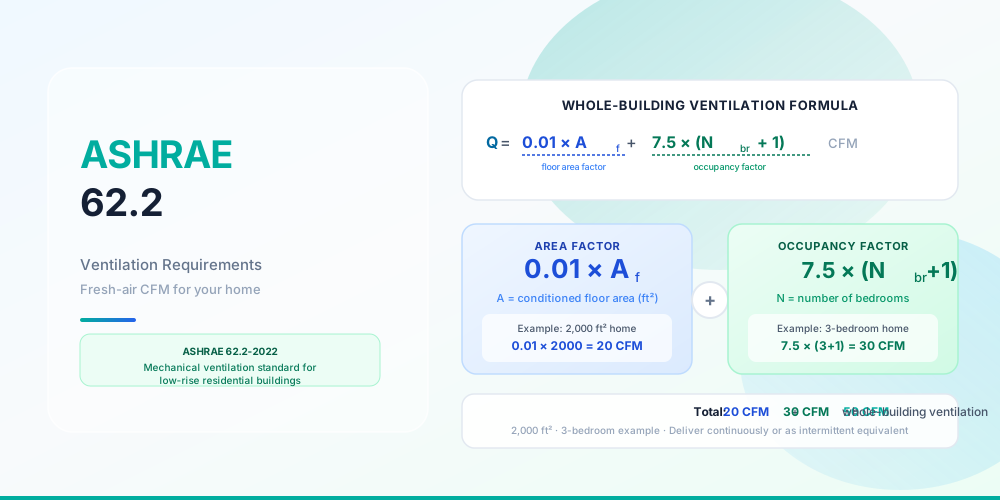
ASHRAE 62.2 is the residential ventilation standard that sets the minimum mechanical fresh-air rate for single-family and low-rise multifamily homes. The current edition, ASHRAE 62.2-2022, uses a simple formula to calculate how many CFM of outdoor air your home needs around the clock.
Why Mechanical Ventilation Is No Longer Optional
Houses built before roughly 1980 leaked enough air through gaps in the envelope that fresh air arrived whether you wanted it or not. That changed with energy codes. Today a well-built home routinely tests at 2–4 ACH50 - air changes per hour at 50 pascals of pressure. At those levels, natural infiltration delivers less than 0.1 air changes per hour under normal weather conditions, which is not enough to dilute CO2, VOCs off-gassing from furniture and finishes, moisture from cooking and bathing, or radon entering from the soil.
The result is that without mechanical ventilation, the indoor air in a tight new home is measurably worse than in a drafty old one. ASHRAE 62.2 exists to correct that.
Why tight homes need mechanical ventilation
The ASHRAE 62.2 Ventilation Formula
The whole-building ventilation rate from Section 4.1.1 of ASHRAE 62.2-2022 is:
Q = 0.03 × A_floor + 7.5 × (N_br + 1)
Where:
- Q = required ventilation rate in CFM
- A_floor = conditioned floor area in square feet
- N_br = number of bedrooms
Worked Example
A 2,000 sq ft home with 3 bedrooms:
Q = 0.03 × 2,000 + 7.5 × (3 + 1) Q = 60 + 30 Q = 90 CFM
That 90 CFM must be delivered on a continuous basis - or an equivalent intermittent schedule - to meet the standard. The rate is expressed in CFM because that is the standard unit of airflow; see what CFM means in HVAC if the term is new to you.
| Home Size (sq ft) | Bedrooms | Required CFM |
|---|---|---|
| 1,000 | 2 | 52.5 |
| 1,500 | 3 | 75 |
| 2,000 | 3 | 90 |
| 2,500 | 4 | 112.5 |
| 3,000 | 4 | 127.5 |
| 3,500 | 5 | 150 |
ASHRAE 62.2 ventilation formula
The Infiltration Credit (Annex A)
ASHRAE 62.2 includes an optional infiltration credit in Annex A. If a home is tested with a blower door and the measured leakage is high enough, the mechanical ventilation requirement can be reduced.
The credit applies when the annual average infiltration exceeds 2 CFM per 100 sq ft of floor area. In practice, homes tighter than approximately 5 ACH50 receive little or no credit and must meet the full mechanical ventilation requirement. Homes above 5 ACH50 can subtract an infiltration credit from Q - but few new homes and almost no energy-efficient homes hit that threshold.
The takeaway: if you are building or retrofitting to current energy codes, assume you need the full mechanical ventilation rate.
Three Ventilation Strategies
Exhaust-Only
A continuously running bathroom exhaust fan or a dedicated exhaust fan draws stale air out. Makeup air enters through envelope leaks and deliberate passive inlets. This is the lowest-cost approach - a Panasonic WhisperGreen or equivalent costs $100–200, and installation adds another $100–200.
The downside is that depressurizing the house can back-draft combustion appliances and pull in unconditioned, unfiltered air from crawlspaces or wall cavities.
Supply-Only
A fresh-air intake duct connected to the return side of the air handler introduces outdoor air when the blower runs. A small dedicated supply fan can also run independently. Supply-only systems pressurize the house slightly, which is beneficial in hot-humid climates where you want to prevent moist outdoor air from infiltrating through the envelope. Note that ventilation dilutes pollutants but does not actively dry the air - in humid regions you may still need to size a dehumidifier alongside it. A filtration rack in the duct allows you to clean incoming air.
The disadvantage is no energy recovery: in winter you are heating 100% outdoor air; in summer you are cooling it.
Balanced: HRV and ERV
A heat recovery ventilator (HRV) or energy recovery ventilator (ERV) supplies and exhausts equal volumes of air simultaneously, transferring 70–85% of the thermal energy from the exhaust stream to the incoming stream. Installed cost ranges from $1,500 to $4,000 depending on unit size, duct complexity, and labor market.
- HRV transfers sensible heat only. Best in cold climates where winter humidity control is a priority.
- ERV transfers both sensible and latent heat. Best in hot-humid climates and mixed climates where you want to limit humidity transfer from outdoors.
Choosing between the two comes down to your climate zone - our full comparison of HRV vs ERV walks through which one fits your region and how to size it.
For a home requiring 90 CFM continuous, a mid-range HRV rated at 100 CFM handles the load with a small buffer.
Three ventilation strategies
Continuous vs. Intermittent Operation
ASHRAE 62.2 allows intermittent ventilation if the rate is increased proportionally to account for the off time. The standard formula for a 20-minutes-per-hour schedule is:
Q_intermittent = Q_continuous × 60 / 20 = 3 × Q_continuous
For a home requiring 90 CFM continuous, an intermittent exhaust fan must run at 270 CFM for 20 minutes out of every hour. That is a much larger, noisier fan than most homeowners want in a bathroom. Most HVAC designers stick with continuous low-flow rather than intermittent high-flow.
HVAC-Integrated vs. Dedicated Units
When fresh air is introduced through the air handler’s return duct, the ventilation rate is only delivered while the blower runs. If the thermostat does not call for heating or cooling, no ventilation occurs. Systems using this approach must include a ventilation controller that cycles the blower independently of temperature demand.
A dedicated HRV or ERV with its own fan and duct system runs independently and delivers a predictable airflow rate regardless of HVAC operation. This is the preferred approach for new construction.
Code Relevance
ASHRAE 62.2 is not just a best-practice guideline. The IECC 2021 residential provisions reference it directly: Section R403.6 requires whole-house mechanical ventilation in homes with tested air leakage below 3 ACH50. Energy Star Certified Homes (Version 3.2) make 62.2 compliance mandatory. Many state and local energy codes have adopted the IECC 2021 or include equivalent language.
If you are pulling a building permit for new construction or a major renovation, confirm with your local jurisdiction whether 62.2 compliance is required. In most jurisdictions built to 2021 IECC, it is a permit item, not a suggestion.
Use the Free Calculator
Ventilation Calculator - get your exact answer in seconds.
Frequently Asked Questions
What is the ASHRAE 62.2 formula for residential ventilation?
The formula is Q = 0.03 × floor area (sq ft) + 7.5 × (bedrooms + 1). The result is in CFM and represents the minimum continuous whole-building ventilation rate.
How much ventilation does a house need?
It depends on floor area and bedroom count. A 2,000 sq ft, 3-bedroom home needs 90 CFM. A 1,500 sq ft, 3-bedroom home needs 75 CFM. Use the formula or the calculator above for your specific home.
Is mechanical ventilation legally required?
In jurisdictions that have adopted IECC 2021 or equivalent, yes - for homes testing below 3 ACH50. Most new construction in the U.S. qualifies. Check your local code, but treat it as a requirement rather than an option.
What is the difference between ASHRAE 62.1 and 62.2?
ASHRAE 62.1 covers ventilation for commercial and institutional buildings. ASHRAE 62.2 covers single-family homes and low-rise residential buildings (four stories and under). They use different calculation methods and are maintained as separate standards.
Can I use a bathroom fan to meet ASHRAE 62.2?
Yes, if it runs continuously at the required CFM and is sized correctly. A fan rated for 90 CFM continuous duty, installed with proper duct sizing, can serve as the whole-house exhaust ventilation system. The fan must be tested at actual installed conditions, not just nameplate rating.
Does an HRV or ERV save money compared to exhaust-only ventilation?
In cold climates, yes. An HRV recovering 80% of heat at 90 CFM will save roughly 2–4 million BTU per heating season compared to exhaust-only, depending on climate and energy prices. At $1.50 per therm, that is $30–60 per year in gas savings. The payback period on the HRV premium over an exhaust fan is typically 8–15 years on energy alone, though the benefits to air quality and moisture control are harder to quantify.