
LED Retrofit Payback: Watts Saved vs Fixture Cost
- 04 Aug, 2026
The payback calculation is trivial:
kWh saved/yr  = watts saved × hours per year ÷ 1,000
Annual saving = kWh saved × $/kWh
Payback       = installed cost ÷ annual saving
What isn’t obvious is which variable dominates. Most people reach for the wattage difference, and it’s the wrong lever.
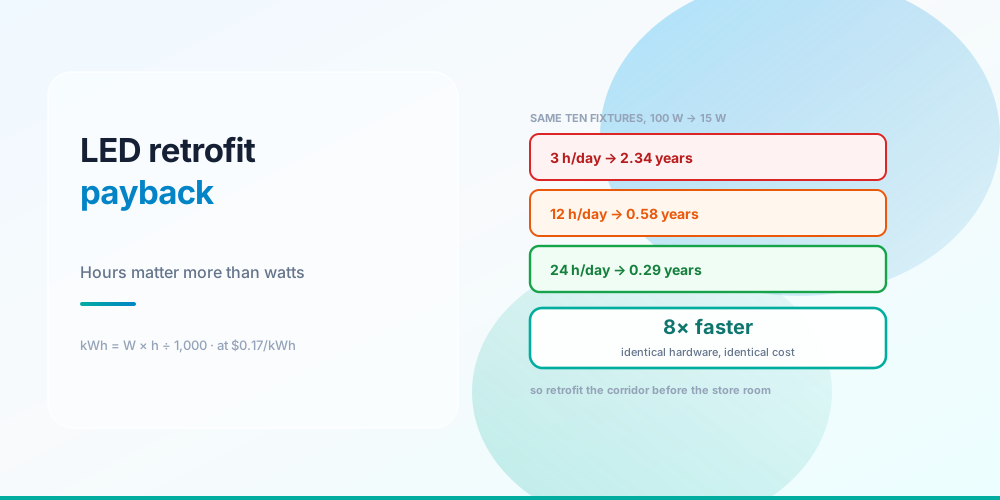
Take ten fixtures going from 100 W to 15 W, costing $370 to convert. At 3 hours a day the payback is 2.34 years. At 24 hours a day it’s 0.29 years. Identical hardware, identical cost, 8× the return - because payback is inversely proportional to operating hours and nothing else moved.
That single fact tells you how to sequence a retrofit: do the corridor before the store room, even if the store room has bigger lamps.
Hours Dominate
Same 10 fixtures, same $370, four duty cycles
| Hours/day | Annual saving | Payback |
|---|---|---|
| 3 h | $158 | 2.34 yr |
| 6 h | $316 | 1.17 yr |
| 12 h | $633 | 0.58 yr |
| 24 h | $1,266 | 0.29 yr |
Double the hours, halve the payback. It’s a straight inverse relationship, so the ranking of candidates in a building is essentially a ranking of duty cycles.
Where the hours actually are: exterior and security lighting (dusk to dawn, ~4,380 h/yr), corridors and stairwells (often 24/7 in commercial buildings, 8,760 h), parking structures (24/7), warehouse aisles, and back-of-house areas that get left on. Where they aren’t: conference rooms, store rooms, mechanical spaces, and anywhere with decent occupancy sensing already.
And the corollary worth stating: if the hours are low enough, no retrofit pays. A closet light used ten minutes a day will never repay a fixture, and that’s a legitimate finding rather than a failure of the analysis.
Five Real Retrofits
Five retrofits, ranked by payback - at $0.17/kWh
| Retrofit | Watts saved | Saving/yr | Cost | Payback |
|---|---|---|---|---|
| Retail, 12 × 100 W halogen → 15 W, 14 h/day | 1,020 W | $874 | $501 | 0.57 yr |
| Home, 20 × 60 W incandescent → 9 W, 3 h/day | 1,020 W | $190 | $120 | 0.63 yr |
| Warehouse, 6 × 400 W MH → 150 W, 24/7 | 1,500 W | $2,234 | $2,460 | 1.10 yr |
| Parking, 8 × 150 W flood → 50 W, 12 h/day | 800 W | $596 | $1,330 | 2.23 yr |
| Office, 40 × 36 W T8 → 18 W tube, 12 h × 260 d | 720 W | $382 | $860 | 2.25 yr |
Two results here are worth pausing on.
The retail halogen job beats the warehouse metal-halide job, even though the warehouse saves 47% more power. The retail retrofit is a lamp swap costing $501; the warehouse job is six fixtures at $220 each plus twelve hours of lift work, costing $2,460. Cost per watt saved decides it, not watts saved.
The office fluorescent retrofit is the worst of the five, and this is the general case: T8 fluorescent is already reasonably efficient. Going from 36 W to 18 W halves the load, where halogen-to-LED cuts it by 85%. The starting point matters as much as the destination - and as buildings finish converting, the easy paybacks are gone.
The household incandescent swap is nearly the best, because a lamp costs $6 and takes no labour. Domestic incandescent-to-LED remains one of the cheapest energy interventions available to anybody.
What Changes the Answer
The electricity rate. Everything above uses $0.17/kWh. At $0.10 every payback stretches by 70%; at $0.30 they nearly halve. Use your own rate - and if you’re on a commercial tariff, remember that demand charges are separate from energy charges, so lighting reductions that don’t coincide with peak may not touch the demand component. See kVA vs kW for that distinction.
Labour access. The warehouse job above is expensive because of the lift, not the fixtures. High-bay, exterior pole and stairwell fixtures carry access costs that can exceed the hardware. If scaffolding is already up for something else, that’s the moment.
Controls. Adding occupancy sensing or daylight dimming often saves more than the lamp change, and the two compound. A corridor at 24/7 dropped to 20% output when unoccupied saves more than the LED conversion did.
Whether the fixture or just the lamp gets replaced. A lamp-and-driver retrofit kit is cheaper than a new luminaire but may compromise the optics. A tubular LED in an old fluorescent troffer inherits a 30-year-old reflector.
What Simple Payback Leaves Out
What a simple payback number leaves out
Helps - relamping labour avoided. A 400 W metal halide rated 20,000 hours needs replacing roughly three times over an LED’s life, and each replacement is a lift visit. On high-access fixtures this saving frequently exceeds the energy saving, and it’s the strongest argument for retrofitting a low-hours high-access fixture that fails the energy test.
Helps - utility rebates. Prescriptive per-fixture rebates are widely available for commercial retrofits and can cover a substantial share of the cost. They change constantly, so check current programmes rather than trusting a figure.
Helps - reduced cooling load. Every watt of lighting was a watt of heat the air conditioning had to remove. In a cooling-dominated climate this is a genuine multiplier on the saving.
Hurts - increased heating load. The same waste heat was doing useful work in winter. In a heating-dominated climate a lighting retrofit shifts some of the load to the heating system, and if that’s electric resistance heat the net saving during heating season is close to zero. This is the factor most often omitted, and omitting it is how payback figures get optimistic.
Hurts - driver failures. LED diodes rarely fail; drivers do, and often well before the rated lumen-maintenance life. Warranty terms and whether the driver is field-replaceable matter more to lifetime cost than the L70 figure on the datasheet.
On balance these usually shorten the payback. The point is to say which way each one points rather than quoting only the favourable ones.
Doing the Sums Properly
Measure the existing load rather than reading nameplates. A “32 W” T8 lamp on a magnetic ballast draws closer to 40 W at the circuit; the ballast is part of the load. Clamp the circuit.
Count actual hours, not assumed hours. A logger on the circuit for a fortnight beats an estimate, and it usually finds more hours than anyone expected.
Check the light levels you actually need before matching the old output. Over-lit spaces are common, and a retrofit is the natural moment to design to a target footcandle level rather than replicate a 1985 layout. See How Many Recessed Lights Do I Need.
Remember the circuit is no longer the constraint. Twelve 9 W LED trims draw 108 W - 0.9 A. Circuit capacity stops mattering entirely, and the real limits become the dimmer’s LED rating and driver inrush. That’s covered in How Many Lights on One Circuit.
Common Mistakes
- Ranking candidates by wattage instead of hours. Payback is inversely proportional to hours.
- Reading nameplate watts on fluorescent. The ballast is part of the load; measure it.
- Assuming a rate. At $0.10/kWh every payback above stretches by 70%.
- Ignoring access cost. The lift can cost more than the fixtures on high-bay and pole work.
- Quoting only the favourable hidden factors. Heating-load interaction and driver failures cut the other way.
- Expecting a T8 retrofit to behave like a halogen one. Fluorescent is already efficient; the saving is roughly half, not 85%.
- Skipping controls. Occupancy and daylight sensing often save more than the lamp change, and they compound.
- Trusting L70 as a lifetime. Drivers fail first. Check the warranty and whether the driver is replaceable.
- Matching old light levels reflexively. Many spaces are over-lit; retrofit is the moment to fix that.
Run Your Own Numbers
kWh Cost Calculator - enter wattage, hours per day, days per month and your rate, and it returns the energy and cost. Run it once for the existing fixtures and once for the replacements; the difference is your annual saving, and the installed cost divided by that is the payback.
For the layout side use the Recessed Lighting Calculator, and for the circuit the Receptacle & Circuit Calculator. See How Many Recessed Lights Do I Need for light-level design and How Many Lights on One Circuit for why the breaker no longer matters.
Sources & standards: the payback arithmetic is straightforward energy accounting; the $0.17/kWh rate is the calculator’s default and varies widely by region and tariff. Lamp, fixture and labour costs are representative planning figures, not quotations. Utility rebate programmes change frequently - verify current availability. HVAC interaction depends on climate and heating fuel; in heating-dominated climates with electric resistance heat the net seasonal saving can be substantially lower than the lighting saving alone.
FAQ
How do I calculate LED retrofit payback?
Watts saved times annual operating hours divided by 1,000 gives kilowatt-hours saved per year. Multiply by your electricity rate for the annual saving, then divide the installed cost by that. Ten fixtures going from 100 W to 15 W at 12 hours a day save 3,723 kWh - about $633 at $0.17/kWh - so a $370 conversion pays back in 0.58 years.
What matters more, wattage saved or operating hours?
Operating hours, and by a wide margin. Payback is inversely proportional to hours, so the same hardware at the same cost pays back 8 times faster at 24 hours a day than at 3 hours a day. Rank retrofit candidates by duty cycle first - corridors, exterior and 24/7 spaces - and by wattage second.
Which LED retrofits pay back fastest?
High-hours, low-cost swaps. A retail halogen-to-LED lamp change running 14 hours a day pays back in about 0.57 years. Household incandescent-to-LED is nearly as fast at 0.63 years despite low hours, because a lamp costs $6 and needs no labour. Warehouse metal-halide conversions take about 1.10 years, and office T8 fluorescent retrofits are the slowest at around 2.25 years.
Why is a fluorescent-to-LED retrofit slower to pay back?
Because T8 fluorescent is already reasonably efficient. Going from 36 W to 18 W halves the load, where halogen-to-LED cuts it by 85%. The starting point matters as much as the destination - which is why the easy paybacks disappear as a building’s lighting stock modernises.
Does an LED retrofit increase my heating bill?
In a heating-dominated climate, slightly - and this is the factor most often left out of payback figures. The waste heat from incandescent and halogen lighting was doing useful work in winter, so removing it shifts some load to the heating system. If that heat is electric resistance, the net saving during heating season can approach zero. In a cooling-dominated climate the interaction runs the other way and helps.
Should I replace the lamp or the whole fixture?
Lamp or retrofit-kit replacement is cheaper and pays back faster, but it inherits the old housing’s optics - a tubular LED in a 30-year-old troffer works with a 30-year-old reflector. A new luminaire costs more and lets you design the light distribution properly. On high-access fixtures where the lift dominates the cost, doing the full fixture while you’re up there is often the better economics.
Do LED savings include maintenance?
Simple payback usually ignores it, and it can be the larger saving on high-access fixtures. A 400 W metal halide rated 20,000 hours needs replacing roughly three times over an LED’s life, each time requiring a lift. That avoided labour is frequently the strongest argument for retrofitting a fixture whose energy numbers alone wouldn’t justify it.
How long do LED fixtures actually last?
The diodes typically outlast the driver, which is the real failure point and often fails well before the L70 lumen-maintenance figure on the datasheet suggests. When comparing products, weight the warranty term and whether the driver is field-replaceable more heavily than the quoted hours - a 50,000-hour rating means little if the driver is potted into a sealed housing.