
Essential HVAC Formulas Every Tech Should Know
- 25 Jun, 2026
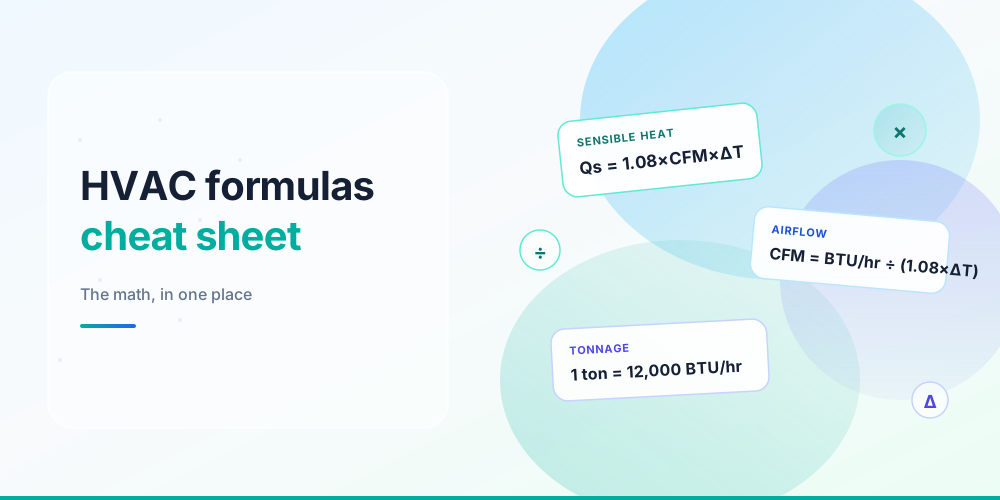
Most of HVAC field work and system design comes back to a handful of formulas. Memorize these basic HVAC formulas and you can size equipment, balance airflow, diagnose a charge, and check efficiency without reaching for anything more exotic. This cheat sheet collects the common HVAC formulas in one place - each one stated clearly, with what every variable means, where the constant comes from, and a one-line worked example.
If you want the interactive versions that do the arithmetic for you, the HVAC Formulas reference page lists every equation with its own calculator. This post is the readable companion: the math and the reasoning behind it.
The Heat Formulas (Sensible, Latent, Total)
Almost every HVAC calculation is a heat-transfer problem, and three formulas cover the bulk of them. All three multiply airflow (CFM) by a property change, with a constant out front that turns the units into BTU per hour.
Sensible heat - the temperature change:
Qs = 1.08 × CFM × ΔT
- Qs - sensible heat, BTU/hr
- CFM - airflow in cubic feet per minute
- ΔT - dry-bulb temperature difference across the coil or duct (°F)
- 1.08 - a constant for standard air (explained below)
Example: 1,200 CFM across a coil dropping the air 20°F removes 1.08 × 1,200 × 20 = 25,920 BTU/hr of sensible heat.
Latent heat - the moisture change:
Ql = 0.68 × CFM × ΔGrains
- Ql - latent heat, BTU/hr
- ΔGrains - difference in humidity ratio, in grains of water per pound of dry air
- 0.68 - the latent-heat constant for standard air
Example: 1,200 CFM removing 30 grains of moisture handles 0.68 × 1,200 × 30 = 24,480 BTU/hr of latent load.
Total heat - sensible plus latent, via enthalpy:
Qt = 4.5 × CFM × Δh
- Qt - total heat, BTU/hr
- Δh - change in enthalpy (total heat content) of the air, BTU/lb of dry air
- 4.5 - the total-heat constant for standard air
Example: 1,200 CFM with a 9 BTU/lb enthalpy drop moves 4.5 × 1,200 × 9 = 48,600 BTU/hr total - close to the sensible plus latent figures above combined.
The three heat formulas
Where the Constants Come From
The 1.08, 0.68, and 4.5 are not magic numbers - they are bundled air properties at standard conditions (sea level, roughly 70°F, air density 0.075 lb/ft³). Knowing their origin tells you when to adjust them, such as at high altitude where air is thinner.
1.08 = 0.24 × 60 × 0.075
- 0.24 - specific heat of air, BTU/(lb·°F)
- 60 - minutes per hour (CFM is per minute, BTU/hr is per hour)
- 0.075 - density of standard air, lb/ft³
0.68 = (0.075 × 60 × 1,061) ÷ 7,000
- 1,061 - latent heat of vaporization of water, BTU/lb
- 7,000 - grains of water per pound (the unit conversion for ΔGrains)
4.5 = 60 × 0.075
- The same minutes-per-hour and density terms; enthalpy already carries the BTU/lb units, so no specific-heat term is needed.
All three assume standard air. At elevation, lower density drops the constants, which is why high-altitude work needs corrected values.
Where the constants come from
Airflow and CFM
The sensible-heat formula rearranges into the most-used sizing equation in the trade - solving for the airflow a given load needs:
CFM = BTU/hr ÷ (1.08 × ΔT)
Example: a 6,000 BTU/hr room with a 20°F supply-to-room ΔT needs 6,000 ÷ (1.08 × 20) = 278 CFM.
The same form checks a furnace using its temperature rise: an 80,000 BTU/hr furnace with a 50°F rise moves 80,000 ÷ (1.08 × 50) ≈ 1,481 CFM. The CFM Calculator runs both directions.
Airflow also ties to duct geometry through velocity:
CFM = velocity (fpm) × area (ft²)
This is why an anemometer reading converts straight to CFM, and why it drives duct sizing. A 200 CFM branch at a 600 fpm target needs 200 ÷ 600 = 0.33 ft² of area - about an 8” round duct. For a deeper walk-through of what CFM is and how to calculate airflow, see the dedicated explainer.
Tonnage and the Cooling Rules of Thumb
Capacity in HVAC is measured in tons, and one ton is a fixed amount of heat:
1 ton = 12,000 BTU/hr → tons = BTU/hr ÷ 12,000
Example: a 36,000 BTU/hr load is 36,000 ÷ 12,000 = 3 tons. The Tonnage Calculator does this with climate and area inputs.
Two rules of thumb get you in the ballpark before a full Manual J:
- ~400 CFM per ton of cooling (acceptable range 350–450 CFM/ton). A 3-ton system moves about 1,200 CFM.
- ~20 BTU/sq ft for cooling load in a moderate climate, ranging from about 14 to 25+ BTU/sq ft depending on climate, insulation, and sun exposure.
Treat both as sanity checks, not substitutes for a load calculation.
Tonnage and airflow rules
Diagnostic Formulas (Delta T and Static Pressure)
Delta T (evaporator): the temperature drop across the indoor coil in cooling mode.
ΔT = T_return − T_supply
A properly charged system with correct airflow and load lands at 16–22°F. A reading below ~14°F points to low airflow or an overcharge; above ~22°F points to low charge or restricted airflow. Our guide to HVAC delta T explains how to read these numbers in the field. Verify against the system’s target before condemning a charge - the Delta T Calculator factors in indoor wet-bulb and return dry-bulb.
Total external static pressure (TESP): the total resistance the blower fights, measured across the air handler.
TESP = SP_supply + |SP_return|
Add the positive supply-plenum pressure to the absolute value of the negative return-plenum pressure. Most residential equipment is rated at 0.5 in.w.c.; readings above about 0.8 in.w.c. choke airflow and CFM falls off the blower table. It is the airflow equivalent of blood pressure - the first thing to measure when something feels off. See HVAC static pressure for how to take the reading and what high TESP is telling you.
Efficiency Formulas (EER, SEER, SEER2)
EER - efficiency at a single rating point:
EER = BTU/hr ÷ watts
Example: a unit delivering 24,000 BTU/hr while drawing 2,000 watts has an EER of 24,000 ÷ 2,000 = 12. Higher is better.
SEER - seasonal efficiency: the same idea averaged over a cooling season’s range of conditions, so it is always higher than the steady-state EER for the same equipment.
SEER2 - the current test standard (M1):
SEER2 ≈ SEER × 0.95
The 2023 DOE testing change (M1) raised external static pressure during the test, so the newer SEER2 rating runs about 5% below the old SEER number for the same equipment. The exact factor is 0.9524 for split systems. For how these ratings differ and which one to shop by, see EER vs SEER vs SEER2. The HVAC Formulas reference includes a SEER/SEER2 converter and a savings calculator.
Quick-Reference Table
| Formula | Equation | Typical use |
|---|---|---|
| Sensible heat | Qs = 1.08 × CFM × ΔT | Temperature-only cooling/heating load |
| Latent heat | Ql = 0.68 × CFM × ΔGrains | Moisture-removal load |
| Total heat | Qt = 4.5 × CFM × Δh | Combined load from enthalpy |
| Airflow | CFM = BTU/hr ÷ (1.08 × ΔT) | Sizing airflow to a load |
| Duct velocity | CFM = velocity × area | Converting anemometer reads, duct sizing |
| Tonnage | tons = BTU/hr ÷ 12,000 | Capacity in tons |
| Cooling rule | ~400 CFM/ton · ~20 BTU/sq ft | Ballpark sizing |
| Delta T | ΔT = T_return − T_supply | Evaporator diagnosis (16–22°F) |
| Static pressure | TESP = SP_supply + |SP_return| | Airflow restriction check |
| EER | EER = BTU/hr ÷ watts | Point efficiency |
| SEER2 | SEER2 ≈ SEER × 0.95 | Converting to current standard |
Use the Free Calculators
HVAC Formulas reference - every formula on this page with its own interactive calculator.
Skip the arithmetic: the Sensible & Latent Heat Calculator, CFM Calculator, Tonnage Calculator, and Delta T Calculator each plug straight into the equations above.
FAQ
What is the basic HVAC heat formula?
The most-used heat formula is the sensible heat equation, Qs = 1.08 × CFM × ΔT, where Qs is sensible heat in BTU/hr, CFM is airflow, and ΔT is the dry-bulb temperature difference across the coil. For a full picture you add latent heat (Ql = 0.68 × CFM × ΔGrains) for the moisture component, or use total heat (Qt = 4.5 × CFM × Δh) to capture both at once through enthalpy.
What does the 1.08 constant mean?
It is three air properties multiplied together at standard conditions: 0.24 BTU/(lb·°F) specific heat × 60 minutes per hour × 0.075 lb/ft³ air density = 1.08. The constant converts CFM and a temperature difference directly into BTU/hr. It holds near sea level around 70°F; at high altitude the lower air density means the constant should be reduced.
How do you calculate tons of cooling?
Divide the cooling load or equipment capacity in BTU/hr by 12,000, since one ton of cooling equals 12,000 BTU/hr. A 36,000 BTU/hr load is 36,000 ÷ 12,000 = 3 tons. As a rough check, a 3-ton system should move about 1,200 CFM at roughly 400 CFM per ton.
What is the sensible heat formula?
Sensible heat is Qs = 1.08 × CFM × ΔT. It captures only the temperature change in the air, not moisture. For example, 1,200 CFM cooled by 20°F removes 1.08 × 1,200 × 20 = 25,920 BTU/hr of sensible heat. Pair it with the latent heat formula to account for dehumidification.
What is a normal evaporator delta T?
A correctly charged system with proper airflow and load runs a 16–22°F temperature drop across the evaporator coil (ΔT = return temperature − supply temperature). A reading under about 14°F usually means low airflow or an overcharge, while a reading over 22°F points to low refrigerant charge or restricted airflow.