
HVAC Delta T: Normal Range and What a Bad Reading Means
- 20 May, 2026
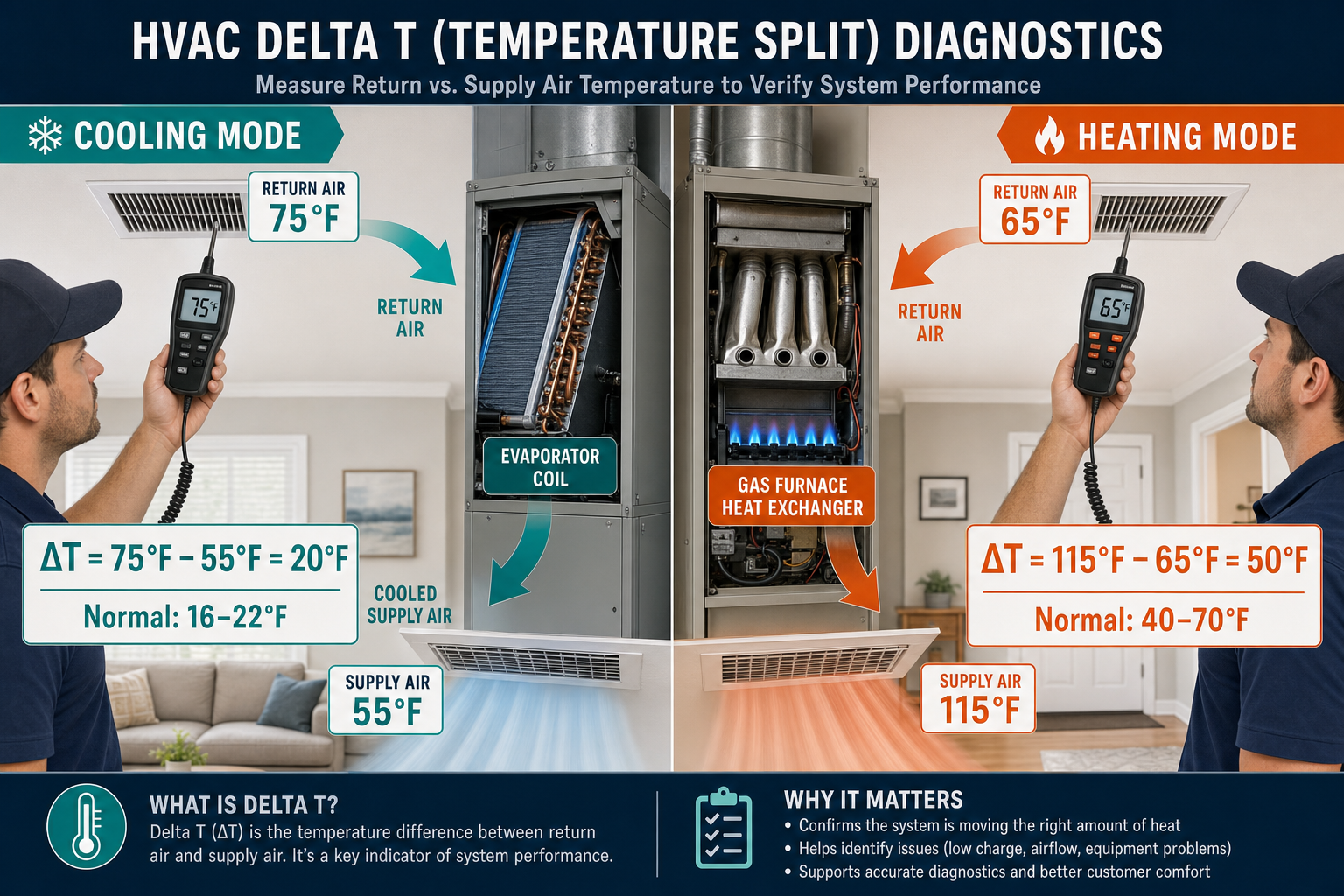
The normal HVAC Delta T (temperature split) for a central air conditioner is 16–22°F; for a gas furnace, the temperature rise across the heat exchanger should fall between 40–70°F. Any reading outside those ranges points to a specific problem - and knowing which direction it drifts narrows down the cause fast.
What Is Delta T in HVAC?
Delta T in HVAC is simply the difference between the air temperature entering the system and the air leaving it.
- Cooling mode: return air temperature minus supply air temperature. Air enters the air handler warm and exits cold.
- Heating mode: supply air temperature minus return air temperature. Air enters the furnace cold and exits warm.
The measurement tells you how much heat the system transferred in one pass. It is the fastest field check available before pulling out gauges or a multimeter.
How Delta T works
Normal Delta T Ranges
| System | Measurement | Normal Range |
|---|---|---|
| Central AC (split system) | Return temp minus supply temp | 16–22°F |
| Heat pump in cooling | Return temp minus supply temp | 16–22°F |
| Gas furnace | Supply temp minus return temp | 40–70°F |
| Heat pump in heating | Supply temp minus return temp | 25–35°F |
Manufacturers publish a rated temperature rise on the furnace data plate. That number always overrides the generic 40–70°F range if it is tighter - check the plate before calling a result abnormal.
How to Measure Delta T
You need two thermometer readings and about 15 minutes.
- Set the thermostat so the system has been running continuously for at least 10–15 minutes. Short-cycling throws off the reading.
- Place a thermometer probe at the return air grille - the large grille that pulls air back to the unit. Record the temperature.
- Place a second probe at the first supply register closest to the air handler, before any significant duct run. Record that temperature.
- Subtract: return minus supply for cooling, supply minus return for heating.
Use a digital probe thermometer, not an infrared gun. Infrared guns read surface temperatures and will give you the metal grille temperature, not the airstream. A difference of even 3–4°F can send a diagnosis in the wrong direction.
How to measure Delta T in the field
Low Delta T in Cooling: What Causes It
A low split (below 16°F) in cooling means the system is not removing enough heat from the airstream. Common causes:
Low airflow across the evaporator coil
- Dirty or clogged air filter - the most common cause by far
- Blocked or closed supply and return registers
- Collapsed flex duct
Refrigerant problems
- Low refrigerant charge reduces the coil’s ability to absorb heat - see how to tell an overcharged system from an undercharged one before adjusting anything
- A frozen evaporator coil (often caused by low refrigerant or low airflow) blocks airflow entirely - you may see ice on the suction line
Oversized system An oversized AC unit short-cycles. It cools the space quickly but never runs long enough to pull humidity or establish a stable temperature split. The measured Delta T will be inconsistent and often low.
High Delta T in Cooling: What Causes It
A high split (above 22°F) means the air is being overcooled, usually because too little air is moving across the coil.
- Restricted airflow through the coil - dirty evaporator coil, dirty blower wheel, or undersized return duct
- Overcharged refrigerant - too much refrigerant raises suction pressure and changes coil performance
- Undersized system - the unit is too small for the load and runs continuously, pulling more heat out of each cubic foot of air
A high Delta T is a better indicator of a dirty coil than a low one. When coil fins foul, airflow drops and the remaining air gets overcooled while the space never reaches setpoint.
Furnace Temperature Rise Outside the Normal Range
For furnaces, the stakes are higher. A temperature rise outside the manufacturer’s specified range is not just an efficiency issue.
Rise too low (below 40°F or below the rated minimum)
- Dirty filter or restricted return - same as cooling, low airflow is the first thing to check
- Oversized duct system - air moves through too fast to absorb adequate heat
- Burner issue - not enough heat input to match the blower
Rise too high (above 70°F or above the rated maximum)
- Restricted supply ducts or blocked registers - the blower cannot move enough air
- Dirty air filter causing low airflow
- Blocked or restricted flue - combustion gases back up and overheat the heat exchanger
- Cracked heat exchanger - a serious safety issue; combustion products can enter the living space. High temperature rise combined with carbon monoxide readings is a strong indicator
If temperature rise is high and you cannot explain it with filter or duct restrictions, inspect the heat exchanger before returning the system to service.
Delta T Is a First Check, Not a Diagnosis
A single Delta T reading tells you the system is off, not exactly why. Think of it as a triage tool:
- Low split in cooling → check filter, then refrigerant charge
- High split in cooling → check coil and blower wheel cleanliness
- Furnace rise too high → check filter, then duct restrictions, then heat exchanger
Every finding from Delta T should lead to a second verification step - a static pressure test to confirm an airflow restriction, superheat and subcooling readings to check the refrigerant side, combustion analysis, or visual inspection. A reading inside the normal range does not rule out all problems either; a system can have partially offsetting faults that produce a normal-looking split.
Delta T triage for cooling mode
Use the Free Calculator
Delta T Calculator - get your exact answer in seconds.
For the delta-T equation alongside the rest of the field math, keep the HVAC formulas cheat sheet handy.
FAQ
What is Delta T in HVAC?
Delta T in HVAC is the temperature difference between the air entering and leaving a system - return minus supply in cooling, supply minus return in heating. It is the fastest field check for how much heat an AC, heat pump, or furnace is transferring in a single pass, before pulling out gauges or a multimeter.
What should Delta T be for AC?
For a central air conditioner or heat pump in cooling mode, Delta T should be between 16°F and 22°F. Measure at the return grille and the nearest supply register after the system has run for at least 15 minutes.
What does low Delta T mean on an air conditioner?
A low split - below 16°F - means the system is not removing enough heat from each cubic foot of air. The most common causes are a clogged air filter, low refrigerant charge, or a frozen evaporator coil. Start by checking and replacing the filter before moving to refrigerant diagnostics.
Is a 20-degree split good for AC?
Yes. A 20°F temperature split falls in the middle of the normal 16–22°F range and indicates the system is transferring heat effectively. If comfort complaints persist with a 20°F split, the issue is likely sizing, humidity control, or duct distribution rather than the refrigeration system itself.
What is normal furnace temperature rise?
Most residential gas furnaces are rated for a temperature rise between 40°F and 70°F, but the specific range is printed on the data plate inside the furnace cabinet. The data plate range takes priority. A rise above the rated maximum is a red flag for restricted airflow or a compromised heat exchanger.
Can Delta T be too high?
Yes. In cooling mode, a split above 22°F usually means airflow is restricted - a dirty evaporator coil, dirty blower wheel, or blocked return ducts. The system overcools the air it does move but cannot condition the full volume of the space. For furnaces, excessive temperature rise can overheat and crack the heat exchanger over time.