
Is a 95% AFUE Furnace Worth the Extra Cost?
- 29 Apr, 2026
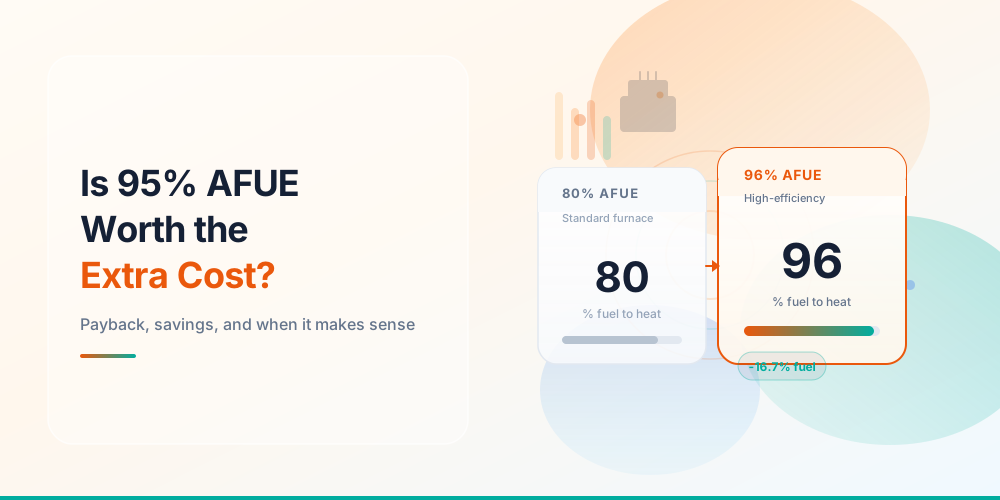
A 95–96% AFUE furnace is worth the extra cost if you heat heavily - payback runs 2–6 years in cold climates and the 15-year savings can exceed $4,000. In mild climates with low heating bills, the math rarely works out before the furnace needs replacing.
What AFUE Means
AFUE stands for Annual Fuel Utilization Efficiency. It measures what percentage of the fuel you buy actually heats your home versus escaping through the flue as waste heat.
- 80% AFUE: 80 cents of every dollar of gas heats your home. 20 cents goes up the chimney.
- 96% AFUE: 96 cents heats your home. Only 4 cents is wasted.
The difference sounds small, but compounded over a heating season on a large gas bill, it adds up fast.
What AFUE means in practice
The Core Savings Calculation
The fuel savings from upgrading is straightforward:
Savings = 1 - (old AFUE / new AFUE)
Going from 80% to 96%:
1 - (80 / 96) = 16.7%
That means a 96% AFUE furnace cuts your heating fuel cost by 16.7% compared to an 80% unit. On a $1,200 annual heating bill, that is $200 saved every year. This is the same payback logic that drives the cooling-side decision of whether a higher SEER will save you money - efficiency only pays back if you use enough of it.
Price Premium
A high-efficiency 96% AFUE furnace costs $300–$800 more installed than a comparable 80% AFUE model. The gap depends on brand, BTU capacity, and whether the installation requires new PVC condensate venting (required on all condensing furnaces) versus existing B-vent.
Budget $500–$600 as a realistic mid-range premium for most residential replacements. That premium sits on top of the base price - see our full breakdown of furnace replacement cost for the all-in numbers. And before you pay for efficiency, make sure the unit is correctly sized: an oversized furnace short-cycles and wastes fuel regardless of its AFUE, so start with the furnace sizing guide.
Payback by Climate
Your heating bill drives everything. The more you spend on gas, the faster the premium pays back.
| Climate Zone | Typical Annual Heating Bill | Annual Savings (16.7%) | Payback on $600 Premium |
|---|---|---|---|
| Zone 5–6 (Minneapolis, Chicago, Boston) | $1,400–$2,000 | $233–$334 | 2–3 years |
| Zone 3–4 (Denver, Kansas City, Philadelphia) | $700–$1,200 | $117–$200 | 3–5 years |
| Zone 1–2 (Dallas, Atlanta, Phoenix) | $300–$600 | $50–$100 | 6–12 years |
96% AFUE payback by climate
Worked Example: Minneapolis
Minneapolis sits in Climate Zone 6. Natural gas heating runs long and hard from October through April.
- Annual heating bill: $1,600
- Savings at 16.7%: $1,600 x 0.167 = $267/year
- Installed premium for 96% AFUE: $600
- Payback period: $600 / $267 = 2.2 years
- 15-year total savings: $267 x 15 = $4,005
In Minneapolis, the 96% furnace pays for itself before the third winter and saves over four thousand dollars across its service life. This is the clearest case for high efficiency.
Worked Example: Dallas
Dallas sits in Climate Zone 2. The heating season is short - roughly December through February.
- Annual heating bill: $450
- Savings at 16.7%: $450 x 0.167 = $75/year
- Installed premium for 96% AFUE: $600
- Payback period: $600 / $75 = 8 years
- 15-year total savings: $75 x 15 = $1,125
Eight years is a long payback, and furnace lifespans average 15–20 years. The 96% unit still comes out ahead over a full service life, but the margin is thin. If the premium is closer to $800, payback stretches to 10–11 years, which makes the decision much harder.
In mild climates, an 80% furnace is often the financially sound choice unless you are replacing with a two-stage or variable-speed unit that carries the efficiency premium for reasons beyond AFUE. If you are weighing fuel type rather than just efficiency tier, our heat pump vs gas furnace running cost comparison shows when electric heat undercuts gas entirely.
Minneapolis vs Dallas: 96% AFUE payback
Two-Stage Furnaces at the Same AFUE
Most 96% AFUE furnaces are two-stage or modulating. This matters beyond the AFUE number itself.
A two-stage furnace runs at low fire (around 65% capacity) most of the time. Longer, slower burns distribute heat more evenly, reduce temperature swings, and - because the blower runs longer at lower speed - add roughly 3–5% real-world efficiency on top of the rated AFUE.
The rated AFUE is a laboratory benchmark. A two-stage 96% unit in the field often performs closer to 98–100% effective efficiency on mild heating days. A single-stage 96% unit does not capture that benefit.
If you are comparing quotes, confirm whether the 96% unit is single-stage, two-stage, or modulating - it affects both comfort and your actual gas bill.
Other Reasons to Choose a 96% Furnace
Direct vent (PVC pipe), no B-vent required. Condensing furnaces vent through PVC pipe run through a wall, not through the roof. This eliminates an existing masonry chimney as a failure point and allows more flexible installation locations. If your current B-vent is aging or shared with a water heater being converted to electric, this matters.
Quieter operation. Two-stage and modulating units run at low speed most of the time. The result is quieter, more consistent airflow rather than the on/off blast of a single-stage furnace.
Utility rebates. Many gas utilities offer $50–$200 rebates on 95%+ AFUE equipment. Check your local utility before pricing - this reduces the effective premium and shortens payback.
Use the Free Calculator
AFUE Savings Calculator - get your exact answer in seconds.
Enter your current heating bill, existing AFUE, and new AFUE to get a precise payback period and 15-year savings estimate for your home.
FAQ
What is AFUE?
AFUE is Annual Fuel Utilization Efficiency - the percentage of fuel energy that becomes usable heat in your home. An 80% AFUE furnace converts 80% of the gas it burns into heat. The remaining 20% exits through the flue as waste.
Is 80% AFUE good enough?
In mild climates (Zone 1–3) with heating bills under $600/year, an 80% furnace is often the better financial choice. The premium for 96% AFUE rarely pays back within 8–10 years when heating costs are low. In cold climates (Zone 4–6), 80% AFUE leaves significant money on the table over the furnace’s lifetime.
How much does a 96% AFUE furnace cost?
Installed cost for a 96% AFUE furnace typically runs $2,500–$4,500 depending on capacity and brand. This is $300–$800 more than a comparable 80% AFUE unit. The condensate drain and PVC venting required for a condensing furnace add minor installation cost if your existing setup uses B-vent.
Do I need a 96% AFUE furnace in a mild climate?
No - not for fuel savings alone. In Dallas, Phoenix, or Atlanta, the payback on a 96% unit can stretch to 8–12 years. If you are choosing primarily for comfort (two-stage operation, quieter blower) or because your B-vent needs replacing anyway, the premium may still be justified. Run the numbers for your actual heating bill before deciding.